
BuddhistCatholicContemplativeEvangelicalGeneral ChristianHinduJewishLatter-day SaintMuslimNew VisionsProgressive Christian
Beliefs
- Buddhist
- Catholic
- Contemplative
- Evangelical
- General Christian
- Hindu
- Jewish
- Latter-day Saint
- More Voices
- Muslim
- New Visions
- Pagan
- Progressive Christian
Topics
- Religion News
- Food and Religion
- Sports and Religion
- Religious Art
- Religious Music and Entertainment
- Religious Events
- History and Religion
- Style and Religion
- Politics and Religion
- Women in Religion
- Recreation Outdoors and Religion
- Business Finance and Religion
- Careers Workplace and Religion
- Education and Religion
- Family Parenting and Religion
- Health Fitness and Religion
- Home and Religion
- Relationships and Religion
- Technology and Religion
- Travel and Religion
Columnists
- Buddhist Columnists
- Business Finance and Religion Columnists
- Careers Workplace and Religion Columnists
- Catholic Columnists
- Contemplative Columnists
- Education and Religion Columnists
- Evangelists Columnists
- Family Parenting and Religion Columnists
- General Christian Columnists
- Health Fitness and Religion Columnists
- Hindu Columnists
- History and Religion Columnists
- Home and Religion Columnists
- Jewish Columnists
- More Voices Columnists
- Latter Day Columnists
- Muslim Columnists
- New Visions Columnists
- Nonreligious Columnists
- Pagan Columnists
- Politics and Religion Columnists
- Progressive Columnists
- Recreation Outdoors and Religion Columnists
- Relationships and Religion Columnists
- Religion News Columnists
- Religious Art Columnists
- Religious Events Columnists
- Religious Music and Entertainment Columnists
- Sports and Religion Columnists
- Style and Religion Columnists
- Technology and Religion Columnists
- Travel and Religion Columnists
- Women in Religion Columnists
Resource Library
- 2026 Calendar
- Library of World Religions
- The 100 Most Holy Places on Earth
- Patheos Answers
- Podcasts
- Videos
- Faith Leaders Database
- Anglican Episcopalian
- Bahai
- Baptist
- Buddhism
- Christianity
- Confucianism
- Eastern Orthodoxy
- Hinduism
- Holiness and Pentecostal
- ISKCON
- Islam
- Judaism
- Lutheran
- Methodist
- The Church of Jesus Christ of Latter-day Saints
- New Age
- Paganism
- Presbytarian and Reformed
- Protestantism
- Religion Behind the Scenes
- Roman Catholic
- Scientology
- Shia Islam
- Sikhism
- Sufism
- Sunni Islam
- Taoism
- Zen
- See all religions
Research Tools
 Ad-Free & Subscriber Log-In Subscription Support
Ad-Free & Subscriber Log-In Subscription Support
Follow Patheos 

- Trending:
- Forgiveness
- |
- Marriage
- |
- Consciousness
- |
- Death Penalty
- |
- Election
- |
- Halloween

- Home
- Muslim
- Family, Parenting and Religion
- Indonesia’s Ban on Interfaith Marriages: A Blow to Religious Freedom
Indonesia’s Ban on Interfaith Marriages: A Blow to Religious Freedom
Last updated on: October 21, 2024 at 5:09 am by Dr. Dilip Amin
Indonesia’s Ban on Interfaith Marriages: A Blow to Religious Freedom 2024-10-21T05:09:18-07:00 Dr. Dilip Amin
Patheos Explore the world's faith through different perspectives on religion and spirituality! Patheos has the views of the prevalent religions and spiritualities of the world.
Indonesia’s Ban on Interfaith Marriages: A Blow to Religious Freedom
Interfaith marriages have become virtually impossible in the Republic of Indonesia. Recently, the Supreme Court issued a directive prohibiting court judges from approving applications for interfaith marriages. Under this ruling, one partner must convert to the religion of the other, effectively stripping citizens of their right to choose their partner without compromising their religious identity.
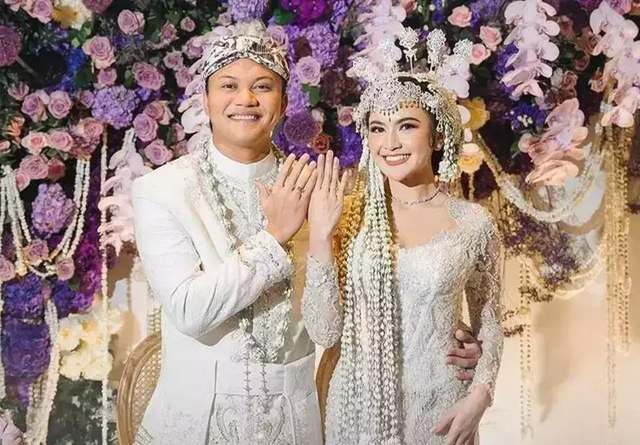
Singers Rizky Febian and Mahalini Raharja tied the knot in a ceremony (Instagram @rizkyfbian)
To comply with the new law, Mahalini Raharja, a Hindu from Bali, was essentially required to convert to Islam before marrying Rizky Febian, a Muslim, on May 10, 2024, in Jakarta.
Key takeaways:
• Indonesia has effectively banned interfaith marriages.
• Imposing religious conversion on one spouse in interfaith marriages, such as between Catholic-Protestant or Hindu-Buddhist couples, is unjust.
• Misinterpreting Quran 2:221 to label Jews, Christians, and Hindus as polytheists or disbelievers is a matter of concern.
• Global leaders who advocate for pluralism should speak out against this ruling and push for its reversal.
New Ruling by the Supreme Court
The issuance of Supreme Court Circular Letter (SEMA) Number 2 of July 17, 2023, it is explained that to provide certainty and legal unity in adjudicating applications for registration of marriages between religious communities of different religions and beliefs, judges must be guided by the following provisions (JILS, The Diplomat):
1. A valid marriage is one that is carried out according to the laws of each religion and belief. (For example, Rizky and Mahalini had two separate marriage ceremonies according to both practices.)
2. The court does not grant requests to register marriages between people of different religions and beliefs. (Thus, Rizky and Mahalini cannot register their marriage as a Hindu-Muslim union.)
The Supreme Court is responding to pressure from Muslim conservatives who are alarmed at the rising number of interfaith unions and have called for stricter adherence to a 1974 law that only recognizes marriages if performed by a religious institution. This effectively requires one side of the couple to convert to the other’s faith.
The new law criminalizes consensual sex outside of ‘legalized’ marriage and cohabitation of unmarried persons, it is the same as committing adultery according to Islamic teachings, permitting intrusions into the most intimate decisions of individuals and families. In Aceh, Indonesia, unmarried couples can even face public caning for cohabitation.
A number of activists contend that the Supreme Court’s ruling clearly violates people’s fundamental rights, including freedom of religion.
Reasons for Rejection of Interfaith Marriages
As per Sharia Law experts (Saha, Maloko et al.), one of the primary reasons for rejecting interfaith marriages in Indonesia is the adherence to religious prohibitions present in all major faiths.
Islam: The concept of interfaith marriages involving non-Muslims (polytheists) is widely considered invalid or forbidden in Islam. Some Muslims prefer non-Muslims, such as Christians and Jews, under the category of polytheist (musyrik). According to qaul mu’tamad (authoritative legal opinion), a Muslim man marrying a woman from the Ahl al-Kitab is prohibited and considered invalid. This fatwa is based on several Quranic verses, including:
– Quran 2:221: “Do not marry polytheistic women until they believe; for a believing slave-woman is better than a free polytheist, even though she may be pleasing to you. And do not marry your women to polytheistic men until they believe, for a believing slave-man is better than a free polytheist, even though he may be pleasing to you. They invite you to the Fire, but Allah invites to Paradise and forgiveness by His grace. He makes His revelations clear to the people so they may be mindful.”
– Quran 60:10: “O believers! When believing women come to you as emigrants, test their faith—Allah knows their faith best—and if you find them to be believers, do not send them back to the disbelievers. These women are not lawful for the disbelievers, nor are the disbelievers lawful for them. Repay the disbelievers whatever dowries they had paid. And there is no blame on you if you marry these women as long as you pay them their dowries. And do not hold on to marriages with polytheistic women.”
– Quran 5:5: “Today, all good and pure foods have been made lawful for you. Similarly, the food of the People of the Book is permissible for you, and yours is permissible for them. Also permissible in marriage are chaste believing women, as well as chaste women of those given the Scripture before you, as long as you give them their dowries in marriage and do not engage in fornication or take them as mistresses. But whoever rejects the faith—his deeds will be void in this life and the Hereafter, and he will be among the losers.”
Christianity: Interfaith marriage is also prohibited in Christianity, as stated in the Old Testament. According to Deuteronomy 7:3, Christians are forbidden to marry individuals of different faiths. In Catholicism, a marriage between a Catholic and a non-baptized individual is explicitly declared invalid (Canon 1086).
– Deuteronomy 7:3: “Neither shalt thou make marriages with them; thy daughter thou shalt not give unto his son, nor his daughter shalt thou take unto thy son.”
– Canon 1086: “A marriage between two persons, one of whom was baptized in the Catholic Church or received into it, and the other of whom is not baptized, is invalid.”
Hinduism: The Hindu doctrine of Wiwaha emphasizes that an unsanctified marriage does not have legal or spiritual validity. A marriage ritual must be conducted under Hindu teachings, and any union performed outside these guidelines is considered invalid (views of Sharia experts).
Buddhism: According to the Buddhist Marriage Law (HPAB) and a ruling by the Supreme Sangha on January 1, 1977, a marriage is considered valid only if it aligns with the HPAB Indonesia (Article 2).
Confucianism: Similar to other recognized religions, Confucians also practice marriage based on the provisions of their religious teachings.
The views above reflect the opinions of Sharia experts in support of the recent Supreme Court ruling. All Abrahamic religions impose restrictions on interfaith marriages, but Islam enforces these restrictions more strictly than others, with limited prospects for reform or leniency in the near future. In contrast, Hinduism, Buddhism, and other Dharmic faiths do not have scriptural prohibitions against interfaith unions.
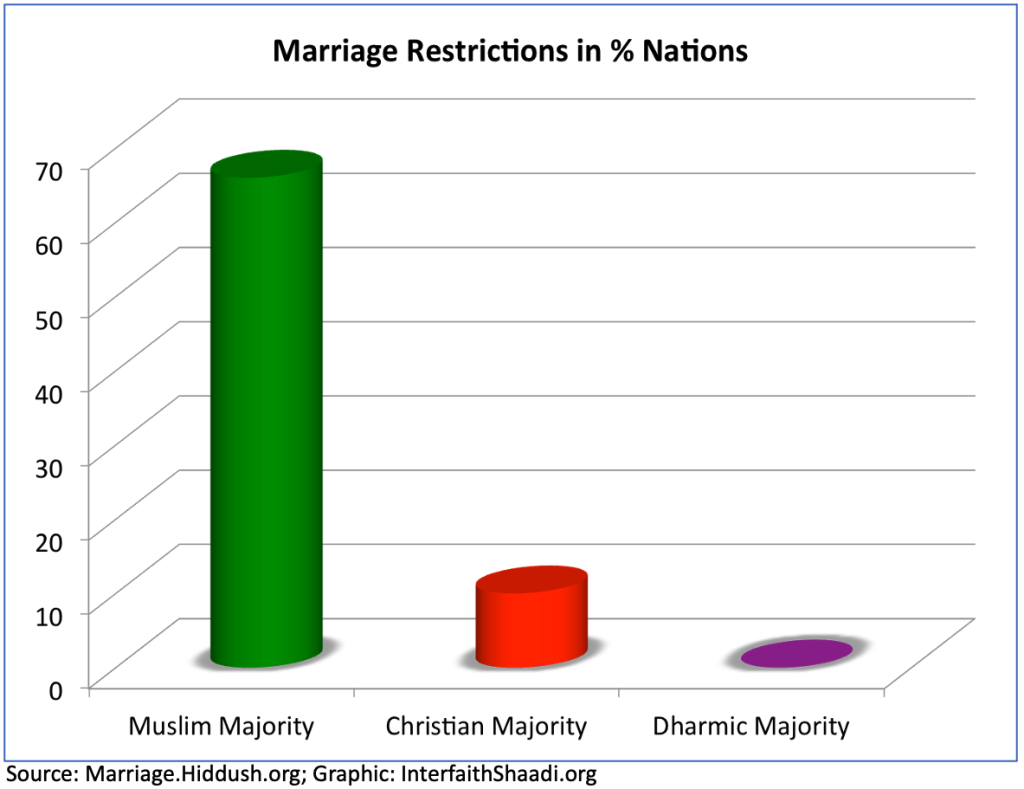
Severe marriage restrictions in Muslim (33/53; freedom of religion in only 3/53), Christian (8/120) and Hindu/Buddhist (0/14) majority nations.
Double Standard by the Courts:
Indonesian courts exhibit a ‘double standard’ in handling interfaith marriage cases. When a marriage involves a Muslim and a non-Muslim, judges tend to strictly enforce the law. However, when both individuals are non-Muslims, such as a Catholic and a Protestant, the courts demonstrate greater flexibility in approving interfaith marriages.
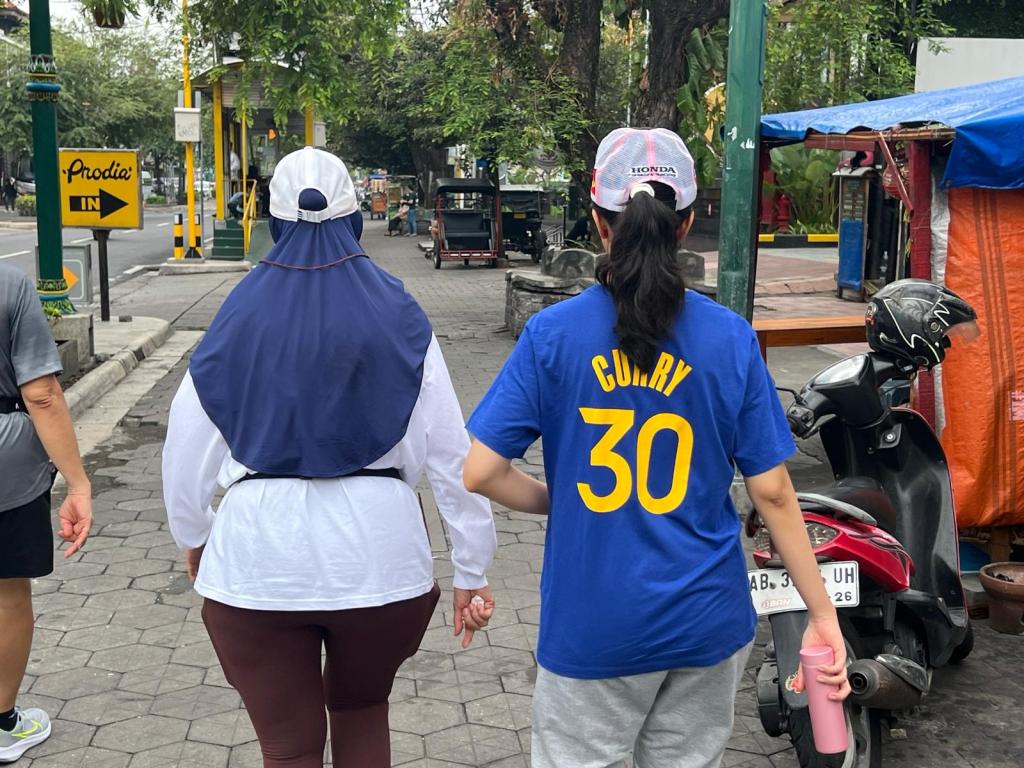
Two women showcasing diverse styles on a Jakarta street—one in traditional Islamic attire with a headscarf, the other is a fan of San Francisco Warriors’ Curry 30.
Faith is a Must!
The first principle of Indonesia’s philosophical foundation, Pancasila, requires citizens to profess a belief in “the one and almighty God.”
Indonesia officially recognizes six religions: Islam (87% of the population, 99% of whom are Sunni), Protestantism (7.4%), Catholicism (3.0%), Hinduism (1.7%, 87% of them in Bali island), Buddhism (0.7%), and Confucianism (0.03%).
While there is no law explicitly banning atheism, individuals have been charged with blasphemy for publicly expressing atheist views.
Having faith is a conditio sine qua non—an essential condition—for couples entering matrimony. All citizens must possess a national identity card (Kartu Tanda Penduduk or KTP) that includes their religion. Interfaith couples, in order to marry legally, may feel compelled to select the same religion on their KTP, which then becomes their official, legal religion.
Marrying Abroad
Many interfaith couples choose to marry overseas at civil registry offices, with Singapore and Australia being popular destinations, to avoid the legal complexities in Indonesia. After their honeymoon, they return home and file their foreign marriage certificate with the local civil registry office. However, such marriages must be registered in Indonesia within one year of their return. Under the new ruling, couples may face increased difficulty in registering their marriage in Indonesia, especially if their official KTP identity cards reflect different religions.
Legality of children from interfaith marriage
According to Article 42 of the Marriage Law, legitimate children are those born within or as a result of a legitimate marriage. If an interfaith marriage is deemed illegitimate due to any technicality, the child may be considered illegitimate (born out of wedlock). Interfaith couples attempting to bypass current laws, such as by marrying abroad, may face difficulties in legalizing their children’s status. These challenges can become even worst when declaring religion of children or seeking child custody after an interfaith divorce.
Given the legal challenges outlined, maintaining a dignified interfaith marriage has become impossible after the recent Supreme Court ruling. This may have been a compelling factor for celebrities like Mahalini Raharja to convert to Islam.
Discrimination Against Minorities
Provisions from the 1965 blasphemy law (further expanded by the new criminal code) and the 2006 religious harmony regulation continue to put religious minorities at risk. The 2006 regulation grants religious majorities in local communities the power to veto religious activities of minority faiths or block the construction of their houses of worship. This primarily affects Christians, Shia Muslims, Hindus, Buddhists, and Confucians. Smaller minorities, such as Ahmadiyah, Bahá’í, and Indigenous faiths, face even harsher treatment.
There are numerous unwritten regulations that restrict minorities from proselytizing to the Sunni majority, while no such restrictions exist in reverse.
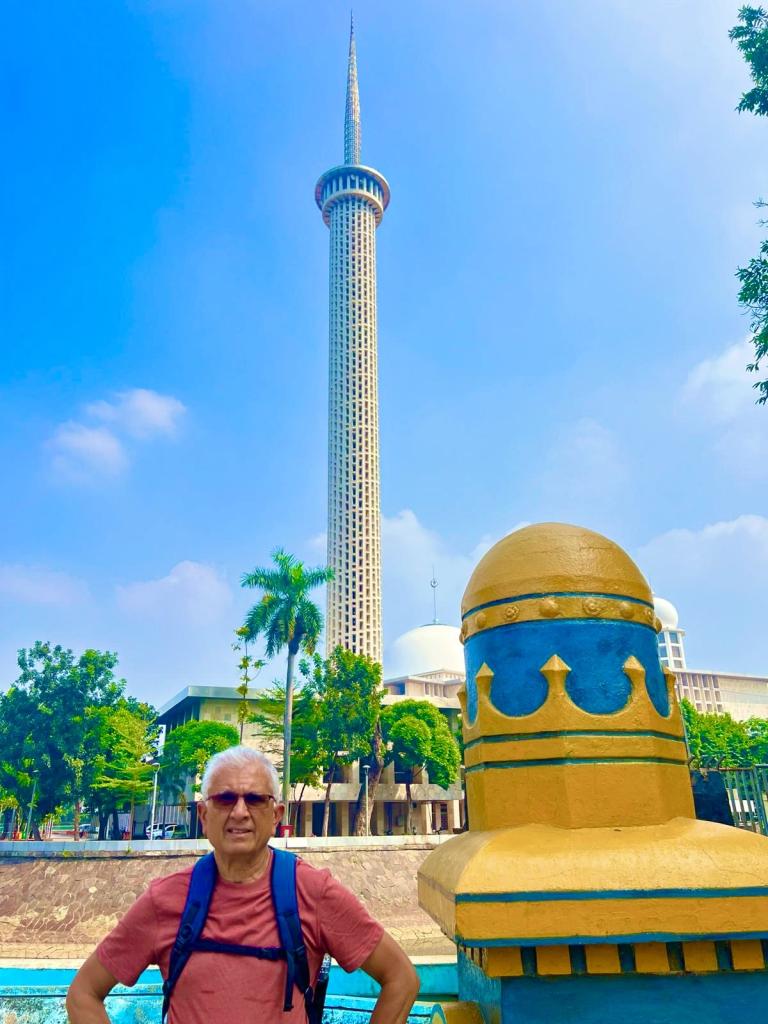
Author in front of Istiqlal Mosque, Jakarta, September 2024, during a two-week cultural exploration in Indonesia.
Indonesia Imposing Abrahamic Concepts on Dharmic Traditions
Terms like “kafirs,” “sinners,” and “heathens” are rooted in Abrahamic traditions to describe non-believers. However, these concepts are absent in Buddhism and Hinduism, since these faiths are based on the belief that all Atmas (souls) are inherently divine.
In contrast to the Abrahamic practice of requiring religious conversion for interfaith marriages, Dharmic traditions—such as Hinduism and Buddhism—generally do not impose such requirements. This may explain why neighboring Malaysia has instituted strict marriage laws exclusively for Muslims while exempting non-Muslims from similar constraints.
Unfortunately, Indonesia is now imposing intolerant Abrahamic-inspired regulations on Hindu-Buddhist (or Confucianist) interfaith couples, requiring one partner to convert to meet government requirements for marriage.
The author spoke with many Hindu and Buddhist locals in Indonesia about the imposition of this new practice. Initially, they were unaware and confused about why conversion was necessary for interfaith marriage. They expressed a preference to accept their partner as they are and raise an interfaith family embracing both faiths. It is wrong for the government to impose exclusivist ideologies on pluralist communities.
This marks the first time in human history that Dharmic traditions are being subjected to such intolerant legal impositions. It is hoped that Indonesia will follow Malaysia’s example, sparing non-Muslims from these restrictive marriage laws and granting Dharmic the freedom they deserve.
Supreme Court’s ruling should be challenged
Indonesians are inherently pluralistic, having woven together elements of Hinduism (starting 132 AD), Buddhism (200 AD) and Islam (1400 AD) while preserving their unique cultural practices. Today, Indonesia is a republic where the constitution mandates equal respect for all religions. However, the recent Supreme Court ruling contradicts these deeply rooted pluralistic values.
Indonesia’s Supreme Court has ‘indirectly’ interpreted Hinduism (used as an example, also applies to other faiths) as:
◦ Polytheists, as applicable in Quran 2:221 and 60:11,
◦ Disbelievers (as in Quran 60:11),
◦ Not People of the Book (as in Quran 5:5), and
◦ Lacking Scriptures prior to the revelation of the Quran (as in Quran 5:5).
As a result, now Hindu-Muslim interfaith marriages are deemed invalid in Indonesia.
This interpretation contradicts the core fundamental beliefs of Hinduism, which assert that:
◦ Hindus are not polytheists,
◦ Hinduism has a vast library of scriptures that existed long before the Quran, and
◦ Hindus believe in One Ultimate Reality.
Two opposing interpretations of Quran 2:221 could acknowledge the following perspectives:
◦ Intolerant View: Hindus are polytheists, disbelievers, and considered kafir. For these reasons, Hindu-Muslim marriages are deemed impossible unless the Hindu partner converts to Islam.
◦ Tolerant View: Hindus are believes and believe in One Supreme Reality. For these reasons, Hindu-Muslim marriages are valid and there should not be a compulsion for conversion.
Any misinterpretation of Hinduism’s core values in a ruling by Indonesia’s Supreme Court will deeply offend the sentiments of Hindus globally.
Many Islamic scholars, including Mike Mohamed Ghouse and Iftekhar Hai have voiced concerns about interpretations that label Hindus as kafirs or suggest that Hindus must convert to marry a Muslim.
The District Courts of Indonesia should challenge the Supreme Court’s misrepresentation of Hinduism and allow the registration of Hindu-Muslim marriages (and others) in accordance with a more inclusive understanding of both faiths.
In summary, the 2023 directive by the Supreme Court effectively undermines religious freedom for interfaith couples and unfairly marginalizes minority communities in Indonesia.
Global leaders who advocate for pluralism should raise their voices against this ruling and work toward its reversal.
Authors’ articles at Patheos:
Hindus Are Not Kafir –By Imam Iftekhar Hai
Hindus are believers –Dr. Mike Mohamed Ghouse
Hindu-Muslim Marriage: Nikah without Sahadah -Drs. Dilip Amin and Mike Mohamed Ghouse
Status of Hindus in Muslim Majority country, Malaysia
Authors books
Interfaith Marriage: Share and Respect with Equality (2017)
Hindu Vivaha Samskara (2011, coauthor)
Hindu-Muslim Shaadi: Samasyayen Aur Samadhan (Hindi Edition)(Mar 2023)
Hindu-Muslim Marriage: Difficulties and Reconciliations (Nov 2023)
Muslim
Hindu
Politics and Religion

About Dr. Dilip Amin
Dr. Dilip Amin is a Director of the Peninsula Multifaith Coalition of the San Francisco Bay area. He is a Dharma Ambassador and on the Advisory Committee at the Hindu American Foundation. He is a jail chaplain. Dr. Amin has co-authored the book Hindu Vivaha Samskara. He founded the web forum InterfaithShaadi.org and guided 1200 youths and summarized his experiences in the book--Interfaith Marriage: Share & Respect with Equality. He is also the founder of HinduSpeakers.org. You can read more about the author here.
Previous Post

July 16, 2024
JD Vance and Usha Chilukuri's Marriage of Religious Equality
Next Post

February 20, 2025 There is No Caste, Only Hindus – A Call for Truth
Recent Comments
"Dear KarolD, Please view my latest video. Please comment on Youtube. I hope to hear ..."
Will Usha Chilukuri Convert to the ..."
"Watch mistakes of Usha Chilukuri... https://youtu.be/LGD4dzRW21o"
Will Usha Chilukuri Convert to the ..."
"Putting public pressure on a spouse to convert or change any aspect of her identity, ..."
Will Usha Chilukuri Convert to the ..."
"But whether or not his wife converts should not be part of politics.And shouldn't be ..."
Will Usha Chilukuri Convert to the ..."
Browse Our Archives
Select a Category Hindu-Christian Marriage Hindu-Jew Marriage Hindu-Muslim marriage Uncategorized
Select a Month September 2026 February 2026 December 2025 November 2025 July 2025 June 2025 May 2025 April 2025 February 2025 October 2024 July 2024 June 2024 April 2024 April 2023 January 2023 December 2022 November 2022 October 2022 September 2022 August 2022 July 2022 June 2022
Follow Us!
TAKE THE
Religious Wisdom Quiz
What Christian denomination is known for circuit riders and revival meetings in America?
Select your answer to see how you score.
Presbyterian Catholic Episcopalian Methodist
Books by This Author Books by Equality For Happiness
Related posts from Equality For Happiness

20 Questions to Ask Before an Interfaith Marriage,...

A Valentine’s Day Message for Dating Couples
Can Kids Be Raised in Two Faiths? A...
Will Usha Chilukuri Convert to the Faith of...
TRENDING AT PATHEOS Family, Parenting and Religion

Indian Hindu pilot’s valor in line of duty...
There is a hoary maritime tradition that the captain of the...

Movie on Neem Karoli Baba’s life is a...
Neem Karoli Baba’s life (1900-1973) is associated with miracles he made in...

20 Questions to Ask Before an Interfaith Marriage,...
Four questions every interfaith couple should discuss before marriage: Conversion. Will either...

Avadhānam: The Art of Concentration and Intellectual Mastery
What is Avadhānam? In the summer of 2015, during a three-day Sanskrit...

Jesus in the Dharma: Where Christ Fits in...
Where Does Jesus Fit in Hinduism? That’s a question I get often...

Hormuz: A Shared Hindu and Zoroastrian Heritage
Every evening, somewhere in the world, a newsreader utters the words: "The...
view all Family, Parenting and Religion blogs
What Are Your Thoughts?leave a comment
Ad-Free & Subscriber Log-In Subscription Support
- About Us
- 2026 Calendar
- Videos
- Podcasts
- Library of World Religions
- Faith In Media Tracker
- Advertise With Us
- Write for Us
- Privacy Policy
- Terms of Service
- Do Not Sell My Data
- Contact Us
- Radiant Digital
- Manage Newsletter Subscriptions
- Unsubscribe From Notifications
- Sitemap
Copyright 2008-2026, Patheos. All rights reserved.
Subscription Support Ad-Free & Subscriber Log-In
Follow Patheos