
BuddhistCatholicContemplativeEvangelicalGeneral ChristianHinduJewishLatter-day SaintMuslimNew VisionsProgressive Christian
Beliefs
- Buddhist
- Catholic
- Contemplative
- Evangelical
- General Christian
- Hindu
- Jewish
- Latter-day Saint
- More Voices
- Muslim
- New Visions
- Pagan
- Progressive Christian
Topics
- Religion News
- Food and Religion
- Sports and Religion
- Religious Art
- Religious Music and Entertainment
- Religious Events
- History and Religion
- Style and Religion
- Politics and Religion
- Women in Religion
- Recreation Outdoors and Religion
- Business Finance and Religion
- Careers Workplace and Religion
- Education and Religion
- Family Parenting and Religion
- Health Fitness and Religion
- Home and Religion
- Relationships and Religion
- Technology and Religion
- Travel and Religion
Columnists
- Buddhist Columnists
- Business Finance and Religion Columnists
- Careers Workplace and Religion Columnists
- Catholic Columnists
- Contemplative Columnists
- Education and Religion Columnists
- Evangelists Columnists
- Family Parenting and Religion Columnists
- General Christian Columnists
- Health Fitness and Religion Columnists
- Hindu Columnists
- History and Religion Columnists
- Home and Religion Columnists
- Jewish Columnists
- More Voices Columnists
- Latter Day Columnists
- Muslim Columnists
- New Visions Columnists
- Nonreligious Columnists
- Pagan Columnists
- Politics and Religion Columnists
- Progressive Columnists
- Recreation Outdoors and Religion Columnists
- Relationships and Religion Columnists
- Religion News Columnists
- Religious Art Columnists
- Religious Events Columnists
- Religious Music and Entertainment Columnists
- Sports and Religion Columnists
- Style and Religion Columnists
- Technology and Religion Columnists
- Travel and Religion Columnists
- Women in Religion Columnists
Resource Library
- 2026 Calendar
- Library of World Religions
- The 100 Most Holy Places on Earth
- Patheos Answers
- Podcasts
- Videos
- Faith Leaders Database
- Anglican Episcopalian
- Bahai
- Baptist
- Buddhism
- Christianity
- Confucianism
- Eastern Orthodoxy
- Hinduism
- Holiness and Pentecostal
- ISKCON
- Islam
- Judaism
- Lutheran
- Methodist
- The Church of Jesus Christ of Latter-day Saints
- New Age
- Paganism
- Presbytarian and Reformed
- Protestantism
- Religion Behind the Scenes
- Roman Catholic
- Scientology
- Shia Islam
- Sikhism
- Sufism
- Sunni Islam
- Taoism
- Zen
- See all religions
Research Tools
 Ad-Free & Subscriber Log-In Subscription Support
Ad-Free & Subscriber Log-In Subscription Support
Follow Patheos 

- Trending:
- Forgiveness
- |
- Marriage
- |
- Consciousness
- |
- Death Penalty
- |
- Election
- |
- Halloween

- Home
- Hindu
- Family, Parenting and Religion
- Caste Bills Could Hurt Interfaith Couples
Caste Bills Could Hurt Interfaith Couples
Last updated on: April 9, 2024 at 6:38 am by Dr. Dilip Amin
Caste Bills Could Hurt Interfaith Couples 2024-04-09T06:38:36-07:00 Dr. Dilip Amin
Patheos Explore the world's faith through different perspectives on religion and spirituality! Patheos has the views of the prevalent religions and spiritualities of the world.
About 40% of Americans marry interfaith. Any future proposal of a caste bill like the vetoed California Senate Bill 403 (SB 403) could increase legal challenges to current, future (dating), and past (divorced) interfaith married couples. Senator Aisha Wahab or any other author of a similar future caste bill should consider these points for the benefit of interfaith couples.

Opponents of SB 403 including Dalit-Bahujan leader Late Milind Makwana protesting against the bill in California Senate (Photo credit: Dilip Amin)
Vetoed SB 403
The California Senate Bill 403 was intended to prohibit discrimination based on caste explicitly, but after revisions merely made affecting discrimination based on ancestry.
Governor Gavin Newsom vetoed it, stating, “Everyone deserves to be treated with dignity and respect” and “caste is already prohibited under these existing categories; this bill is unnecessary,” and returned it to the Senate on October 7, 2023.
Existing law, the Unruh Civil Rights Act, provides that all persons within the jurisdiction of the state of California are free and equal, no matter their sex, race, color, religion, ancestry, and more. SB 403 tried to define further “ancestry” for purposes of the act to include, among other things, caste. If ever implemented, such a law will affect public school policies, enforce civil rights laws concerning housing and employment, and could impact interfaith marriages.
The SB 403 states:
- Ancestry includes but is not limited to, lineal descent, heritage, parentage, caste, or any inherited social status. Nothing precludes a person from alleging discrimination based on ancestry in combination with discrimination based on other protected characteristics
- Caste means an individual’s perceived position in a system of social stratification based on inherited status. ‘A system of social stratification based on inherited status’ may be characterized by factors that may include, but are not limited to, inability or restricted ability to alter inherited status; socially enforced restrictions on marriage, private and public segregation, and discrimination; and social exclusion of based on perceived status.
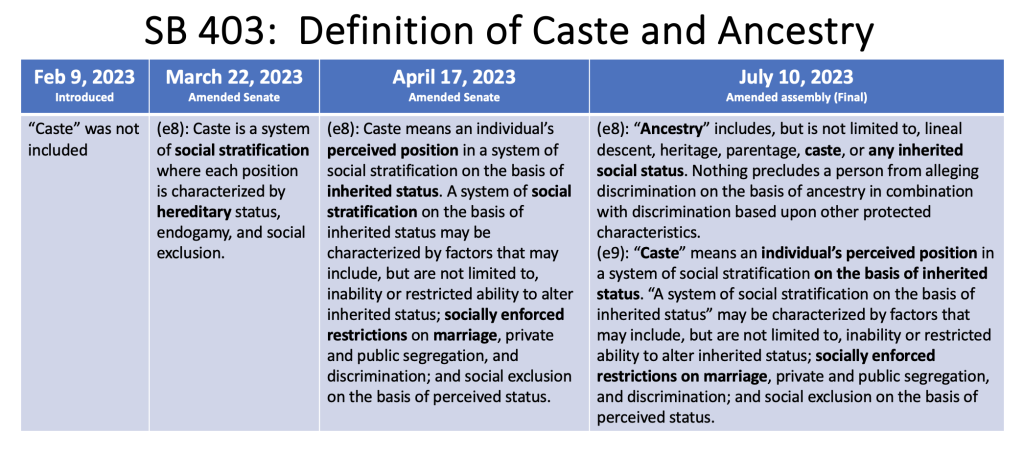
The author of SB 403 could not define “caste” clearly and it kept on changing (Photo credit: Dilip Amin)
Further, this bill clarified:
- “Religious creed,” “religion,” “religious observance,” “religious belief,” and “creed” include all aspects of religious belief, observance, and practice, including religious dress and grooming practices. “Religious dress practice” shall be construed broadly to include the wearing or carrying of religious clothing, head or face coverings, jewelry, artifacts, and any other item that is part of an individual observing a religious creed. “Religious grooming practice” shall be construed broadly to include all forms of head, facial, and body hair that are part of an individual observing a religious creed
Clarifications on the Definition of Caste and Ancestry
This failed bill, though intended to clarify, introduced new unclear terms:
- The phrase “perceived position” raised the immediate question–perceived by whom? For example, by the victim (self-identified) or the perpetrator of alleged discrimination? This is a fundamental flaw in the bill
- The phrase “social stratification” left unclear whether it is stratification established and enforced by an authority or informal stratification observed naturally in a community
- The phrase “inherited status” leaves open whether an individual perceives the inheritance as formal, such as through a Will or Trust. It also does not clarify how many generations an individual may carry the liability of “inherited status.”
Further, the SB 403 failed to recognize critical relevant factors, such as:
- The phrase “inability or restricted ability to alter inherited status” is meaningless since, by definition, one cannot alter the “inherited status” ever
- The stated “socially enforced restrictions on marriage” is the central theme of this article. In this “caste” SB 403 proposal, any conflict due to religious or social practice based on social stratification and inherited status in any marriage can become a potential legal “caste” related liability
Conflicts in the Wordings of the Bill
An individual should have the liberty of having a “perceived position” based on what he or she has learned from his or her life. However, that person is still potentially stuck with the law, if approved, because of his or her “inherited status” (which cannot be changed for generations to come).
In all practicality, it takes work to prove the perceived position in a court of law (see Sundar Iyer below). Thus, all Californians could carry liabilities of their inherited status for generations, irrespective of their beliefs or actions. Secondly, the perceived position can constantly be challenged based on who the perceiver is.
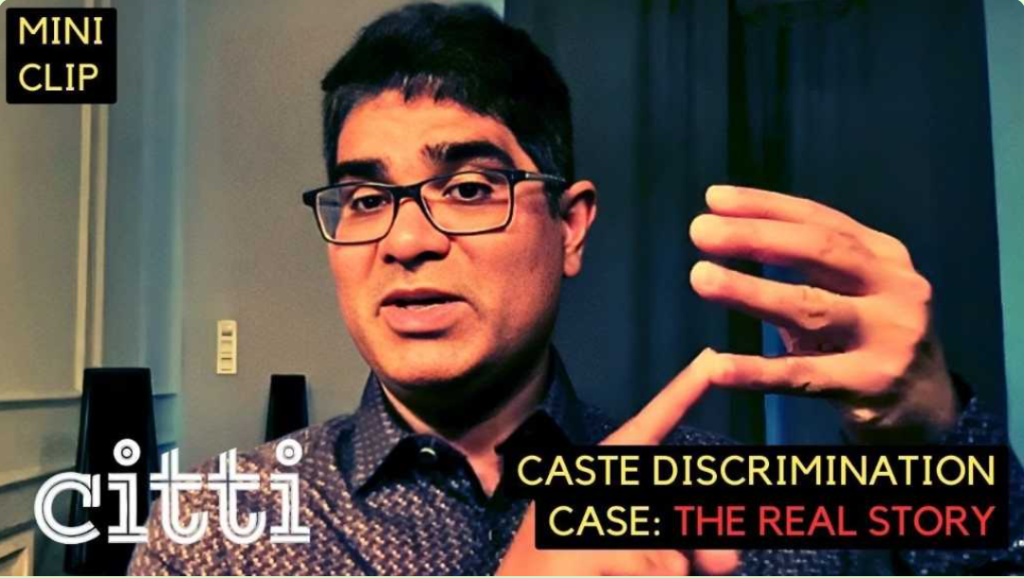
Sundar Iyer’s perceived position was non-religious atheist but California Civil Rights Department (CRD) assigned his caste as an upper caste Hindu Brahmin (view) (Photo credit: Citti)
Sundar Iyer’s perceived position while working at Cisco was non-religious. He publicly declared himself as an atheist. However, based on the Indian/Hindu perceived system of social stratification and his inherited status (last name being Iyer), the California Civil Rights Department (CRD) assigned his caste as an upper caste Hindu Brahmin. After several years of litigation, CRD finally dropped the case of caste discrimination at Cisco on two defendants after they filed a motion for sanctions alleging prosecutorial abuse and fabrication of facts.
The Discriminatory Bill
In the initial versions of the bill, the word “caste” was linked to South Asians and all people of color, and thus the draft bill racially profiled South Asians. Many legal experts (Vikram Amar, Barbara McGraw, Suhag Shukla, and others) raised legal concerns about the bill. Later, the mention of “South Asian” was removed, but the intentions of the bill’s author would remain open for legal challenges if this bill ever became a law.
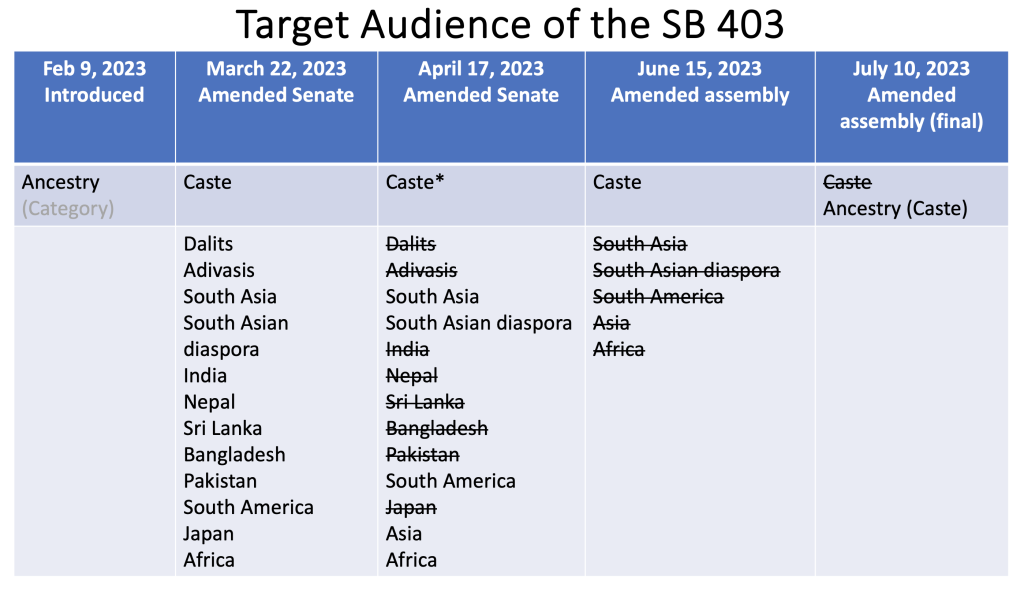
The target audience of SB 403 was not clear in the author’s mind (Photo credit: Dilip Amin)
The term Caste in SB 403 Points to Hinduism
Since dictionaries and all middle school textbooks erroneously define “caste” as a Hindu practice, that remains the default public perception. Therefore, as most opponents of the bill claimed (1, 2, 3), SB 403 is an anti-Hindu bill in effect, even if not in intent.
Benefit of Doubt
Nevertheless, since “Hinduism” is never mentioned in SB 403, and even the term South Asians has been later removed, this article will assume that this bill is merely providing a novel definition of “caste.” Below, we will assume that “caste” is irrelevant to Jati and Varna in Hinduism.
Examples of Socially Enforced Restrictions on Marriages
The new proposed definition of caste in SB 403 covered inherited status that may include socially enforced restrictions on marriage. As said earlier, the author assumes for this article that this law applies to people of all faiths equally.
Some examples of “socially enforced restrictions on marriages” include:
- Muslim girls’ inability to marry a non-Muslim (including a Christian or Jew)
- A Muslim’s marriage to a Hindu without religious conversion of the Hindu (or any non-Abrahamic)
- A Muslim’s marriage to a Christian or Jew without children following Islam
- Any Muslim marriage without Shahadah (conversion to Islam) and nikah (Muslim marriage contract)
- Marriage of a Muslim to a kafir (polytheist or an idol-worshiper)
- Asking a Shia Muslim or Ahmadi Muslim not to follow certain practices by a Sunni Muslim is caste-based discrimination (socially enforced restrictions)
- Hazaras Shia vs Pashtun Sunnis (Afghanistan caste system)
- Marriage of a Christian to a heathen (not a follower of Jesus)
- Marriage of a Catholic to a Hindu without a one-sided prenuptial agreement (restriction imposed by the Catholic church)
- Restriction on Catholic-Protestant (or any inter-denomination) marriage
- Some Jewish leaders consider interfaith marriage as a silent holocaust, and a rabbi may restrict such marriage (read Jewish-Hindu marriages)
- Restrictions on Sikh inter-jati (Jaat to Chamar) marriages
- Restrictions on Hindu inter-jati marriages
- Any restriction presented by any faith leader for an inter-religious marriage (could be considered as socially enforced restrictions on marriage)
If anyone faced past or present restrictions on interfaith marriage by a faith leader or was coerced to change religion for marriage, that incident could be a ground for a lawsuit for caste-based discrimination (considering it is based on an individual’s perceived position in a system of social stratification based on inherited status).
Other Socially Enforced Restrictions
The draft SB 403 considered some other acts as offences, including “the wearing or carrying of religious clothing, head or face coverings, jewelry, artifacts, and any other item that is part of an individual observing a religious creed.”
Some examples of caste-based discrimination offences or a potential case for a new lawsuit may include:
- Asking or suggesting a Muslim lady spouse not to wear a hijab in an interfaith marriage setup
- Asking or suggesting a non-Muslim spouse to consider wearing a hijab, even on a special occasion
- Asking or suggesting a Hindu lady to wear or not to wear a bindi (head dot), sari, or mangal sutra (sacred necklace)
- Asking or suggesting a Hindu spouse not to have Hindu icons (for example, the Lord Ganesh statue can be considered as an “artifact” as per SB 403) in an interfaith home with an Abrahamic (some consider it as sin or idol-worshiping)
- Asking a Sikh not to wear a turban or make any offensive statement about it
The above list is endless since two incompatible systems of social stratifications and ancestries (from two entirely different faiths) are merging in one household (after an interfaith marriage), and an individual’s personal beliefs (self-perceived position) are given lesser importance.
The introduction of SB 403 or any future proposal of a new bill similar to SB 403 with a similar definition of caste could open a new Pandora’s box for potential lawsuits for interfaith dating and married couples.
For any similar bill to be practical, personal relationships must be specifically exempted from the law and left up to the two individuals involved.
Disclaimer: The author is not a legal expert, and the views presented here are his interpretations of the vetoed SB 403 based on his personal experience of 18 years of dealing with more than 1200 youths in interfaith love relationships.
Hindu
Politics and Religion
Previous Post

April 2, 2024
Legal Implications in Interfaith Marriages
Next Post

June 24, 2024 Intermarriage as a New Category of CASTE Systems
Recent Comments
"Dear KarolD, Please view my latest video. Please comment on Youtube. I hope to hear ..."
Will Usha Chilukuri Convert to the ..."
"Watch mistakes of Usha Chilukuri... https://youtu.be/LGD4dzRW21o"
Will Usha Chilukuri Convert to the ..."
"Putting public pressure on a spouse to convert or change any aspect of her identity, ..."
Will Usha Chilukuri Convert to the ..."
"But whether or not his wife converts should not be part of politics.And shouldn't be ..."
Will Usha Chilukuri Convert to the ..."
Browse Our Archives
Select a Category Hindu-Christian Marriage Hindu-Jew Marriage Hindu-Muslim marriage Uncategorized
Select a Month September 2026 February 2026 December 2025 November 2025 July 2025 June 2025 May 2025 April 2025 February 2025 October 2024 July 2024 June 2024 April 2024 April 2023 January 2023 December 2022 November 2022 October 2022 September 2022 August 2022 July 2022 June 2022
Follow Us!
TAKE THE
Religious Wisdom Quiz
I am a runaway slave who became a brother. Paul pleaded for my master to receive me back in love. Who am I?
Select your answer to see how you score.
Onesimus Timothy Philemon Titus
Books by This Author Books by Equality For Happiness
Related posts from Equality For Happiness

20 Questions to Ask Before an Interfaith Marriage,...

A Valentine’s Day Message for Dating Couples

Can Kids Be Raised in Two Faiths? A...

Will Usha Chilukuri Convert to the Faith of...
TRENDING AT PATHEOS Family, Parenting and Religion

Indian Hindu pilot’s valor in line of duty...
There is a hoary maritime tradition that the captain of the...

Movie on Neem Karoli Baba’s life is a...
Neem Karoli Baba’s life (1900-1973) is associated with miracles he made in...

20 Questions to Ask Before an Interfaith Marriage,...
Four questions every interfaith couple should discuss before marriage: Conversion. Will either...

Avadhānam: The Art of Concentration and Intellectual Mastery
What is Avadhānam? In the summer of 2015, during a three-day Sanskrit...

Jesus in the Dharma: Where Christ Fits in...
Where Does Jesus Fit in Hinduism? That’s a question I get often...

Hormuz: A Shared Hindu and Zoroastrian Heritage
Every evening, somewhere in the world, a newsreader utters the words: "The...
view all Family, Parenting and Religion blogs
What Are Your Thoughts?leave a comment
Ad-Free & Subscriber Log-In Subscription Support
- About Us
- 2026 Calendar
- Videos
- Podcasts
- Library of World Religions
- Faith In Media Tracker
- Advertise With Us
- Write for Us
- Privacy Policy
- Terms of Service
- Do Not Sell My Data
- Contact Us
- Radiant Digital
- Manage Newsletter Subscriptions
- Unsubscribe From Notifications
- Sitemap
Copyright 2008-2026, Patheos. All rights reserved.
Subscription Support Ad-Free & Subscriber Log-In
Follow Patheos