
BuddhistCatholicContemplativeEvangelicalGeneral ChristianHinduJewishLatter-day SaintMuslimNew VisionsProgressive Christian
Beliefs
- Buddhist
- Catholic
- Contemplative
- Evangelical
- General Christian
- Hindu
- Jewish
- Latter-day Saint
- More Voices
- Muslim
- New Visions
- Pagan
- Progressive Christian
Topics
- Religion News
- Food and Religion
- Sports and Religion
- Religious Art
- Religious Music and Entertainment
- Religious Events
- History and Religion
- Style and Religion
- Politics and Religion
- Women in Religion
- Recreation Outdoors and Religion
- Business Finance and Religion
- Careers Workplace and Religion
- Education and Religion
- Family Parenting and Religion
- Health Fitness and Religion
- Home and Religion
- Relationships and Religion
- Technology and Religion
- Travel and Religion
Columnists
- Buddhist Columnists
- Business Finance and Religion Columnists
- Careers Workplace and Religion Columnists
- Catholic Columnists
- Contemplative Columnists
- Education and Religion Columnists
- Evangelists Columnists
- Family Parenting and Religion Columnists
- General Christian Columnists
- Health Fitness and Religion Columnists
- Hindu Columnists
- History and Religion Columnists
- Home and Religion Columnists
- Jewish Columnists
- More Voices Columnists
- Latter Day Columnists
- Muslim Columnists
- New Visions Columnists
- Nonreligious Columnists
- Pagan Columnists
- Politics and Religion Columnists
- Progressive Columnists
- Recreation Outdoors and Religion Columnists
- Relationships and Religion Columnists
- Religion News Columnists
- Religious Art Columnists
- Religious Events Columnists
- Religious Music and Entertainment Columnists
- Sports and Religion Columnists
- Style and Religion Columnists
- Technology and Religion Columnists
- Travel and Religion Columnists
- Women in Religion Columnists
Resource Library
- 2026 Calendar
- Library of World Religions
- The 100 Most Holy Places on Earth
- Patheos Answers
- Podcasts
- Videos
- Faith Leaders Database
- Anglican Episcopalian
- Bahai
- Baptist
- Buddhism
- Christianity
- Confucianism
- Eastern Orthodoxy
- Hinduism
- Holiness and Pentecostal
- ISKCON
- Islam
- Judaism
- Lutheran
- Methodist
- The Church of Jesus Christ of Latter-day Saints
- New Age
- Paganism
- Presbytarian and Reformed
- Protestantism
- Religion Behind the Scenes
- Roman Catholic
- Scientology
- Shia Islam
- Sikhism
- Sufism
- Sunni Islam
- Taoism
- Zen
- See all religions
Research Tools
 Ad-Free & Subscriber Log-In Subscription Support
Ad-Free & Subscriber Log-In Subscription Support
Follow Patheos 

- Trending:
- Forgiveness
- |
- Marriage
- |
- Consciousness
- |
- Death Penalty
- |
- Election
- |
- Halloween

- Home
- Buddhism
- Family, Parenting and Religion
- 15 FAQs on Interfaith Marriage
15 FAQs on Interfaith Marriage
Last updated on: September 16, 2025 at 11:57 am by Dr. Dilip Amin
15 FAQs on Interfaith Marriage 2025-09-16T11:57:54-07:00 Dr. Dilip Amin
Patheos Explore the world's faith through different perspectives on religion and spirituality! Patheos has the views of the prevalent religions and spiritualities of the world.
If you are in an interfaith love relationship, you must critically evaluate these frequently asked questions about your planned interfaith married life. These 15 FAQs are applicable to inter- or intra- Dharmic and/or Abrahamic faiths.
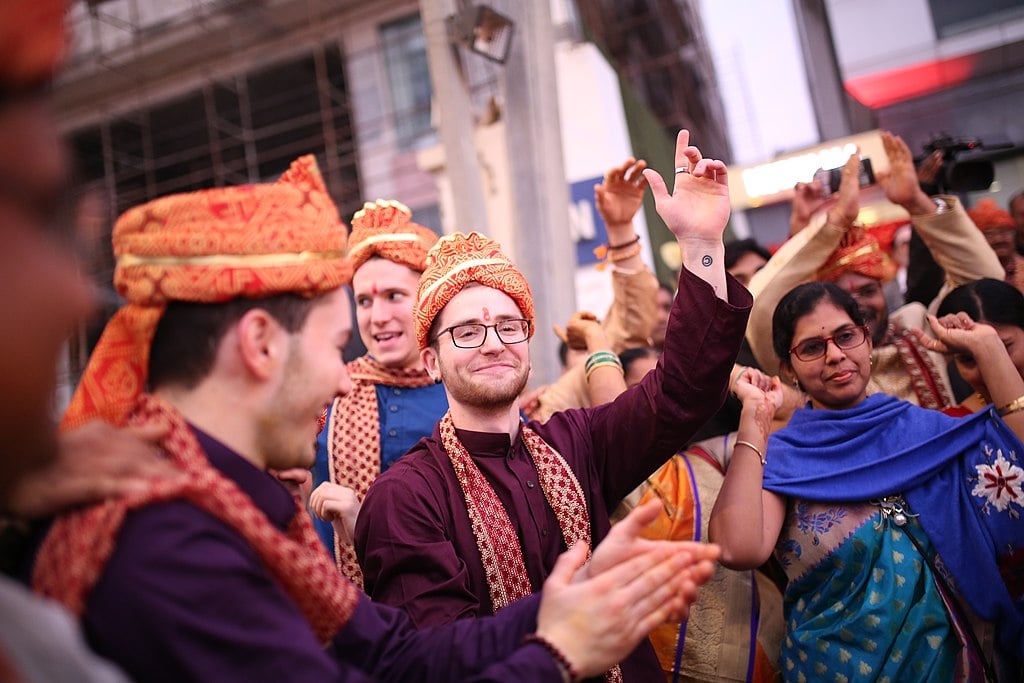
Fully informed decision can bring joy for years to come. Photo: Dinesh Mendhe/Wikimedia
1. What is the main message here?
Interfaith relationships should be based on mutual respect for both the faiths, and marriage should be solemnized without imposing religious conversion on a spouse.
After marriage, both the spouses’ faiths should get equal respect and consideration at home and in raising children.
2. Is religious conversion for marriage wrong?
Not if it is discussed early in the relationship and agreed to by both the parties, and adopted without coercion.
Some conservative families, rooted in the belief that their faith is superior to others, force the spouse-to-be of any other faith to convert before the wedding can take place. If such is the case, the expectations vis-a-vis conversion should be discussed upfront before getting into an intimate relationship.
After years of romantic relationship, to ask an intended spouse to give up his or her religion just before the wedding is not only HIGHLY UNETHICAL but is bound to lead to marital discord.
In such a scenario, the coerced spouse will surely feel cheated, that too at a time when he/she is gearing up to experience some of the sweetest memories of his/her life. It may even sow seeds of doubt in his/her heart on whether the intended spouse deceptively practiced proselytism under the guise of love.
3. What is wrong if one converts to a new faith for the sake of a marriage, but is allowed to practise his/her own faith after the marriage?
Be careful—religious conversion is not a hollow ritual devoid of any meaning or consequences. Let’s take a Christian-Muslim marriage as an example.
As per the Shahadah oath to convert to Islam for Nikaah, you accept and declare that there is no God but Allah and Mohammad is His messenger. Moreover, you acknowledge that associating others with Allah is the greatest of all sins.
Similarly, to undergo baptism before a church wedding means not only to accept Christianity and commit to repudiate former practices (of Islam), but to live with Christ forever.
These are deep allegiances and cannot be taken lightly. Therefore, it is imperative to be honest with yourself and cognizant of your real intentions.
The most difficult question a Christian-Muslim couple will face is “Is Jesus Son of God?”
4. What religion will my children follow?
This should be the MOST CRITICAL question in an interfaith relationship, even if there was no conversion required for the marriage ceremony.
Ask if your intended spouse expects your sons and daughters to have baptism, bris, bar/bat mitzvah or sunat (BBS), including namasanskara, in order to declare their faith for life.
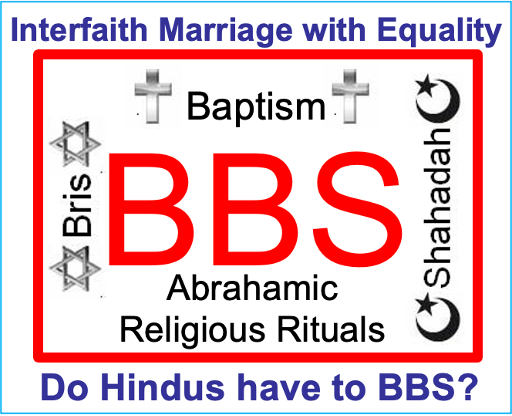
Bris, Baptism, Shahadah and Namasamskara are holy rituals for religious people. However, do Hindus have to BBS? Alternatively, do Abrahamic have to accept namasanskara as a ritual for their children? Photo: InterfaithShaadi
5. How is the decision to select a faith usually made?
In most cases, the decision for selection of the faith for the spouse and children is made to please the more rigid and intolerant spouse, or the more stubborn parents/community.
If one spouse feels that he/she is relenting to coercion, it will create resentment and marital discord will follow.
6. Are conflicts due to what is written in scriptures?
In most cases, it is not the scriptures that pose a problem, but the way they are interpreted/understood.
For example, the “Dharmic” religions (Hindus, Jains, Sikhs and Buddhists) are not normally accepted by the Abrahamic (“People of the Book”) in a marriage. Hindus believe in one Supreme Being, but they are free to worship its manifestations in many forms, even in inanimate objects. However, this practice is forbidden in Christianity, Judaism and Islam and can pose a serious issue when it comes to “puja” (devotional ritual) of various Hindu forms of God.
According to the Ten Commandments (Exodus 20:4-5): “I am the Lord your God. You shall have no other gods before me. You shall not make for yourself an idol, whether in the form of anything that is in heaven above, or that is on the earth beneath, or that is in the water under the earth. You shall not bow down to them or worship them; for I the Lord your God am a jealous God… punishing children for the inequity of parents, to the third and fourth generations of those who reject me.”
It is for the couple and their parents to discuss upfront about any conflicting scripture (read concerning statements for interfaith dating couples in Geeta, Bible, Koran, Bar Mitzvah and Torah).
7. Can we teach our children both religions?
It is difficult if you have an exclusivist mindset.
Having to adhere to two faiths might cause confusion in young minds, trying to absorb everything, especially since the messages from their scriptures can be poles apart, and therefore quite conflicting. For example, on a visit to a Hindu or Jain temple, they would learn to respect and revere the myriad manifestations of God at various strata of Life. Yet, on the other hand, while attending the prayers at a mosque/church/synagogue, they may be exposed to messages which propound something quite the opposite. When confronted with such apparent contradictions, children could lose faith in any God or religion.
Needless to say, if both parties are truly pluralist, this question would never even come up and raising children in TWO FAITHS would be something spontaneous and organic.
8. If my spouse is open-minded, can we get around these religious expectations?
Remember, a marriage is not just the union of two individuals but, believe it or not, a union of two families and two communities. It is ethical to be sincere about your religious and spiritual beliefs with your new family rather than building life-long relationships based on lies and deception. If both the spouses are open-minded and ready to take the leap, they can definitely forego the religious expectations.
9. I’m not so religious. What if I don’t mind religious conversion for the marriage to please my spouse?
Life is full of changes. In general, people tend to return to their roots as they age, especially when they have children. How would you feel if you find yourself irreversibly locked into onerous practices?
10. Conversion is only a formality; why not do it just to please my spouse and his/her family?
Religious conversion is not a one time deal; you are setting a new tone for your life. If you feed a shark, it will come back again for more. Similarly, religious conversion for marriage will be followed by the expectation of a declaration of faith for your children. Later, you may be forbidden to practice your own religion or even pass on its essence to your children so they may culturally and spiritually enrich themselves by it.
Also, your spouse or his/her family may not like to be part of religious activities/ceremonies observed by your family members. Your spouse may even insult these religious practices and force you to denounce them in front of your family and friends.
When your fantasy honeymoon period ends and transforms into a routine married life, these issues could make you feel suffocated and trapped in the barrage of religious expectations thrust upon you.
11. What if my spouse claims he/she didn’t know beforehand but is asking for it now to please his/her parents?
Do not fall prey to the commonly used old trick of playing innocent. After living with the same parents and community for most of one’s life, he/she should have been well-versed in his/her parents’ and community’s expectations. If he/she did not, then you have the right to question his/her intelligence and honesty.
12. What is the true test that my intended spouse is not a religious fanatic?
Simple! Just ask him/her to promise two things (the second being the more important one):
1) No religious conversion before or after marriage; and
2) No religious labeling for the offspring until they are adults. Give them the freedom to figure out their own religious proclivity.
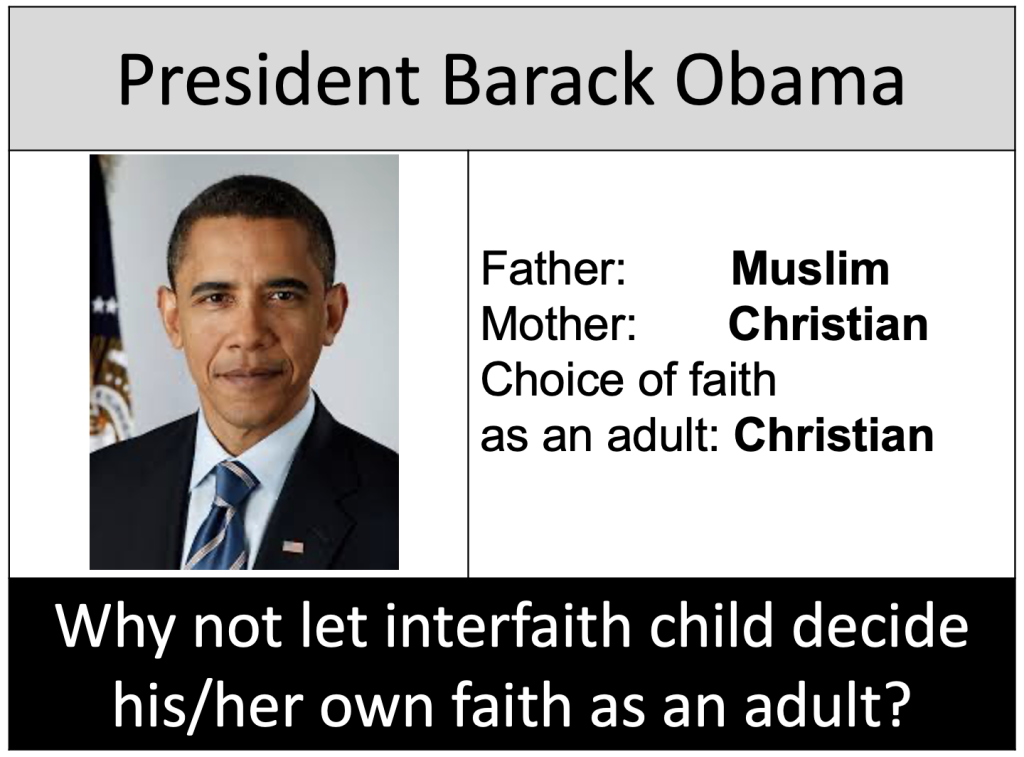
Former President Barack Obama decided his own faith as an adult. Photo: InterfaithShaad
13. But what if he or she does not agree?
If someone you are dating lacks tolerance for what you believe in and expects you to forsake your own religion and pride for your heritage in order to enter a wedlock, even if it be merely a meaningless ritual to pacify his/her family, you must ask yourself if you are prepared to tolerate the intolerance, hurled on you and your belief system.
14. Why do so many marriages end in divorce?
Some of the major reasons include unresolved issues of primary importance that were somehow either not discussed in their entirety or conveniently procrastinated. As a result, one lands up with the exasperating accusations of a complaining spouse that “he/she changed” after the marriage.
In my opinion, people don’t really change. It is us who fail to recognize who he/she truly is. But then, as they say, “love is blind.”
Before entering an interfaith relationship, go to every length possible to find out if he or she truly has at least the “tolerance,” if not an outright appreciation, for what you are and for your beliefs.
You, in your turn, should remain true to yourself. Do not fake to be what you are not.
15. Is a fulfilling relationship possible in an interfaith marriage?
Yes, if the interfaith relationship is based on a true mutual respect for religious diversity and both parties are willing to continually work towards a lasting relationship that often includes compromises.
Read other articles at Equality for Happiness to help make a fully informed decision for your planned Interfaith married life.
@@@
This message is based on my personal experiences gained while guiding 1200 youths in interfaith love.
There is no intention here to hurt anyone’s religious feelings or criticize any religious practices or belief system.
Those entrenched in their own religion, and wearing blinkers against other faiths and creeds, will never consider an interfaith relationship and thus this message does not apply to them. However, such candid discussion about two faiths is important for a happy and everlasting interfaith married life.
The practice of expecting religious conversion for marriage is wrong and should end now. If you have experienced the expectation of religious conversion for marriage, please share your views below.
Further Readings:
10 Keys to a Successful Interfaith Marriage
Interfaith Marriage and Divorce Laws
Love-Jihad: Use and misuse of the term
Hindu-Muslim Marriages: When Gandhi and Mohammed Meet
Myth: I Converted by My Choice for Interfaith Marriage
99% of Interfaith Marriage Bans Found in Muslim Nations
Buddhism
Catholic
Contemplative
Eastern Orthodox
Evangelical
General Christian
Hindu
Interfaith
Jewish
Latter-day Saint
Muslim
Education and Religion
History and Religion
Home and Religion
Politics and Religion
Relationships and Religion

About Dr. Dilip Amin
Dr. Dilip Amin is a Director of the Peninsula Multifaith Coalition of the San Francisco Bay area and a certified speaker at Islamic Networks Group. He is a Dharma Ambassador and on the Advisory Committee at the Hindu American Foundation. He is a jail chaplain. Dr. Amin has co-authored the book Hindu Vivaha Samskara. He founded the web forum InterfaithShaadi.org and guided 1200 youths and summarized his experiences in the book--Interfaith Marriage: Share & Respect with Equality. He is also the founder of HinduSpeakers.org. You can read more about the author here.
Previous Post

July 9, 2022
Meera versus Margaret: Discrimination of Own Type
Next Post

July 23, 2022 Idol-worshiper: Who Is and Who Is Not?
Recent Comments
"Dear KarolD, Please view my latest video. Please comment on Youtube. I hope to hear ..."
Will Usha Chilukuri Convert to the ..."
"Watch mistakes of Usha Chilukuri... https://youtu.be/LGD4dzRW21o"
Will Usha Chilukuri Convert to the ..."
"Putting public pressure on a spouse to convert or change any aspect of her identity, ..."
Will Usha Chilukuri Convert to the ..."
"But whether or not his wife converts should not be part of politics.And shouldn't be ..."
Will Usha Chilukuri Convert to the ..."
Browse Our Archives
Select a Category Hindu-Christian Marriage Hindu-Jew Marriage Hindu-Muslim marriage Uncategorized
Select a Month September 2026 February 2026 December 2025 November 2025 July 2025 June 2025 May 2025 April 2025 February 2025 October 2024 July 2024 June 2024 April 2024 April 2023 January 2023 December 2022 November 2022 October 2022 September 2022 August 2022 July 2022 June 2022
Follow Us!
TAKE THE
Religious Wisdom Quiz
What does Romans say is the result of justification by faith?
Select your answer to see how you score.
We become righteous We are saved from wrath We have peace with God We receive eternal life
Books by This Author Books by Equality For Happiness
Related posts from Equality For Happiness

20 Questions to Ask Before an Interfaith Marriage,...

A Valentine’s Day Message for Dating Couples
Can Kids Be Raised in Two Faiths? A...
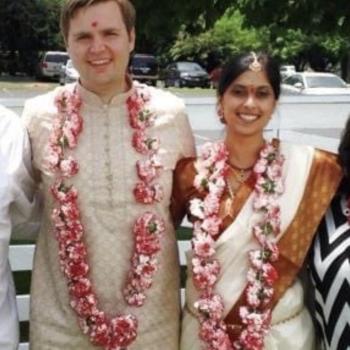
Will Usha Chilukuri Convert to the Faith of...
TRENDING AT PATHEOS Family, Parenting and Religion

Indian Hindu pilot’s valor in line of duty...
There is a hoary maritime tradition that the captain of the...

Movie on Neem Karoli Baba’s life is a...
Neem Karoli Baba’s life (1900-1973) is associated with miracles he made in...

20 Questions to Ask Before an Interfaith Marriage,...
Four questions every interfaith couple should discuss before marriage: Conversion. Will either...

Avadhānam: The Art of Concentration and Intellectual Mastery
What is Avadhānam? In the summer of 2015, during a three-day Sanskrit...

Jesus in the Dharma: Where Christ Fits in...
Where Does Jesus Fit in Hinduism? That’s a question I get often...

Hormuz: A Shared Hindu and Zoroastrian Heritage
Every evening, somewhere in the world, a newsreader utters the words: "The...
view all Family, Parenting and Religion blogs
What Are Your Thoughts?leave a comment
Ad-Free & Subscriber Log-In Subscription Support
- About Us
- 2026 Calendar
- Videos
- Podcasts
- Library of World Religions
- Faith In Media Tracker
- Advertise With Us
- Write for Us
- Privacy Policy
- Terms of Service
- Do Not Sell My Data
- Contact Us
- Radiant Digital
- Manage Newsletter Subscriptions
- Unsubscribe From Notifications
- Sitemap
Copyright 2008-2026, Patheos. All rights reserved.
Subscription Support Ad-Free & Subscriber Log-In
Follow Patheos