
BuddhistCatholicContemplativeEvangelicalGeneral ChristianHinduJewishLatter-day SaintMuslimNew VisionsProgressive Christian
Beliefs
- Buddhist
- Catholic
- Contemplative
- Evangelical
- General Christian
- Hindu
- Jewish
- Latter-day Saint
- More Voices
- Muslim
- New Visions
- Pagan
- Progressive Christian
Topics
- Religion News
- Food and Religion
- Sports and Religion
- Religious Art
- Religious Music and Entertainment
- Religious Events
- History and Religion
- Style and Religion
- Politics and Religion
- Women in Religion
- Recreation Outdoors and Religion
- Business Finance and Religion
- Careers Workplace and Religion
- Education and Religion
- Family Parenting and Religion
- Health Fitness and Religion
- Home and Religion
- Relationships and Religion
- Technology and Religion
- Travel and Religion
Columnists
- Buddhist Columnists
- Business Finance and Religion Columnists
- Careers Workplace and Religion Columnists
- Catholic Columnists
- Contemplative Columnists
- Education and Religion Columnists
- Evangelists Columnists
- Family Parenting and Religion Columnists
- General Christian Columnists
- Health Fitness and Religion Columnists
- Hindu Columnists
- History and Religion Columnists
- Home and Religion Columnists
- Jewish Columnists
- More Voices Columnists
- Latter Day Columnists
- Muslim Columnists
- New Visions Columnists
- Nonreligious Columnists
- Pagan Columnists
- Politics and Religion Columnists
- Progressive Columnists
- Recreation Outdoors and Religion Columnists
- Relationships and Religion Columnists
- Religion News Columnists
- Religious Art Columnists
- Religious Events Columnists
- Religious Music and Entertainment Columnists
- Sports and Religion Columnists
- Style and Religion Columnists
- Technology and Religion Columnists
- Travel and Religion Columnists
- Women in Religion Columnists
Resource Library
- 2026 Calendar
- Library of World Religions
- The 100 Most Holy Places on Earth
- Patheos Answers
- Podcasts
- Videos
- Faith Leaders Database
- Anglican Episcopalian
- Bahai
- Baptist
- Buddhism
- Christianity
- Confucianism
- Eastern Orthodoxy
- Hinduism
- Holiness and Pentecostal
- ISKCON
- Islam
- Judaism
- Lutheran
- Methodist
- The Church of Jesus Christ of Latter-day Saints
- New Age
- Paganism
- Presbytarian and Reformed
- Protestantism
- Religion Behind the Scenes
- Roman Catholic
- Scientology
- Shia Islam
- Sikhism
- Sufism
- Sunni Islam
- Taoism
- Zen
- See all religions
Research Tools
 Ad-Free & Subscriber Log-In Subscription Support
Ad-Free & Subscriber Log-In Subscription Support
Follow Patheos 

- Trending:
- Forgiveness
- |
- Marriage
- |
- Consciousness
- |
- Death Penalty
- |
- Election
- |
- Halloween
 Epiphenom
- Home
- Nonreligious
- Can you use religion to change attitudes towards immigrants?
Can you use religion to change attitudes towards immigrants?
Last updated on: March 25, 2016 at 4:01 pm by Epiphenom
Can you use religion to change attitudes towards immigrants? 2016-03-25T16:01:09+01:00 Epiphenom
Patheos Explore the world's faith through different perspectives on religion and spirituality! Patheos has the views of the prevalent religions and spiritualities of the world.
Migration is a hot topic at the moment. While Americans debate the infamous ‘wall’ proposed between Mexico and the USA, in Europe the language around the waves of migrants from the Middle East and North Africa is becoming increasingly inflamed.
Does religion play a role in attitudes to migrants? It’s difficult to unravel because migrants often differ in both religion and ethnicity from the host countries. Does the fact that many migrants to Europe are Muslims contribute to the hostility, or is it more to do with other cultural attributes and customs?
Complicating matters is the fact that research has linked religion to two directly opposite effects on attitudes to migrants. Religious affiliation has been linked towards hostility to people of different religions, while pro-social religious beliefs can encourage acceptance of strangers.
It’s been shown, for example, that hostility to migrants in Europe is strongest among the ‘culturally Christian’ — those who are claim a Christian affiliation but rarely practice the religion.
But maybe people just choose to identify with religion in a particular way because they’re the kind of person who’s hostile to immigrants. Can you actually manipulate attitudes towards migrants by playing upon these different aspects of religion?
Two recent studies have investigated this using a technique called priming. Concepts and ideas are subliminally implanted in the mind of the research subject to see if it changes attitudes or behaviour.
An international trio of researchers (Pazit Ben0Nun Bloom at Hebrew University in Jerusalem, Gizem Arikan at Yasar University in Turkey, and Marie Courtmanche at Thiel College in the USA) ran a survey of over 450 religious people in Israel, Turkey, and the USA.
The survey was about attitudes to immigrants. But before asking about attitudes, they asked their subjects to unscramble some religion-related sentences. Some subjects got sentences about compassionate aspects of belief, some about the social identity dimension of religion (belonging to a religion) and some (the controls) just had neutral sentences. The idea was to mentally prime their subjects with these different thoughts before asking them about immigrants.
What they found was that priming ideas about belonging had a small but significant effect, encouraging their religious subjects to be more hostile towards immigrants (unless they were of the same religion and ethnicity as the subject).
Priming thoughts of compassion had, to their surprise, no effect (although it did in another study they ran just looking at students). What they then found was that compassion had a strong interaction with political persuasion.
As shown in the figure below, among liberals, priming religious belonging increased hostility to immigrants, but priming compassion decreased it. Among conservatives, priming belonging had a similar effect, but priming compassion actually increased hostility even more!
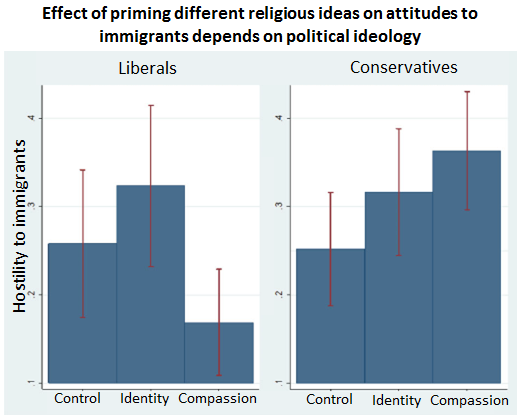
They suggest that for conservatives, even the religious compassion prime may activate a heightened sense of group boundaries, leading to intolerance of anyone outside their immediate moral circle.
They also found that, in their sample, religion was much more important then ethnicity in driving attitudes to immigrants. This is evidence that religion can break down some barriers while at the same time building others.
In a related study, Jonathon Ramsay (SIM University, Singapore) and colleagues tested 119 undergraduate students from Nanyang Technological University in Singapore. Each of them was asked to evaluate “Adrian Garcia” – a fictional foreign student, based on a short vignette they were given to read (women received the same material but the name was changed to Adriana, to avoid gender bias).
Before they did this, however, they were asked to do a ‘spot the difference’ task. They were shown two pictures of a desktop, and asked to point out what had been changed. Prominent in the images was a folder with either the word Religion, God, or Neutral. This was the subliminal prime, intended to implant thoughts either of religious affiliation, religious beliefs, or neither.
Ramsay and colleagues found no effect at all of any of the primes.
That’s something of a surprise given that a previous study with roughly similar design did find that such primes affected attitudes toward so-called “out-group” members. However, numerous small differences in the design of the experiments could explain the different findings, overall it underlines just how sensitive the effects of religious primes are be to cultural and social contexts.
Nevertheless, it seems clear that in certain social contexts, priming thoughts of religion can indeed change attitudes to immigrants — in particular towards migrants of differing or similar religion, but the effects are by not means straightforward or consistent from person to person.
 BEN-NUN BLOOM, P., ARIKAN, G., & COURTEMANCHE, M. (2015). Religious Social Identity, Religious Belief, and Anti-Immigration Sentiment American Political Science Review, 109 (02), 203-221 DOI: 10.1017/S0003055415000143
Ramsay, J., Tong, E., Pang, J., & Chowdhury, A. (2016). A Puzzle Unsolved: Failure to Observe Different Effects of God and Religion Primes on Intergroup Attitudes PLOS ONE, 11 (1) DOI: 10.1371/journal.pone.0147178

Next Post

March 23, 2016 What kind of woman would pray for health or use spiritual healing?
Browse Our Archives
Select a Category Causes of religion - evolution Causes of religion - psychological Causes of religion - social Demographics Digest Effects of religion - health Effects of religion - psychological Effects of religion - social Notifications Politics Uncategorized
Select a Month March 2016 February 2016 January 2016 December 2015 November 2015 October 2015 September 2015 August 2015 July 2015 June 2015 May 2015 April 2015 March 2015 February 2015 January 2015 December 2014 November 2014 October 2014 September 2014 August 2014 July 2014 June 2014 May 2014 April 2014 March 2014 February 2014 January 2014 December 2013 November 2013 October 2013 September 2013 August 2013 July 2013 June 2013 May 2013 April 2013 March 2013 February 2013 January 2013 December 2012 November 2012 October 2012 September 2012 August 2012 July 2012 June 2012 May 2012 April 2012 March 2012 February 2012 January 2012 December 2011 November 2011 October 2011 September 2011 August 2011 July 2011 June 2011 May 2011 April 2011 March 2011 February 2011 January 2011 December 2010 November 2010 October 2010 September 2010 August 2010 July 2010 June 2010 May 2010 April 2010 March 2010 February 2010 January 2010 December 2009 November 2009 October 2009 September 2009 August 2009 July 2009 June 2009 May 2009 April 2009 March 2009 February 2009 January 2009 December 2008 November 2008 October 2008 September 2008 August 2008 July 2008 June 2008 May 2008 April 2008 March 2008 February 2008 January 2008 December 2007 November 2007 October 2007
Follow Us!
TAKE THE
Religious Wisdom Quiz
What did God tell Moses from the burning bush?
Select your answer to see how you score.
That he would lead Israel out of Egypt That he would be king of Israel That he would build the temple That he would become Pharaoh
Related posts from Epiphenom

Do you wanna be in my clan? Moralising...
The decline of religion in Europe did not...

How religious schools led to the decline of...

Trust is more important than religion in encouraging...
TRENDING AT PATHEOS Nonreligious

Dethroning Jesus and Enthroning Yourself
Jesus Never Asked to Be Worshipped. He Asked to Be Understood. Christianity...

Why Most Christians are Really Paulians and Jobians
I Don't Care, But It Matters Let's get this out of the...

Essential Tips to Successfully Navigate the Selling Process
Selling a house can feel overwhelming, but it doesn’t have to be....

To Make Remote Work Effective, Think About Others
The COVID-19 pandemic forced many companies to rapidly transition to remote work....

Flexibility Is Key to Solving Problems of Tomorrow
The world of work is undergoing a dramatic transformation. The COVID-19 pandemic...
view all Nonreligious blogs
Ad-Free & Subscriber Log-In Subscription Support
- About Us
- 2026 Calendar
- Videos
- Podcasts
- Library of World Religions
- Faith In Media Tracker
- Advertise With Us
- Write for Us
- Privacy Policy
- Terms of Service
- Do Not Sell My Data
- Contact Us
- Radiant Digital
- Manage Newsletter Subscriptions
- Unsubscribe From Notifications
- Sitemap
Copyright 2008-2026, Patheos. All rights reserved.
Subscription Support Ad-Free & Subscriber Log-In
Follow Patheos