
BuddhistCatholicContemplativeEvangelicalGeneral ChristianHinduJewishLatter-day SaintMuslimNew VisionsProgressive Christian
Beliefs
- Buddhist
- Catholic
- Contemplative
- Evangelical
- General Christian
- Hindu
- Jewish
- Latter-day Saint
- More Voices
- Muslim
- New Visions
- Pagan
- Progressive Christian
Topics
- Religion News
- Food and Religion
- Sports and Religion
- Religious Art
- Religious Music and Entertainment
- Religious Events
- History and Religion
- Style and Religion
- Politics and Religion
- Women in Religion
- Recreation Outdoors and Religion
- Business Finance and Religion
- Careers Workplace and Religion
- Education and Religion
- Family Parenting and Religion
- Health Fitness and Religion
- Home and Religion
- Relationships and Religion
- Technology and Religion
- Travel and Religion
Columnists
- Buddhist Columnists
- Business Finance and Religion Columnists
- Careers Workplace and Religion Columnists
- Catholic Columnists
- Contemplative Columnists
- Education and Religion Columnists
- Evangelists Columnists
- Family Parenting and Religion Columnists
- General Christian Columnists
- Health Fitness and Religion Columnists
- Hindu Columnists
- History and Religion Columnists
- Home and Religion Columnists
- Jewish Columnists
- More Voices Columnists
- Latter Day Columnists
- Muslim Columnists
- New Visions Columnists
- Nonreligious Columnists
- Pagan Columnists
- Politics and Religion Columnists
- Progressive Columnists
- Recreation Outdoors and Religion Columnists
- Relationships and Religion Columnists
- Religion News Columnists
- Religious Art Columnists
- Religious Events Columnists
- Religious Music and Entertainment Columnists
- Sports and Religion Columnists
- Style and Religion Columnists
- Technology and Religion Columnists
- Travel and Religion Columnists
- Women in Religion Columnists
Resource Library
- 2026 Calendar
- Library of World Religions
- The 100 Most Holy Places on Earth
- Patheos Answers
- Podcasts
- Videos
- Faith Leaders Database
- Anglican Episcopalian
- Bahai
- Baptist
- Buddhism
- Christianity
- Confucianism
- Eastern Orthodoxy
- Hinduism
- Holiness and Pentecostal
- ISKCON
- Islam
- Judaism
- Lutheran
- Methodist
- The Church of Jesus Christ of Latter-day Saints
- New Age
- Paganism
- Presbytarian and Reformed
- Protestantism
- Religion Behind the Scenes
- Roman Catholic
- Scientology
- Shia Islam
- Sikhism
- Sufism
- Sunni Islam
- Taoism
- Zen
- See all religions
Research Tools
 Ad-Free & Subscriber Log-In Subscription Support
Ad-Free & Subscriber Log-In Subscription Support
Follow Patheos 

- Trending:
- Forgiveness
- |
- Marriage
- |
- Consciousness
- |
- Death Penalty
- |
- Election
- |
- Halloween
 Epiphenom
- Home
- Nonreligious
- The decline of religion in Europe did not lead to a decline in moral standards
The decline of religion in Europe did not lead to a decline in moral standards
Last updated on: February 11, 2016 at 4:34 pm by Epiphenom
The decline of religion in Europe did not lead to a decline in moral standards 2016-02-11T16:34:31+01:00 Epiphenom
Patheos Explore the world's faith through different perspectives on religion and spirituality! Patheos has the views of the prevalent religions and spiritualities of the world.
Morality is a complex notion, and means different things to different people. Still, there remains a pervasive idea that religion is linked in some general way to moral behaviour. Trying to work out from the data what truth there is in that is tough, but at least we can say with some confidence what people’s attitudes to different moral questions are.
That’s due to projects such as the European Values Survey, a massive initiative that has been run at regular intervals across many different European countries for several decades. Among the many questions it asks are ones on attitudes to bribery, cheating, lying, abortion, homosexuality, prostitution, suicide (and many others besides.
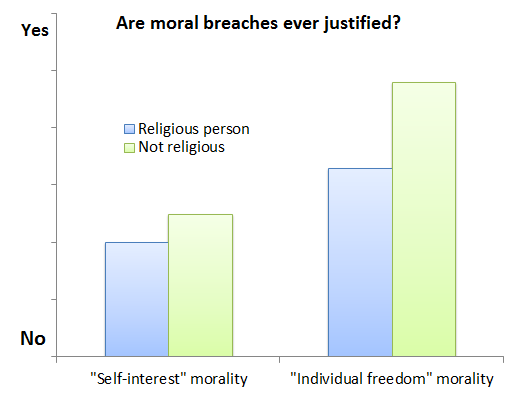
Using statistical techniques, Ingrid Storm (a social scientist at the University of Manchester in the UK) was able to show that responses to these items cluster together. One group of moral attitudes roughly corresponds to individual freedom – people who who believe that abortion is morally wrong are also likely to believe that homosexuality, prostitution, and suicide are wrong.
But attitudes to self-interest morals – things like using lies, bribery or cheating to gain personal advantage – cluster separately. This suggests that these are viewed as a different kind of morality to the ‘individual freedom’ kind of morality.
What Storm then showed was that, while attitudes towards ‘individual freedom’ morality has relaxed quite a lot over recent decades, attitudes towards ‘self-interest’ morality have not.
When she looked at data from individuals, she found that religious people did in fact disapprove more strongly of breaches of both kinds of morality than did the non-religious. But the difference was much smaller for issues of ‘self-interest’ morality. You can see for yourself in the graph below.
This relationship between religion and morality was stronger in countries where there are more religious people. And this in turn suggests a kind of networking effect, in which a strong religious social context provides a kind of validation for the association of religion with moral values.
Religion also had a stronger influence on ‘self interest’ morality in countries where confidence in he government was low. This supports the idea that people turn to religion as a way to enforce moral behaviour when secular governance is weak.
All this suggest that the relationship between religion and morality is complex, and influenced by what’s going on in wider society. As personal freedoms have increased, so religion has become less important in people’s lives (alternatively, in those parts of Europe where religion remains important, individual freedom is still regarded as morally wrong).
But although religion is linked in a weak way with attitudes to ‘self-interest’ morality, the decline in religion has not lead to a loosening of attitudes to bribery, cheating, and lying.
That’s probably because the link between religion and morality, at least when it comes to bribery, cheating, and lying, gets weaker as religion becomes less dominant in society as a whole.
 Storm, I. (2015). Morality in Context: A Multilevel Analysis of the Relationship between Religion and Values in Europe Politics and Religion, 1-28 DOI: 10.1017/S1755048315000899
Browse Our Archives
Select a Category Causes of religion - evolution Causes of religion - psychological Causes of religion - social Demographics Digest Effects of religion - health Effects of religion - psychological Effects of religion - social Notifications Politics Uncategorized
Select a Month March 2016 February 2016 January 2016 December 2015 November 2015 October 2015 September 2015 August 2015 July 2015 June 2015 May 2015 April 2015 March 2015 February 2015 January 2015 December 2014 November 2014 October 2014 September 2014 August 2014 July 2014 June 2014 May 2014 April 2014 March 2014 February 2014 January 2014 December 2013 November 2013 October 2013 September 2013 August 2013 July 2013 June 2013 May 2013 April 2013 March 2013 February 2013 January 2013 December 2012 November 2012 October 2012 September 2012 August 2012 July 2012 June 2012 May 2012 April 2012 March 2012 February 2012 January 2012 December 2011 November 2011 October 2011 September 2011 August 2011 July 2011 June 2011 May 2011 April 2011 March 2011 February 2011 January 2011 December 2010 November 2010 October 2010 September 2010 August 2010 July 2010 June 2010 May 2010 April 2010 March 2010 February 2010 January 2010 December 2009 November 2009 October 2009 September 2009 August 2009 July 2009 June 2009 May 2009 April 2009 March 2009 February 2009 January 2009 December 2008 November 2008 October 2008 September 2008 August 2008 July 2008 June 2008 May 2008 April 2008 March 2008 February 2008 January 2008 December 2007 November 2007 October 2007
Follow Us!
TAKE THE
Religious Wisdom Quiz
What was the occupation of Lydia, Paul's first convert in Philippi?
Select your answer to see how you score.
Dealer in purple cloth Tax collector Tentmaker Fisherman
Related posts from Epiphenom

Do social crises lead to religious revivals? Nah!

Can you use religion to change attitudes towards...

Do you wanna be in my clan? Moralising...

How religious schools led to the decline of...
TRENDING AT PATHEOS Nonreligious

Dethroning Jesus and Enthroning Yourself
Jesus Never Asked to Be Worshipped. He Asked to Be Understood. Christianity...

Why Most Christians are Really Paulians and Jobians
I Don't Care, But It Matters Let's get this out of the...

Essential Tips to Successfully Navigate the Selling Process
Selling a house can feel overwhelming, but it doesn’t have to be....

To Make Remote Work Effective, Think About Others
The COVID-19 pandemic forced many companies to rapidly transition to remote work....

Flexibility Is Key to Solving Problems of Tomorrow
The world of work is undergoing a dramatic transformation. The COVID-19 pandemic...
view all Nonreligious blogs
Ad-Free & Subscriber Log-In Subscription Support
- About Us
- 2026 Calendar
- Videos
- Podcasts
- Library of World Religions
- Faith In Media Tracker
- Advertise With Us
- Write for Us
- Privacy Policy
- Terms of Service
- Do Not Sell My Data
- Contact Us
- Radiant Digital
- Manage Newsletter Subscriptions
- Unsubscribe From Notifications
- Sitemap
Copyright 2008-2026, Patheos. All rights reserved.
Subscription Support Ad-Free & Subscriber Log-In
Follow Patheos