
BuddhistCatholicContemplativeEvangelicalGeneral ChristianHinduJewishLatter-day SaintMuslimNew VisionsProgressive Christian
Beliefs
- Buddhist
- Catholic
- Contemplative
- Evangelical
- General Christian
- Hindu
- Jewish
- Latter-day Saint
- More Voices
- Muslim
- New Visions
- Pagan
- Progressive Christian
Topics
- Religion News
- Food and Religion
- Sports and Religion
- Religious Art
- Religious Music and Entertainment
- Religious Events
- History and Religion
- Style and Religion
- Politics and Religion
- Women in Religion
- Recreation Outdoors and Religion
- Business Finance and Religion
- Careers Workplace and Religion
- Education and Religion
- Family Parenting and Religion
- Health Fitness and Religion
- Home and Religion
- Relationships and Religion
- Technology and Religion
- Travel and Religion
Columnists
- Buddhist Columnists
- Business Finance and Religion Columnists
- Careers Workplace and Religion Columnists
- Catholic Columnists
- Contemplative Columnists
- Education and Religion Columnists
- Evangelists Columnists
- Family Parenting and Religion Columnists
- General Christian Columnists
- Health Fitness and Religion Columnists
- Hindu Columnists
- History and Religion Columnists
- Home and Religion Columnists
- Jewish Columnists
- More Voices Columnists
- Latter Day Columnists
- Muslim Columnists
- New Visions Columnists
- Nonreligious Columnists
- Pagan Columnists
- Politics and Religion Columnists
- Progressive Columnists
- Recreation Outdoors and Religion Columnists
- Relationships and Religion Columnists
- Religion News Columnists
- Religious Art Columnists
- Religious Events Columnists
- Religious Music and Entertainment Columnists
- Sports and Religion Columnists
- Style and Religion Columnists
- Technology and Religion Columnists
- Travel and Religion Columnists
- Women in Religion Columnists
Resource Library
- 2026 Calendar
- Library of World Religions
- The 100 Most Holy Places on Earth
- Patheos Answers
- Podcasts
- Videos
- Faith Leaders Database
- Anglican Episcopalian
- Bahai
- Baptist
- Buddhism
- Christianity
- Confucianism
- Eastern Orthodoxy
- Hinduism
- Holiness and Pentecostal
- ISKCON
- Islam
- Judaism
- Lutheran
- Methodist
- The Church of Jesus Christ of Latter-day Saints
- New Age
- Paganism
- Presbytarian and Reformed
- Protestantism
- Religion Behind the Scenes
- Roman Catholic
- Scientology
- Shia Islam
- Sikhism
- Sufism
- Sunni Islam
- Taoism
- Zen
- See all religions
Research Tools
 Ad-Free & Subscriber Log-In Subscription Support
Ad-Free & Subscriber Log-In Subscription Support
Follow Patheos 

- Trending:
- Forgiveness
- |
- Marriage
- |
- Consciousness
- |
- Death Penalty
- |
- Election
- |
- Halloween
 Epiphenom
- Home
- Nonreligious
- Do you wanna be in my clan? Moralising gods encourage long-distance sharing with co-religionists
Do you wanna be in my clan? Moralising gods encourage long-distance sharing with co-religionists
Last updated on: February 11, 2016 at 11:36 pm by Epiphenom
Do you wanna be in my clan? Moralising gods encourage long-distance sharing with co-religionists 2016-02-11T23:36:10+01:00 Epiphenom
Patheos Explore the world's faith through different perspectives on religion and spirituality! Patheos has the views of the prevalent religions and spiritualities of the world.
Most gods that have been invented don’t give a damn about what us mortals get up to. Researchers think that belief in the few that do, the ones that can be thought of as moralising gods, might have a significant effect on behaviour.
For example, more complex societies are more likely to believe in moralising gods (When did Moralizing Gods Emerge?), and people living societies in which there is a level of belief in ‘world religions’ like Christianity and Buddhism are more willing to share money with strangers (Did World Religions Help Bring About Complex Societies?).
Now, a team of scientists that reads like a ‘Who’s Who’ of experts in the anthropology of belief in moralising gods has come together to perform a sophisticated international study in a wide variety of world cultures. You can see the locations of the cultures they studied on the map below.
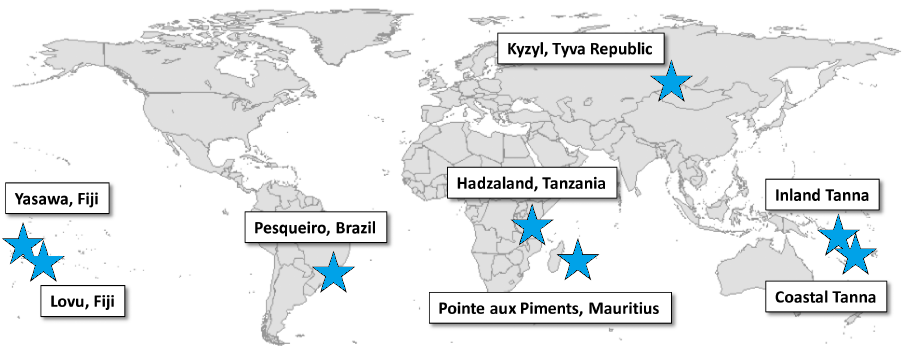
These societies span the range from hunter-gatherers through herders, farmers, to wage-labour economies. What they all have in common is that they mix belief in a moralising religion (Christianity, Buddhism, Hinduism, and a couple of local gods) with a wide variety of non-moralising spirits, gods and ghosts.
In each of these societies, they asked the locals to play a game. One that tested their honesty in dealing with anonymous strangers.
Basically, they were given thirty coins and two cups. In one version of the game, they were told that they could keep whatever money went into the first cup, and that whatever went into the second cup went to a co-religionist living in a neighbouring community.
They had to mentally choose a cup, and then roll a die that had just two colours. If the die came up red, then they had to put the coin in the cup they secretly chose. If it came up blue, then they had to put it in the opposite cup.
The second version of the game was just the same, except all the money in the first cup went to a co-religionist in their community.
Now, if you think about it, if all the participants were honest then the money should have been distributed equally between he two cups. After all, it’s just down to the roll of a die. But of course that’s not what happened.
In fact, they lied. They tended to put more money in the first cup – the proceeds of which went to themselves or people from their own community.
However, those who believed in a punishing god were more likely to be honest. In fact, as you can see in the graph below, these people nearly reached magic number of 15 coins donated to distant co-religionists (which would’ve indicated full honesty).
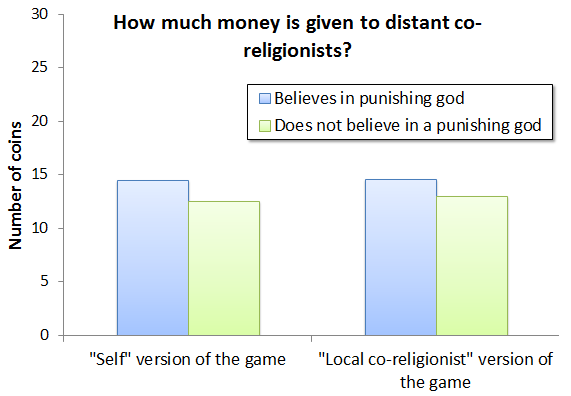
Now, the effect is not huge. But it is there, and it is statistically significant.
They ran their data through a model that controlled for a bunch of variables, like material insecurity, number of children and also beliefs about the local gods (whether they are all-knowing and/or punishing). But the findings were pretty robust.
What this suggests is that people are indeed more likely to give to co-religionists, even when they are geographically remote. That supports other research suggesting that religion encourages people to see their co-religionists as part of their own tribe (see: the hand grenade experiment, for example).
However, when they tried subliminally priming their subjects with ideas about moralising gods, it had no effect on their behaviour. So it’s not altogether clear whether their belief is a cause of their behaviour, or simply a product of it.
What’s more, other research that has been done into the timing of the emergence of moralising gods has tended to show that they come about after the emergence of complex societies (see: Wealth and Enlightenment in the Ancient World and Did Belief in Ghosts Help Kick-Start Civilisation?).
So does belief in moralising gods help to create and sustain complex societies? Well, it certainly seems that it can change behaviour towards co-religionists, making them feel like part of your tribe – even if that effect is small. But it’s also clear that the emergence of moralising gods is something that has played a kind of waltz with civilisations – being constantly adapted in response to changing social needs.
Cause or effect? Perhaps we’ll never know.
 Purzycki, B., Apicella, C., Atkinson, Q., Cohen, E., McNamara, R., Willard, A., Xygalatas, D., Norenzayan, A., & Henrich, J. (2016). Moralistic gods, supernatural punishment and the expansion of human sociality Nature DOI: 10.1038/nature16980

Browse Our Archives
Select a Category Causes of religion - evolution Causes of religion - psychological Causes of religion - social Demographics Digest Effects of religion - health Effects of religion - psychological Effects of religion - social Notifications Politics Uncategorized
Select a Month March 2016 February 2016 January 2016 December 2015 November 2015 October 2015 September 2015 August 2015 July 2015 June 2015 May 2015 April 2015 March 2015 February 2015 January 2015 December 2014 November 2014 October 2014 September 2014 August 2014 July 2014 June 2014 May 2014 April 2014 March 2014 February 2014 January 2014 December 2013 November 2013 October 2013 September 2013 August 2013 July 2013 June 2013 May 2013 April 2013 March 2013 February 2013 January 2013 December 2012 November 2012 October 2012 September 2012 August 2012 July 2012 June 2012 May 2012 April 2012 March 2012 February 2012 January 2012 December 2011 November 2011 October 2011 September 2011 August 2011 July 2011 June 2011 May 2011 April 2011 March 2011 February 2011 January 2011 December 2010 November 2010 October 2010 September 2010 August 2010 July 2010 June 2010 May 2010 April 2010 March 2010 February 2010 January 2010 December 2009 November 2009 October 2009 September 2009 August 2009 July 2009 June 2009 May 2009 April 2009 March 2009 February 2009 January 2009 December 2008 November 2008 October 2008 September 2008 August 2008 July 2008 June 2008 May 2008 April 2008 March 2008 February 2008 January 2008 December 2007 November 2007 October 2007
Follow Us!
TAKE THE
Religious Wisdom Quiz
Who was the youngest king of Judah?
Select your answer to see how you score.
Hezekiah Asa Josiah Jehoshaphat
Related posts from Epiphenom

Can you use religion to change attitudes towards...
The decline of religion in Europe did not...

How religious schools led to the decline of...

Trust is more important than religion in encouraging...
TRENDING AT PATHEOS Nonreligious

Dethroning Jesus and Enthroning Yourself
Jesus Never Asked to Be Worshipped. He Asked to Be Understood. Christianity...

Why Most Christians are Really Paulians and Jobians
I Don't Care, But It Matters Let's get this out of the...

Essential Tips to Successfully Navigate the Selling Process
Selling a house can feel overwhelming, but it doesn’t have to be....

To Make Remote Work Effective, Think About Others
The COVID-19 pandemic forced many companies to rapidly transition to remote work....

Flexibility Is Key to Solving Problems of Tomorrow
The world of work is undergoing a dramatic transformation. The COVID-19 pandemic...
view all Nonreligious blogs
Ad-Free & Subscriber Log-In Subscription Support
- About Us
- 2026 Calendar
- Videos
- Podcasts
- Library of World Religions
- Faith In Media Tracker
- Advertise With Us
- Write for Us
- Privacy Policy
- Terms of Service
- Do Not Sell My Data
- Contact Us
- Radiant Digital
- Manage Newsletter Subscriptions
- Unsubscribe From Notifications
- Sitemap
Copyright 2008-2026, Patheos. All rights reserved.
Subscription Support Ad-Free & Subscriber Log-In
Follow Patheos