
BuddhistCatholicContemplativeEvangelicalGeneral ChristianHinduJewishLatter-day SaintMuslimNew VisionsProgressive Christian
Beliefs
- Buddhist
- Catholic
- Contemplative
- Evangelical
- General Christian
- Hindu
- Jewish
- Latter-day Saint
- More Voices
- Muslim
- New Visions
- Pagan
- Progressive Christian
Topics
- Religion News
- Food and Religion
- Sports and Religion
- Religious Art
- Religious Music and Entertainment
- Religious Events
- History and Religion
- Style and Religion
- Politics and Religion
- Women in Religion
- Recreation Outdoors and Religion
- Business Finance and Religion
- Careers Workplace and Religion
- Education and Religion
- Family Parenting and Religion
- Health Fitness and Religion
- Home and Religion
- Relationships and Religion
- Technology and Religion
- Travel and Religion
Columnists
- Buddhist Columnists
- Business Finance and Religion Columnists
- Careers Workplace and Religion Columnists
- Catholic Columnists
- Contemplative Columnists
- Education and Religion Columnists
- Evangelists Columnists
- Family Parenting and Religion Columnists
- General Christian Columnists
- Health Fitness and Religion Columnists
- Hindu Columnists
- History and Religion Columnists
- Home and Religion Columnists
- Jewish Columnists
- More Voices Columnists
- Latter Day Columnists
- Muslim Columnists
- New Visions Columnists
- Nonreligious Columnists
- Pagan Columnists
- Politics and Religion Columnists
- Progressive Columnists
- Recreation Outdoors and Religion Columnists
- Relationships and Religion Columnists
- Religion News Columnists
- Religious Art Columnists
- Religious Events Columnists
- Religious Music and Entertainment Columnists
- Sports and Religion Columnists
- Style and Religion Columnists
- Technology and Religion Columnists
- Travel and Religion Columnists
- Women in Religion Columnists
Resource Library
- 2026 Calendar
- Library of World Religions
- The 100 Most Holy Places on Earth
- Patheos Answers
- Podcasts
- Videos
- Faith Leaders Database
- Anglican Episcopalian
- Bahai
- Baptist
- Buddhism
- Christianity
- Confucianism
- Eastern Orthodoxy
- Hinduism
- Holiness and Pentecostal
- ISKCON
- Islam
- Judaism
- Lutheran
- Methodist
- The Church of Jesus Christ of Latter-day Saints
- New Age
- Paganism
- Presbytarian and Reformed
- Protestantism
- Religion Behind the Scenes
- Roman Catholic
- Scientology
- Shia Islam
- Sikhism
- Sufism
- Sunni Islam
- Taoism
- Zen
- See all religions
Research Tools
 Ad-Free & Subscriber Log-In Subscription Support
Ad-Free & Subscriber Log-In Subscription Support
Follow Patheos 

- Trending:
- Forgiveness
- |
- Marriage
- |
- Consciousness
- |
- Death Penalty
- |
- Election
- |
- Halloween
 Epiphenom
- Home
- Nonreligious
- How religious schools led to the decline of Arabic science
How religious schools led to the decline of Arabic science
Last updated on: January 14, 2016 at 11:14 pm by Epiphenom
How religious schools led to the decline of Arabic science 2016-01-14T23:14:54+01:00 Epiphenom
Patheos Explore the world's faith through different perspectives on religion and spirituality! Patheos has the views of the prevalent religions and spiritualities of the world.

Credit: Two Circles @ Flickr
The world’s first scientific renaissance took place not in Italy, but in the Arab world.
The period between the 9th and 11th centuries AD, when Islam took hold of a band of territory strategy from Spain in the West through to what is now Pakistan, saw an extraordinary intellectual flowering. Scientists in the Arab world during this period made important advances in fields as varied as astronomy, mathematics, medicine and optics – advances that fed into and stimulated the later European Renaissance.
Which makes it all the stranger that modern Islamic nations have such a lamentable record in science. Where did it all go wrong?
There are several competing theories about what happened, and Eric Chaney, an Economist at Harvard University, turned to an unusual source to try to find out which is correct (you can read his paper on the topic here).
He trawled through the Harvard Library’s catalogue of over 13 million books to identify works by Islamic authors on scientific and religious topics. What he found was that, during the ‘Golden Age’, 12% of books written in the Islamic world were on scientific topics and 30% were on religious topics.
Two hundred years later just 7% of books were scientific in nature, and that drops to 2% by 1700 (shown in the graphic below). Meanwhile, there was an upsurge in religious books.
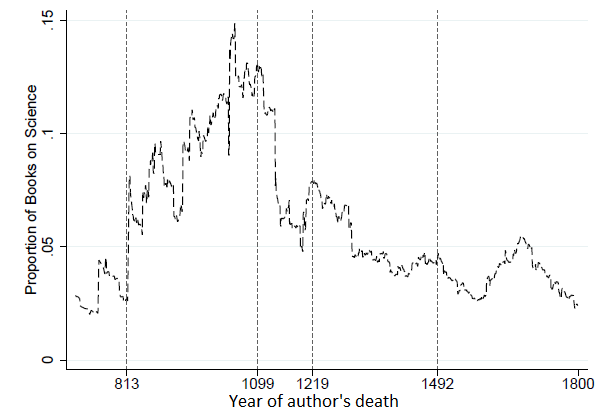
One traditional explanation for this decline has been that outside aggressors – the Crusaders, or the Mongols – destroyed the centres of learning. But Chaney found that both the timing and the geographical distribution of the decline makes this explanation unlikely.
Chaney in fact found that scientific output increased in the Levant over the time period of the crusades. Scientific output did decline in Iran over this time period, but the decline began well before the Mongol invasions.
However, the decline in scientific output did correlate strongly with a dramatic rise in output from Islamic religious schools, or Madrasas.
Chaney believes that the decline in Arabic science a direct result of the ‘Sunni Revival’ – a kind of upsurge in religious sentiment and authority.
From the very beginning, Islam has been divided into two traditions. One of these is rationalist, stressing the importance of the use of reason in defining Islamic law. The other is traditionalist, stressing the importance of using ‘revealed wisdom’ as laid down in the Koran and the sayings of Muhammed, or Hadiths.
In the early years of Islam, during the Abbasid Caliphate there was a kind of inquisition. But this inquisition required all religious leaders to adopt rationalist approaches and reject traditionalist doctrines.
The Sunni revival was a traditionalist backlash.
Why did the traditionalist movement gain power? Chaney provides evidence that it was due to the increasing conversions to Islam.
In the early days of Islam, although the ruling classes were Muslim large numbers of the populace were not. The rulers insisted on rationalist version of Islam to appeal to their subjects and also to gain converts. Chaney shows that the Sunni revival occurred at different times in different regions, and coincided with the point at which Muslims became the majority.
The decline in Arab science was, according to this view, caused by the political empowerment of Muslim religious leaders. As a result, education and learning was focussed on the Madrasas and not in independent Universities as in the West – a key factor in the upsurge of learning in the West).
And once religious traditionalists took control of the education system, they shut down most lines of scientific inquiry. Not only were there fewer scientific works after the Sunni Revival took hold, but those that were produced in the were cited less often – indicating that they had less impact on other scholars.
Chaney quotes al-Ghazali, who lived in the 11th century and is one of Islam’s most renowned religious scholars
…he who studies mathematics is amazed by its precision and proofs. He then takes a more positive view of philosophy and reckons that all of the rational sciences are as clear and trustworthy as mathematics […] and he says: if religion were true, then philosophers would have proved its veracity with their precise methods […] we have seen many deviate from [Islam] in this manner.
So this is a simple case of power and control. Once the Sunnis became dominant, they clamped down on any potential challenges to their authority. And that included rational inquiry – dealing a fatal blow to the region and causing lasting damage that persists to this day.
Chaney E. Religion and the Rise and Fall of Islamic Science. Working Paper.


Browse Our Archives
Select a Category Causes of religion - evolution Causes of religion - psychological Causes of religion - social Demographics Digest Effects of religion - health Effects of religion - psychological Effects of religion - social Notifications Politics Uncategorized
Select a Month March 2016 February 2016 January 2016 December 2015 November 2015 October 2015 September 2015 August 2015 July 2015 June 2015 May 2015 April 2015 March 2015 February 2015 January 2015 December 2014 November 2014 October 2014 September 2014 August 2014 July 2014 June 2014 May 2014 April 2014 March 2014 February 2014 January 2014 December 2013 November 2013 October 2013 September 2013 August 2013 July 2013 June 2013 May 2013 April 2013 March 2013 February 2013 January 2013 December 2012 November 2012 October 2012 September 2012 August 2012 July 2012 June 2012 May 2012 April 2012 March 2012 February 2012 January 2012 December 2011 November 2011 October 2011 September 2011 August 2011 July 2011 June 2011 May 2011 April 2011 March 2011 February 2011 January 2011 December 2010 November 2010 October 2010 September 2010 August 2010 July 2010 June 2010 May 2010 April 2010 March 2010 February 2010 January 2010 December 2009 November 2009 October 2009 September 2009 August 2009 July 2009 June 2009 May 2009 April 2009 March 2009 February 2009 January 2009 December 2008 November 2008 October 2008 September 2008 August 2008 July 2008 June 2008 May 2008 April 2008 March 2008 February 2008 January 2008 December 2007 November 2007 October 2007
Follow Us!
TAKE THE
Religious Wisdom Quiz
Who was the youngest king of Judah?
Select your answer to see how you score.
Hezekiah Asa Josiah Jehoshaphat
Related posts from Epiphenom

Can you use religion to change attitudes towards...

Do you wanna be in my clan? Moralising...
The decline of religion in Europe did not...

Trust is more important than religion in encouraging...
TRENDING AT PATHEOS Nonreligious

Dethroning Jesus and Enthroning Yourself
Jesus Never Asked to Be Worshipped. He Asked to Be Understood. Christianity...

Why Most Christians are Really Paulians and Jobians
I Don't Care, But It Matters Let's get this out of the...

Essential Tips to Successfully Navigate the Selling Process
Selling a house can feel overwhelming, but it doesn’t have to be....

To Make Remote Work Effective, Think About Others
The COVID-19 pandemic forced many companies to rapidly transition to remote work....

Flexibility Is Key to Solving Problems of Tomorrow
The world of work is undergoing a dramatic transformation. The COVID-19 pandemic...
view all Nonreligious blogs
Ad-Free & Subscriber Log-In Subscription Support
- About Us
- 2026 Calendar
- Videos
- Podcasts
- Library of World Religions
- Faith In Media Tracker
- Advertise With Us
- Write for Us
- Privacy Policy
- Terms of Service
- Do Not Sell My Data
- Contact Us
- Radiant Digital
- Manage Newsletter Subscriptions
- Unsubscribe From Notifications
- Sitemap
Copyright 2008-2026, Patheos. All rights reserved.
Subscription Support Ad-Free & Subscriber Log-In
Follow Patheos