
BuddhistCatholicContemplativeEvangelicalGeneral ChristianHinduJewishLatter-day SaintMuslimNew VisionsProgressive Christian
Beliefs
- Buddhist
- Catholic
- Contemplative
- Evangelical
- General Christian
- Hindu
- Jewish
- Latter-day Saint
- More Voices
- Muslim
- New Visions
- Pagan
- Progressive Christian
Topics
- Religion News
- Food and Religion
- Sports and Religion
- Religious Art
- Religious Music and Entertainment
- Religious Events
- History and Religion
- Style and Religion
- Politics and Religion
- Women in Religion
- Recreation Outdoors and Religion
- Business Finance and Religion
- Careers Workplace and Religion
- Education and Religion
- Family Parenting and Religion
- Health Fitness and Religion
- Home and Religion
- Relationships and Religion
- Technology and Religion
- Travel and Religion
Columnists
- Buddhist Columnists
- Business Finance and Religion Columnists
- Careers Workplace and Religion Columnists
- Catholic Columnists
- Contemplative Columnists
- Education and Religion Columnists
- Evangelists Columnists
- Family Parenting and Religion Columnists
- General Christian Columnists
- Health Fitness and Religion Columnists
- Hindu Columnists
- History and Religion Columnists
- Home and Religion Columnists
- Jewish Columnists
- More Voices Columnists
- Latter Day Columnists
- Muslim Columnists
- New Visions Columnists
- Nonreligious Columnists
- Pagan Columnists
- Politics and Religion Columnists
- Progressive Columnists
- Recreation Outdoors and Religion Columnists
- Relationships and Religion Columnists
- Religion News Columnists
- Religious Art Columnists
- Religious Events Columnists
- Religious Music and Entertainment Columnists
- Sports and Religion Columnists
- Style and Religion Columnists
- Technology and Religion Columnists
- Travel and Religion Columnists
- Women in Religion Columnists
Resource Library
- 2026 Calendar
- Library of World Religions
- The 100 Most Holy Places on Earth
- Patheos Answers
- Podcasts
- Videos
- Faith Leaders Database
- Anglican Episcopalian
- Bahai
- Baptist
- Buddhism
- Christianity
- Confucianism
- Eastern Orthodoxy
- Hinduism
- Holiness and Pentecostal
- ISKCON
- Islam
- Judaism
- Lutheran
- Methodist
- The Church of Jesus Christ of Latter-day Saints
- New Age
- Paganism
- Presbytarian and Reformed
- Protestantism
- Religion Behind the Scenes
- Roman Catholic
- Scientology
- Shia Islam
- Sikhism
- Sufism
- Sunni Islam
- Taoism
- Zen
- See all religions
Research Tools
 Ad-Free & Subscriber Log-In Subscription Support
Ad-Free & Subscriber Log-In Subscription Support
Follow Patheos 

- Trending:
- Forgiveness
- |
- Marriage
- |
- Consciousness
- |
- Death Penalty
- |
- Election
- |
- Halloween
 Epiphenom
- Home
- Nonreligious
- Trust is more important than religion in encouraging charitable acts
Trust is more important than religion in encouraging charitable acts
Last updated on: December 11, 2015 at 1:50 pm by Epiphenom
Trust is more important than religion in encouraging charitable acts 2015-12-11T13:50:19+01:00 Epiphenom
Patheos Explore the world's faith through different perspectives on religion and spirituality! Patheos has the views of the prevalent religions and spiritualities of the world.
 It’s well established that religious people tend to volunteer more and give more to charity than the non-religious. There are many factors that could contribute to this. Many charities that explicitly to support co-religionists or to promote religion, and what’s more religious people also tend to be older and married, both of which predict
But what’s less well understood is how important religion is compared with other factors. In particular Jennifer Glanville (University of Iowa) and colleagues were interested to know how important trust levels and social networks were in encouraging charitable donations and volunteering.
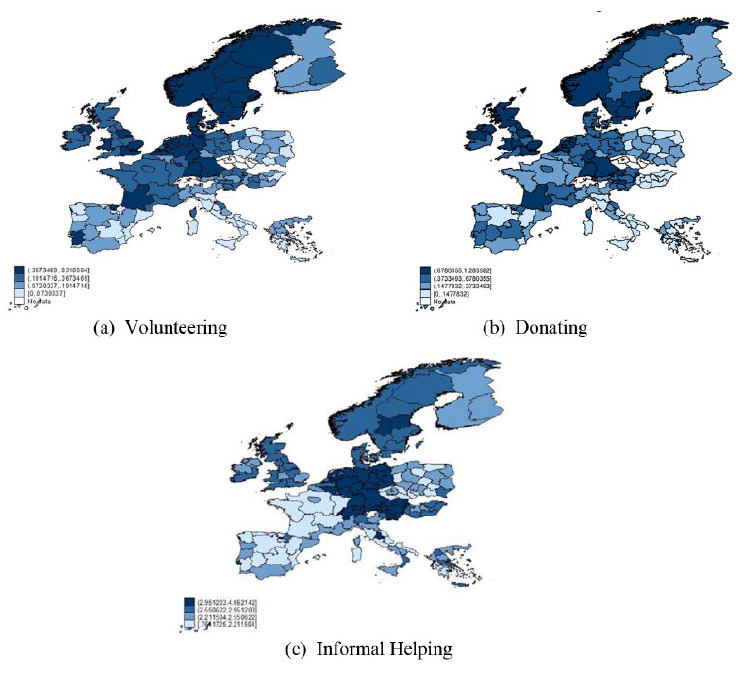
They used data from the 2002 European Social Survey, which surveyed over 30,000 people across most countries of Europe. Among the many questions in this survey were ones about formal volunteering (for any of a range of sports, religious, political, or other voluntary groups), charitable donations, and informal volunteering (actively providing help for other people outside family, work or formal volunteering).
As the graphic shows the levels of these different amounts of voluntary and charitable activities varies quite widely across Europe. The question is, why?
What they found was that religious people actually tend to report being less likely to engage in informal voluntary help. Protestants and ‘Other Christians’ – but not Catholics or Orthodox – were, however, more likely to say that they did charity work or donated to charities.
Compared with religious affiliation, church going was more consistently linked to all kinds of charitable behaviour. That’s to be expected, since people who are actively engaged in church are also likely to be the kinds of people who engage in other social activities.
However, rather more important than belonging to a religion was how trusting they were, and the strength of their social ties (how often they met socially with friends, relatives, or work colleagues). These social factors are part of a broader concept termed ‘social capital’.
Trust was about one-third as important as educational levels in predicting both volunteering and charitable giving, and about half as important in predicting informal helping.
Unfortunately, the authors don’t really make clear the comparative importance of religion versus such social capital in driving charitable behaviour, although it is clear that religious affiliation is not important. Religious service attendance was about as important as more general social ties in predicting these behaviours.
They also found that average levels of trust in a region was critically important. Where trust was low in general, social ties didn’t improve voluntary and charitable acts. Where trust was high, social ties become much more important. They make this rather interesting point:
…social capital is an important contextual influence on generosity because community integration and trust increase information about opportunities for generous activities and the motivation for participating in these activities
In other words, the critical factor in driving generosity is bonds of trust and integration. And that, ultimately, is why central and northern European countries have relatively high levels of volunteering and charity.

Glanville, J., Paxton, P., & Wang, Y. (2015). Social Capital and Generosity: A Multilevel Analysis Nonprofit and Voluntary Sector Quarterly DOI: 10.1177/0899764015591366
Previous Post

December 3, 2015
Can atheism increase stock market volatility?
Browse Our Archives
Select a Category Causes of religion - evolution Causes of religion - psychological Causes of religion - social Demographics Digest Effects of religion - health Effects of religion - psychological Effects of religion - social Notifications Politics Uncategorized
Select a Month March 2016 February 2016 January 2016 December 2015 November 2015 October 2015 September 2015 August 2015 July 2015 June 2015 May 2015 April 2015 March 2015 February 2015 January 2015 December 2014 November 2014 October 2014 September 2014 August 2014 July 2014 June 2014 May 2014 April 2014 March 2014 February 2014 January 2014 December 2013 November 2013 October 2013 September 2013 August 2013 July 2013 June 2013 May 2013 April 2013 March 2013 February 2013 January 2013 December 2012 November 2012 October 2012 September 2012 August 2012 July 2012 June 2012 May 2012 April 2012 March 2012 February 2012 January 2012 December 2011 November 2011 October 2011 September 2011 August 2011 July 2011 June 2011 May 2011 April 2011 March 2011 February 2011 January 2011 December 2010 November 2010 October 2010 September 2010 August 2010 July 2010 June 2010 May 2010 April 2010 March 2010 February 2010 January 2010 December 2009 November 2009 October 2009 September 2009 August 2009 July 2009 June 2009 May 2009 April 2009 March 2009 February 2009 January 2009 December 2008 November 2008 October 2008 September 2008 August 2008 July 2008 June 2008 May 2008 April 2008 March 2008 February 2008 January 2008 December 2007 November 2007 October 2007
Follow Us!
TAKE THE
Religious Wisdom Quiz
What is taught about promises or oaths?
Select your answer to see how you score.
Let your yes be yes Swear on everything Change your answer Never promise
Related posts from Epiphenom

Can you use religion to change attitudes towards...
Do you wanna be in my clan? Moralising...
The decline of religion in Europe did not...

How religious schools led to the decline of...
TRENDING AT PATHEOS Nonreligious

Dethroning Jesus and Enthroning Yourself
Jesus Never Asked to Be Worshipped. He Asked to Be Understood. Christianity...

Why Most Christians are Really Paulians and Jobians
I Don't Care, But It Matters Let's get this out of the...

Essential Tips to Successfully Navigate the Selling Process
Selling a house can feel overwhelming, but it doesn’t have to be....

To Make Remote Work Effective, Think About Others
The COVID-19 pandemic forced many companies to rapidly transition to remote work....

Flexibility Is Key to Solving Problems of Tomorrow
The world of work is undergoing a dramatic transformation. The COVID-19 pandemic...
view all Nonreligious blogs
Ad-Free & Subscriber Log-In Subscription Support
- About Us
- 2026 Calendar
- Videos
- Podcasts
- Library of World Religions
- Faith In Media Tracker
- Advertise With Us
- Write for Us
- Privacy Policy
- Terms of Service
- Do Not Sell My Data
- Contact Us
- Radiant Digital
- Manage Newsletter Subscriptions
- Unsubscribe From Notifications
- Sitemap
Copyright 2008-2026, Patheos. All rights reserved.
Subscription Support Ad-Free & Subscriber Log-In
Follow Patheos