
BuddhistCatholicContemplativeEvangelicalGeneral ChristianHinduJewishLatter-day SaintMuslimNew VisionsProgressive Christian
Beliefs
- Buddhist
- Catholic
- Contemplative
- Evangelical
- General Christian
- Hindu
- Jewish
- Latter-day Saint
- More Voices
- Muslim
- New Visions
- Pagan
- Progressive Christian
Topics
- Religion News
- Food and Religion
- Sports and Religion
- Religious Art
- Religious Music and Entertainment
- Religious Events
- History and Religion
- Style and Religion
- Politics and Religion
- Women in Religion
- Recreation Outdoors and Religion
- Business Finance and Religion
- Careers Workplace and Religion
- Education and Religion
- Family Parenting and Religion
- Health Fitness and Religion
- Home and Religion
- Relationships and Religion
- Technology and Religion
- Travel and Religion
Columnists
- Buddhist Columnists
- Business Finance and Religion Columnists
- Careers Workplace and Religion Columnists
- Catholic Columnists
- Contemplative Columnists
- Education and Religion Columnists
- Evangelists Columnists
- Family Parenting and Religion Columnists
- General Christian Columnists
- Health Fitness and Religion Columnists
- Hindu Columnists
- History and Religion Columnists
- Home and Religion Columnists
- Jewish Columnists
- More Voices Columnists
- Latter Day Columnists
- Muslim Columnists
- New Visions Columnists
- Nonreligious Columnists
- Pagan Columnists
- Politics and Religion Columnists
- Progressive Columnists
- Recreation Outdoors and Religion Columnists
- Relationships and Religion Columnists
- Religion News Columnists
- Religious Art Columnists
- Religious Events Columnists
- Religious Music and Entertainment Columnists
- Sports and Religion Columnists
- Style and Religion Columnists
- Technology and Religion Columnists
- Travel and Religion Columnists
- Women in Religion Columnists
Resource Library
- 2026 Calendar
- Library of World Religions
- The 100 Most Holy Places on Earth
- Patheos Answers
- Podcasts
- Videos
- Faith Leaders Database
- Anglican Episcopalian
- Bahai
- Baptist
- Buddhism
- Christianity
- Confucianism
- Eastern Orthodoxy
- Hinduism
- Holiness and Pentecostal
- ISKCON
- Islam
- Judaism
- Lutheran
- Methodist
- The Church of Jesus Christ of Latter-day Saints
- New Age
- Paganism
- Presbytarian and Reformed
- Protestantism
- Religion Behind the Scenes
- Roman Catholic
- Scientology
- Shia Islam
- Sikhism
- Sufism
- Sunni Islam
- Taoism
- Zen
- See all religions
Research Tools
 Ad-Free & Subscriber Log-In Subscription Support
Ad-Free & Subscriber Log-In Subscription Support
Follow Patheos 

- Trending:
- Forgiveness
- |
- Marriage
- |
- Consciousness
- |
- Death Penalty
- |
- Election
- |
- Halloween
 Epiphenom
- Home
- Nonreligious
- Top 10 studies of the psychology of religion from 2015
Top 10 studies of the psychology of religion from 2015
Last updated on: December 29, 2015 at 12:02 am by Epiphenom
Top 10 studies of the psychology of religion from 2015 2015-12-29T00:02:48+01:00 Epiphenom
Patheos Explore the world's faith through different perspectives on religion and spirituality! Patheos has the views of the prevalent religions and spiritualities of the world.
New Year’s Day is closing in fast – so it must be annual round-up time! Here’s the research news on psychology of belief and non-belief that I found most interesting over the past year – the top 10 – and in reverse order, naturally.
10. Conspiracy theories flourish when people feel like things are slipping out of control
Mining data from a 15-year old survey revealed that people who felt least able to keep on top of the infamous ‘Millenium Bug’ were also the most likely to believe a whole host of different conspiracy theories. This adds to the growing pile of evidence that people who don’t feel in control of their surroundings are more likely to ‘invent’ comforting rationalizations to try to make sense of the world.
9. State and religion: a tale of waning influence and modern resurgence
A historical analysis of the past 1000 years of civilisation showed a massive decoupling of state and religion that began in the West in the 17th century and spread to the rest of the world in the 19th and 20th centuries. It also showed that the trend has reversed in recent decades, mainly in majority Muslim countries.
8. Most supernatural beliefs are about avoiding harm, not bringing benefit
A cross-cultural survey found that superstitious beliefs are likely to be about ways to avoid harm, rather than to bring good fortune. It also revealed that fake news stories about hazards were more believable than ones about good news. All this provides more support for the idea that people develop supernatural beliefs as a way to try to make themselves feel safer.
7. What do people think God is actually like?
Contrary to previous research, this new study found that adults don’t tend think of gods in a ‘minimally counter-intuitive’ way. Actually what seems to be happening is that people happily hold a range of irreconcilable beliefs about their gods, and that they don’t notice the incongruity simply because they don’t think about it too hard.
6. A world by design – even atheists intuitively think the natural world has a designer
When under time pressure, both atheists and believers make fundamental logical errors about the the world around us. This is the best study to date showing that all of us have a tendency to see the world as being designed, but that atheists over-ride those natural instincts.
5. Did belief in ghosts help kick-start civilization?
A detailed analysis of the wide variety of cultures spread across the Pacific Ocean found that, contrary to previous wisdom, belief in so-called ‘moralising high gods’ does not seem to be a necessary first step for the development of big, complex societies. It does seem, however, that popular belief in ancestral spirits is a necessary prelude to allow a narrow political elite to take power.
4. Religious authority increases the number of donations but decreases the value
A clever study on itinerant labourers in Afghanistan found that, when appeals for charitable donations were made by someone dressed as an Imam, the number of donations rose but their average value actually decreased. It seems that reminding people that god is watching them encourages them to fulfil the letter of their religious obligations, but undermines the ethical and moral motivation.
3. The statistics are clear: a cultural shift away from religion is under way in the USA
A new analysis of a massive survey of over 11 million school-age Americans found that they are increasingly saying that religion is simply unimportant in their lives. What’s more, as they leave the parental home they are dropping religion in large numbers – a strong indicator that there is a major change afoot in the USA.
2. In the face of discrimination, non-believers commit more strongly to their atheism
A survey of nearly 1,000 self-identified atheists in the USA revealed that atheists who feel that they are the victims of discrimination were also the most likely to identify strongly as atheists. This suggests that atheist groups can form a valuable support network.
1. Countries free of religion are the most socially advanced, data show
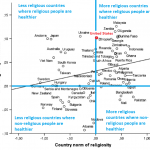
My analysis of the latest data from the Social Progress Index found that countries that scored most highly also tended to be the least religious. That’s not too surprising, given that people suffering poverty or repression tend to latch onto religion. But it’s always interesting to see it supported by cold, hard facts! And it was by a long stretch the most widely shared Epiphenom post from 2015.
The long read
If that whet your appetite, be sure to check out two editorial posts that covered a couple of topics in more detail, bringing together and summarizing in one place all the relevant research that’s been covered in Epiphenom over the years: The science is in, and God is not the answer (a rebuttal of an article in a popular Canadian magazine claiming that science supports the idea that religion makes for better people), and America is finally losing its religion – and that’s a good thing! (my contribution to a Patheos series on the implications of the monumental Pew Religion Survey).
And of course there are also all the annual reviews from previous years: 2014, 2013, 2012, 2011, 2010, and 2009.
Enjoy – and have a very Happy New Year!

Browse Our Archives
Select a Category Causes of religion - evolution Causes of religion - psychological Causes of religion - social Demographics Digest Effects of religion - health Effects of religion - psychological Effects of religion - social Notifications Politics Uncategorized
Select a Month March 2016 February 2016 January 2016 December 2015 November 2015 October 2015 September 2015 August 2015 July 2015 June 2015 May 2015 April 2015 March 2015 February 2015 January 2015 December 2014 November 2014 October 2014 September 2014 August 2014 July 2014 June 2014 May 2014 April 2014 March 2014 February 2014 January 2014 December 2013 November 2013 October 2013 September 2013 August 2013 July 2013 June 2013 May 2013 April 2013 March 2013 February 2013 January 2013 December 2012 November 2012 October 2012 September 2012 August 2012 July 2012 June 2012 May 2012 April 2012 March 2012 February 2012 January 2012 December 2011 November 2011 October 2011 September 2011 August 2011 July 2011 June 2011 May 2011 April 2011 March 2011 February 2011 January 2011 December 2010 November 2010 October 2010 September 2010 August 2010 July 2010 June 2010 May 2010 April 2010 March 2010 February 2010 January 2010 December 2009 November 2009 October 2009 September 2009 August 2009 July 2009 June 2009 May 2009 April 2009 March 2009 February 2009 January 2009 December 2008 November 2008 October 2008 September 2008 August 2008 July 2008 June 2008 May 2008 April 2008 March 2008 February 2008 January 2008 December 2007 November 2007 October 2007
Follow Us!
TAKE THE
Religious Wisdom Quiz
What was the primary construction in Biblical times?
Select your answer to see how you score.
Stone hammer Iron hammer Bronze chisel Wooden mallet
Related posts from Epiphenom

America is finally losing its religion - and...

The science is in, and God is not...

The Best Science of Religion Stories of 2014

TRENDING AT PATHEOS Nonreligious

Dethroning Jesus and Enthroning Yourself
Jesus Never Asked to Be Worshipped. He Asked to Be Understood. Christianity...

Why Most Christians are Really Paulians and Jobians
I Don't Care, But It Matters Let's get this out of the...

Essential Tips to Successfully Navigate the Selling Process
Selling a house can feel overwhelming, but it doesn’t have to be....

To Make Remote Work Effective, Think About Others
The COVID-19 pandemic forced many companies to rapidly transition to remote work....

Flexibility Is Key to Solving Problems of Tomorrow
The world of work is undergoing a dramatic transformation. The COVID-19 pandemic...
view all Nonreligious blogs
Ad-Free & Subscriber Log-In Subscription Support
- About Us
- 2026 Calendar
- Videos
- Podcasts
- Library of World Religions
- Faith In Media Tracker
- Advertise With Us
- Write for Us
- Privacy Policy
- Terms of Service
- Do Not Sell My Data
- Contact Us
- Radiant Digital
- Manage Newsletter Subscriptions
- Unsubscribe From Notifications
- Sitemap
Copyright 2008-2026, Patheos. All rights reserved.
Subscription Support Ad-Free & Subscriber Log-In
Follow Patheos