
BuddhistCatholicContemplativeEvangelicalGeneral ChristianHinduJewishLatter-day SaintMuslimNew VisionsProgressive Christian
Beliefs
- Buddhist
- Catholic
- Contemplative
- Evangelical
- General Christian
- Hindu
- Jewish
- Latter-day Saint
- More Voices
- Muslim
- New Visions
- Pagan
- Progressive Christian
Topics
- Religion News
- Food and Religion
- Sports and Religion
- Religious Art
- Religious Music and Entertainment
- Religious Events
- History and Religion
- Style and Religion
- Politics and Religion
- Women in Religion
- Recreation Outdoors and Religion
- Business Finance and Religion
- Careers Workplace and Religion
- Education and Religion
- Family Parenting and Religion
- Health Fitness and Religion
- Home and Religion
- Relationships and Religion
- Technology and Religion
- Travel and Religion
Columnists
- Buddhist Columnists
- Business Finance and Religion Columnists
- Careers Workplace and Religion Columnists
- Catholic Columnists
- Contemplative Columnists
- Education and Religion Columnists
- Evangelists Columnists
- Family Parenting and Religion Columnists
- General Christian Columnists
- Health Fitness and Religion Columnists
- Hindu Columnists
- History and Religion Columnists
- Home and Religion Columnists
- Jewish Columnists
- More Voices Columnists
- Latter Day Columnists
- Muslim Columnists
- New Visions Columnists
- Nonreligious Columnists
- Pagan Columnists
- Politics and Religion Columnists
- Progressive Columnists
- Recreation Outdoors and Religion Columnists
- Relationships and Religion Columnists
- Religion News Columnists
- Religious Art Columnists
- Religious Events Columnists
- Religious Music and Entertainment Columnists
- Sports and Religion Columnists
- Style and Religion Columnists
- Technology and Religion Columnists
- Travel and Religion Columnists
- Women in Religion Columnists
Resource Library
- 2026 Calendar
- Library of World Religions
- The 100 Most Holy Places on Earth
- Patheos Answers
- Podcasts
- Videos
- Faith Leaders Database
- Anglican Episcopalian
- Bahai
- Baptist
- Buddhism
- Christianity
- Confucianism
- Eastern Orthodoxy
- Hinduism
- Holiness and Pentecostal
- ISKCON
- Islam
- Judaism
- Lutheran
- Methodist
- The Church of Jesus Christ of Latter-day Saints
- New Age
- Paganism
- Presbytarian and Reformed
- Protestantism
- Religion Behind the Scenes
- Roman Catholic
- Scientology
- Shia Islam
- Sikhism
- Sufism
- Sunni Islam
- Taoism
- Zen
- See all religions
Research Tools
 Ad-Free & Subscriber Log-In Subscription Support
Ad-Free & Subscriber Log-In Subscription Support
Follow Patheos 

- Trending:
- Forgiveness
- |
- Marriage
- |
- Consciousness
- |
- Death Penalty
- |
- Election
- |
- Halloween
 Epiphenom
- Home
- Nonreligious
- Your good deeds are pleasing God? That might impress kids but it doesn’t impress adults!
Your good deeds are pleasing God? That might impress kids but it doesn’t impress adults!
Last updated on: September 30, 2015 at 9:32 pm by Epiphenom
Your good deeds are pleasing God? That might impress kids but it doesn’t impress adults! 2015-09-30T21:32:55+01:00 Epiphenom
Patheos Explore the world's faith through different perspectives on religion and spirituality! Patheos has the views of the prevalent religions and spiritualities of the world.
The most magnificent charitable gesture can fall flat if it turns out that you just did it to get a promotion, or get some other kind of pay off. People don’t like it if they think they detect a hidden motive behind apparently charitable behaviour.
Last year, research by University of Kentucky psychologist Will Gervais showed that something similar seems to happen when people do charitable deeds motivated by their religious beliefs. Observers will rate them less favourably than if the same deeds are done for secular reasons.
The question is, is this something that linked to our beliefs about religious people, or about religious motives? And is it something that’s innate, or learned?
Larisa Heiphetz at Boston College in the USA, and colleagues ran a series of studies to learn more. And the results are really interesting.
They interviewed 269 kids between the ages of 5 and 10 and showed them PowerPoint displays about characters who did some simple altruistic acts, such as helping his or her friends to make an art project for school. Some characters, they were told, were motivated by religion (they did it “to make God happy”). Others had secular motives (to make his or her parents happy).
They were then asked about which characters’ behaviour was better.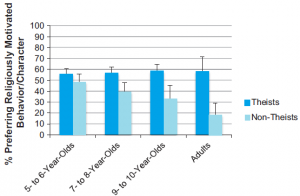 The answers they got depended on whether or not the kids had religious parents.
At all ages, kids of religious parents preferred the religiously-motivated characters. What’s more, when they tested religious adults they found a similar bias.
They got a different result with the children of non-religious parents. At young ages they preferred religiously motivated characters, just like the kids of religious parents. But as they got older that preference decreased – and non-religious adults were decidedly hostile to religious motives.
So it seems that non-religious people are learning as they develop to be sceptical of religious motives. The investigators did another couple of studies to find out why.
First off, it’s not to do with the fact that there are more religious people. They thought that young kids might prefer religious motives just because it seems more normal, more typical. But when they subtly tweaked their perception about the prevalence of religious people, it had no effect.
So then they looked at prejudice and thinking style.
They used something called the Implicit Association Test to reveal that, although both religious and non-religious adults are subconsciously prejudiced against non-believers, the effect was much stronger among the religious.
Then they measured teleology – the tendency to wrongly assign meaning and purpose to things that just happen to be associated (e.g “The sun shines because it helps the plants to grow”). They found that “The more likely participants were to intuitively perceive purpose-driven design in the world around them, the stronger were their pro-theist preferences.”
What this suggests is that there is an instinctive preference for religious motives, which non-believers consciously reject.
Here’s what they say about why teleological beliefs and preference for religious motives correlate:
One possibility is that the more individuals perceive aspects of the world as created for a purpose, the more drawn they may be to individuals whose motivations are in line with the belief that an intentional agent (i.e., God) could be responsible for such creation.
I suspect a simpler explanation. We know that instinctive thinkers are more likely to believe in a personal god, that Hare Krishna worshippers are also instinctive thinkers, that paranormal believers are confused about how the world works, and that deep thinkers are more likely to lose their faith.
All of which suggests that people who are able to overcome their instinctive beliefs and adopt a more considered world view are more likely to lose their faith. It would not be surprising, therefore, if they were also more able to overcome an instinctive preference for religious motivations.
 Gervais, W. (2014). Good for God? Religious motivation reduces perceived responsibility for and morality of good deeds. Journal of Experimental Psychology: General, 143 (4), 1616-1626 DOI: 10.1037/a0036678
Heiphetz, L., Spelke, E., & Young, L. (2015). In the name of God: How children and adults judge agents who act for religious versus secular reasons Cognition, 144, 134-149 DOI: 10.1016/j.cognition.2015.07.017
Causes of religion - psychological

Browse Our Archives
Select a Category Causes of religion - evolution Causes of religion - psychological Causes of religion - social Demographics Digest Effects of religion - health Effects of religion - psychological Effects of religion - social Notifications Politics Uncategorized
Select a Month March 2016 February 2016 January 2016 December 2015 November 2015 October 2015 September 2015 August 2015 July 2015 June 2015 May 2015 April 2015 March 2015 February 2015 January 2015 December 2014 November 2014 October 2014 September 2014 August 2014 July 2014 June 2014 May 2014 April 2014 March 2014 February 2014 January 2014 December 2013 November 2013 October 2013 September 2013 August 2013 July 2013 June 2013 May 2013 April 2013 March 2013 February 2013 January 2013 December 2012 November 2012 October 2012 September 2012 August 2012 July 2012 June 2012 May 2012 April 2012 March 2012 February 2012 January 2012 December 2011 November 2011 October 2011 September 2011 August 2011 July 2011 June 2011 May 2011 April 2011 March 2011 February 2011 January 2011 December 2010 November 2010 October 2010 September 2010 August 2010 July 2010 June 2010 May 2010 April 2010 March 2010 February 2010 January 2010 December 2009 November 2009 October 2009 September 2009 August 2009 July 2009 June 2009 May 2009 April 2009 March 2009 February 2009 January 2009 December 2008 November 2008 October 2008 September 2008 August 2008 July 2008 June 2008 May 2008 April 2008 March 2008 February 2008 January 2008 December 2007 November 2007 October 2007
Follow Us!
TAKE THE
Religious Wisdom Quiz
True or False: The book of Lamentations contains seven chapters.
Select your answer to see how you score.
TRUE FALSE
Related posts from Epiphenom

Dogmatic atheism and fundamentalist Christianity: creating certainty in...
Religion linked to reduced levels of stress hormones...

A sense of mystery results from the brain...
Reminding people of mortality makes them more religious?...
TRENDING AT PATHEOS Nonreligious

Dethroning Jesus and Enthroning Yourself
Jesus Never Asked to Be Worshipped. He Asked to Be Understood. Christianity...

Why Most Christians are Really Paulians and Jobians
I Don't Care, But It Matters Let's get this out of the...

Essential Tips to Successfully Navigate the Selling Process
Selling a house can feel overwhelming, but it doesn’t have to be....

To Make Remote Work Effective, Think About Others
The COVID-19 pandemic forced many companies to rapidly transition to remote work....

Flexibility Is Key to Solving Problems of Tomorrow
The world of work is undergoing a dramatic transformation. The COVID-19 pandemic...
view all Nonreligious blogs
Ad-Free & Subscriber Log-In Subscription Support
- About Us
- 2026 Calendar
- Videos
- Podcasts
- Library of World Religions
- Faith In Media Tracker
- Advertise With Us
- Write for Us
- Privacy Policy
- Terms of Service
- Do Not Sell My Data
- Contact Us
- Radiant Digital
- Manage Newsletter Subscriptions
- Unsubscribe From Notifications
- Sitemap
Copyright 2008-2026, Patheos. All rights reserved.
Subscription Support Ad-Free & Subscriber Log-In
Follow Patheos