
BuddhistCatholicContemplativeEvangelicalGeneral ChristianHinduJewishLatter-day SaintMuslimNew VisionsProgressive Christian
Beliefs
- Buddhist
- Catholic
- Contemplative
- Evangelical
- General Christian
- Hindu
- Jewish
- Latter-day Saint
- More Voices
- Muslim
- New Visions
- Pagan
- Progressive Christian
Topics
- Religion News
- Food and Religion
- Sports and Religion
- Religious Art
- Religious Music and Entertainment
- Religious Events
- History and Religion
- Style and Religion
- Politics and Religion
- Women in Religion
- Recreation Outdoors and Religion
- Business Finance and Religion
- Careers Workplace and Religion
- Education and Religion
- Family Parenting and Religion
- Health Fitness and Religion
- Home and Religion
- Relationships and Religion
- Technology and Religion
- Travel and Religion
Columnists
- Buddhist Columnists
- Business Finance and Religion Columnists
- Careers Workplace and Religion Columnists
- Catholic Columnists
- Contemplative Columnists
- Education and Religion Columnists
- Evangelists Columnists
- Family Parenting and Religion Columnists
- General Christian Columnists
- Health Fitness and Religion Columnists
- Hindu Columnists
- History and Religion Columnists
- Home and Religion Columnists
- Jewish Columnists
- More Voices Columnists
- Latter Day Columnists
- Muslim Columnists
- New Visions Columnists
- Nonreligious Columnists
- Pagan Columnists
- Politics and Religion Columnists
- Progressive Columnists
- Recreation Outdoors and Religion Columnists
- Relationships and Religion Columnists
- Religion News Columnists
- Religious Art Columnists
- Religious Events Columnists
- Religious Music and Entertainment Columnists
- Sports and Religion Columnists
- Style and Religion Columnists
- Technology and Religion Columnists
- Travel and Religion Columnists
- Women in Religion Columnists
Resource Library
- 2026 Calendar
- Library of World Religions
- The 100 Most Holy Places on Earth
- Patheos Answers
- Podcasts
- Videos
- Faith Leaders Database
- Anglican Episcopalian
- Bahai
- Baptist
- Buddhism
- Christianity
- Confucianism
- Eastern Orthodoxy
- Hinduism
- Holiness and Pentecostal
- ISKCON
- Islam
- Judaism
- Lutheran
- Methodist
- The Church of Jesus Christ of Latter-day Saints
- New Age
- Paganism
- Presbytarian and Reformed
- Protestantism
- Religion Behind the Scenes
- Roman Catholic
- Scientology
- Shia Islam
- Sikhism
- Sufism
- Sunni Islam
- Taoism
- Zen
- See all religions
Research Tools
 Ad-Free & Subscriber Log-In Subscription Support
Ad-Free & Subscriber Log-In Subscription Support
Follow Patheos 

- Trending:
- Forgiveness
- |
- Marriage
- |
- Consciousness
- |
- Death Penalty
- |
- Election
- |
- Halloween
 Epiphenom
- Home
- Nonreligious
- Distrust of atheists is widespread and pervasive: more evidence
Distrust of atheists is widespread and pervasive: more evidence
Last updated on: July 1, 2015 at 12:33 pm by Epiphenom
Distrust of atheists is widespread and pervasive: more evidence 2015-07-01T12:33:03+01:00 Epiphenom
Patheos Explore the world's faith through different perspectives on religion and spirituality! Patheos has the views of the prevalent religions and spiritualities of the world.
A new opinion poll has some bad news for atheists. Some 40% of the US population would not consider voting for an atheist presidential candidate, regardless of their policies. That’s fewer than would vote for a gay or lesbian – or even (gasp!) a Muslim! It’s pretty much in accordance with a previous poll which showed that atheism is a bigger no-no for presidential candidates than homosexuality, extra-marital affairs, or drug use.
Why do people hate atheists so much? One recent study found that atheists terrify believers, because they remind them of their own mortality. It’s an idea that got a lot of airtime among atheists, but unfortunately for them it’s certainly not the whole story, and probably not even the most important factor. Let me tell you the story.
______________
When Luke Galen and colleagues from Grand Valley State University in Michigan asked undergraduates to evaluate videos of regular college kids describing formative experiences, the results they got were quite surprising.
The undergraduates didn’t much like the student who described herself as an atheist, rating her as significantly less agreeable and conscientious than the devout Christian. But that’s not the surprising bit.
The surprise is that the college kids in the videos were actually actors, reading from a script. The scripts were virtually identical, except the script for the atheist role mentioned that the student was an atheists and that the volunteer activity was with a secular group. whereas the script for the Christian said that they were a Christian and that the voluntary activity was through a Church group (it was the same volunteer activity in both cases). And, for good measure, the actors swapped roles for half the viewings (i.e. both Actor 1 and Actor 2 recorded the atheist script and the Christian script).
So these little video shorts were of people identical in every way, except that one was supposed to be an atheist and the other a Christian. This graphic shows the results
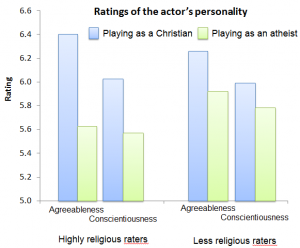 The first thing to notice is that the highly religious raters (the bars on the left) rated religious people to be considerably higher in two key facets of personality – agreeableness and conscientiousness.
OK, maybe that’s not too surprising. But what is remarkable is the less religious raters (which includes the entirely non-religious). They were just about as positive about the Christian, but only somewhat warmer towards the atheist.
In other words, even the less and non-religious were biased against atheists.
They found that this effect was independent of how much the raters liked or disliked atheists as a group, leading them to conclude that:
These findings provide strong evidence showing that the religious bias in the attribution of personality characteristics is occurring via people’s perceptions of morality independently of their impression of the target’s broader religious group.
Now one interpretation of this is that, sure, the raters are projecting their own beliefs about atheists. But maybe they’re on to something, because when you ask people to rate their own personalities you find that, at least in the USA, atheists actually rate themselves as being disagreeable and unconscientious (See: Why are American atheists disagreeable and unconscientious?).
One school of thought says that this is just an American thing. After all, it takes a pretty unusual kind of individual to be openly atheist in the USA – given that there is so much anti-atheist prejudice.
That’s probably why the personality self-ratings of atheists in Europe are quite different from those in the USA. In Europe, you don’t have to be a black sheep to be an atheist.
So let’s talk about trust.
Previous Post

June 16, 2015
The Pope's call for climate action is more radical than you might think

Browse Our Archives
Select a Category Causes of religion - evolution Causes of religion - psychological Causes of religion - social Demographics Digest Effects of religion - health Effects of religion - psychological Effects of religion - social Notifications Politics Uncategorized
Select a Month March 2016 February 2016 January 2016 December 2015 November 2015 October 2015 September 2015 August 2015 July 2015 June 2015 May 2015 April 2015 March 2015 February 2015 January 2015 December 2014 November 2014 October 2014 September 2014 August 2014 July 2014 June 2014 May 2014 April 2014 March 2014 February 2014 January 2014 December 2013 November 2013 October 2013 September 2013 August 2013 July 2013 June 2013 May 2013 April 2013 March 2013 February 2013 January 2013 December 2012 November 2012 October 2012 September 2012 August 2012 July 2012 June 2012 May 2012 April 2012 March 2012 February 2012 January 2012 December 2011 November 2011 October 2011 September 2011 August 2011 July 2011 June 2011 May 2011 April 2011 March 2011 February 2011 January 2011 December 2010 November 2010 October 2010 September 2010 August 2010 July 2010 June 2010 May 2010 April 2010 March 2010 February 2010 January 2010 December 2009 November 2009 October 2009 September 2009 August 2009 July 2009 June 2009 May 2009 April 2009 March 2009 February 2009 January 2009 December 2008 November 2008 October 2008 September 2008 August 2008 July 2008 June 2008 May 2008 April 2008 March 2008 February 2008 January 2008 December 2007 November 2007 October 2007
Follow Us!
TAKE THE
Religious Wisdom Quiz
What is the first book of the Bible?
Select your answer to see how you score.
Genesis Matthew Psalms Exodus
Related posts from Epiphenom

Can you use religion to change attitudes towards...

Dogmatic atheism and fundamentalist Christianity: creating certainty in...
Do you wanna be in my clan? Moralising...
The decline of religion in Europe did not...
TRENDING AT PATHEOS Nonreligious

Dethroning Jesus and Enthroning Yourself
Jesus Never Asked to Be Worshipped. He Asked to Be Understood. Christianity...

Why Most Christians are Really Paulians and Jobians
I Don't Care, But It Matters Let's get this out of the...

Essential Tips to Successfully Navigate the Selling Process
Selling a house can feel overwhelming, but it doesn’t have to be....

To Make Remote Work Effective, Think About Others
The COVID-19 pandemic forced many companies to rapidly transition to remote work....

Flexibility Is Key to Solving Problems of Tomorrow
The world of work is undergoing a dramatic transformation. The COVID-19 pandemic...
view all Nonreligious blogs
Ad-Free & Subscriber Log-In Subscription Support
- About Us
- 2026 Calendar
- Videos
- Podcasts
- Library of World Religions
- Faith In Media Tracker
- Advertise With Us
- Write for Us
- Privacy Policy
- Terms of Service
- Do Not Sell My Data
- Contact Us
- Radiant Digital
- Manage Newsletter Subscriptions
- Unsubscribe From Notifications
- Sitemap
Copyright 2008-2026, Patheos. All rights reserved.
Subscription Support Ad-Free & Subscriber Log-In
Follow Patheos