
BuddhistCatholicContemplativeEvangelicalGeneral ChristianHinduJewishLatter-day SaintMuslimNew VisionsProgressive Christian
Beliefs
- Buddhist
- Catholic
- Contemplative
- Evangelical
- General Christian
- Hindu
- Jewish
- Latter-day Saint
- More Voices
- Muslim
- New Visions
- Pagan
- Progressive Christian
Topics
- Religion News
- Food and Religion
- Sports and Religion
- Religious Art
- Religious Music and Entertainment
- Religious Events
- History and Religion
- Style and Religion
- Politics and Religion
- Women in Religion
- Recreation Outdoors and Religion
- Business Finance and Religion
- Careers Workplace and Religion
- Education and Religion
- Family Parenting and Religion
- Health Fitness and Religion
- Home and Religion
- Relationships and Religion
- Technology and Religion
- Travel and Religion
Columnists
- Buddhist Columnists
- Business Finance and Religion Columnists
- Careers Workplace and Religion Columnists
- Catholic Columnists
- Contemplative Columnists
- Education and Religion Columnists
- Evangelists Columnists
- Family Parenting and Religion Columnists
- General Christian Columnists
- Health Fitness and Religion Columnists
- Hindu Columnists
- History and Religion Columnists
- Home and Religion Columnists
- Jewish Columnists
- More Voices Columnists
- Latter Day Columnists
- Muslim Columnists
- New Visions Columnists
- Nonreligious Columnists
- Pagan Columnists
- Politics and Religion Columnists
- Progressive Columnists
- Recreation Outdoors and Religion Columnists
- Relationships and Religion Columnists
- Religion News Columnists
- Religious Art Columnists
- Religious Events Columnists
- Religious Music and Entertainment Columnists
- Sports and Religion Columnists
- Style and Religion Columnists
- Technology and Religion Columnists
- Travel and Religion Columnists
- Women in Religion Columnists
Resource Library
- 2026 Calendar
- Library of World Religions
- The 100 Most Holy Places on Earth
- Patheos Answers
- Podcasts
- Videos
- Faith Leaders Database
- Anglican Episcopalian
- Bahai
- Baptist
- Buddhism
- Christianity
- Confucianism
- Eastern Orthodoxy
- Hinduism
- Holiness and Pentecostal
- ISKCON
- Islam
- Judaism
- Lutheran
- Methodist
- The Church of Jesus Christ of Latter-day Saints
- New Age
- Paganism
- Presbytarian and Reformed
- Protestantism
- Religion Behind the Scenes
- Roman Catholic
- Scientology
- Shia Islam
- Sikhism
- Sufism
- Sunni Islam
- Taoism
- Zen
- See all religions
Research Tools
 Ad-Free & Subscriber Log-In Subscription Support
Ad-Free & Subscriber Log-In Subscription Support
Follow Patheos 

- Trending:
- Forgiveness
- |
- Marriage
- |
- Consciousness
- |
- Death Penalty
- |
- Election
- |
- Halloween
 Epiphenom
- Home
- Nonreligious
- Religious authority increases the number of donations but decreases the value
Religious authority increases the number of donations but decreases the value
Last updated on: March 31, 2015 at 10:15 pm by Epiphenom
Religious authority increases the number of donations but decreases the value 2015-03-31T22:15:33+01:00 Epiphenom
Patheos Explore the world's faith through different perspectives on religion and spirituality! Patheos has the views of the prevalent religions and spiritualities of the world.
In a run-down market place in Kabul, Afghanistan, groups of men hang around hoping that someone will offer them a job for the day. But today is different. Today they get an unusual offer.
Somebody is willing to pay them a whole days wage (about $9) just to fill out a survey. Of course, many agree, and are taken by bus to the survey station. Once the survey is complete, they get handed their money in a blank envelope.
Before they go, a guy comes in and makes an appeal to their charitable nature. He wants them to donate to a well-known charity that provides hospital care to the needy. All they need do is take the money they want to keep out of the envelope, leave whatever they want inside, and drop it in a box in the way out.
That little story relates an experiment that actually took place. OWhat the experimenters (Luke Condra and Sera Linardi, University of Pittsburgh, and Mohammad Isaqzadeh of the University of Afghanistan) were interested in was not the survey results, but rather how much their subjects decided to leave to charity.
The catch was this: the guy who made the appeal was a Muslim cleric, and they ran the experiment several times. Sometimes he wore civilian clothes, sometime he wore clerical garb, and sometimes he wore clerical garb and anded a line at the end of his appeal quoting a verse from the Koran extolling the virtues of charity.
What they found was quite remarkable.
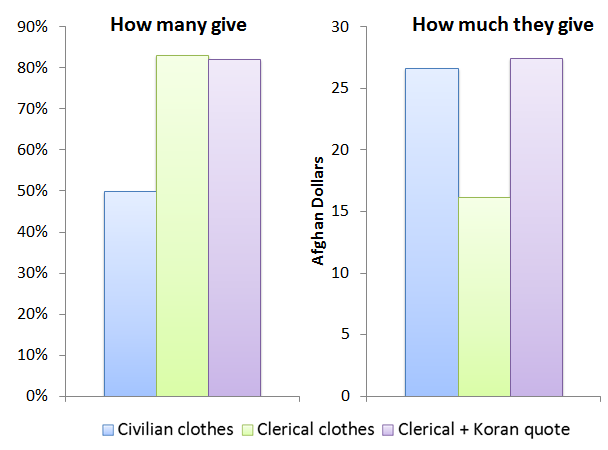 When the appeal was made by a guy wearing clerical attire, more people donated. But the average value of the donations actually went down. What happened was that many people made the absolute minimum donation possible (a 10 Afghani note).
The overall effect was that the total value of the donations remained exactly the same.
When the quote from the Koran was added to the appeal, the value of the donations went back up again, and the percentage of people donating remained high. So the total value of donations increased.
This is important because it’s been found before that subtly reminding people about religion makes them more charitable. But the reason for this was never quite clear.
Is it because people are reminded that God is watching them, so they make token gestures towards being nicer? Or is it because they are genuinely motivated to altruism?
These results suggest that the feeling of being watched by God is important. That certainly chimes with other research on the topic.
The problem with this is that it encourages people to fulfil the letter, but not the spirit, of religious law. As the researchers write:
We interpret this reaction as a form of legalism, common to many religions, whereby the individual feels compelled to give by virtue of the clergy’s recognized ecclesiastical authority, but bridles against the clergyman’s exercise of power and negatively responds by decreasing the amount given.
Adding an appeal to the goodness of charity reversed that effect. If people are reminded about why they should give, they readily respond. The unresolved question is: are secular appeals to charity just as effective?
The researchers found something else interesting. The effects they saw were entirely due to the subjects who felt poor relative to their neighbours.
All these people were poor. But those who felt relatively poor were far more susceptible to the influence of religion.
Now, this is an area that’s particularly interesting to me – in fact, they cite my 2009 research paper as a motivation to look at this aspect themselves. Since then there’s been plenty more evidence to back that up.
It’s always nice to see evidence from an unexpected angle to support the idea that religion and personal insecurity go hand in hand!
Luke N Condra, Mohammad Isaqzadeh, Sera Linardi. Clerics and Sermons: An Experiment on the Impact of Religious Authority on Inter-Ethnic Giving in Afghanistan. ASREC conference 2015, Boston, 20-21 March 2015.
Effects of religion - psychological
Previous Post

March 24, 2015
Did belief in ghosts help kick-start civilization?
Next Post

April 8, 2015 The science is in, and God is not the answer
Browse Our Archives
Select a Category Causes of religion - evolution Causes of religion - psychological Causes of religion - social Demographics Digest Effects of religion - health Effects of religion - psychological Effects of religion - social Notifications Politics Uncategorized
Select a Month March 2016 February 2016 January 2016 December 2015 November 2015 October 2015 September 2015 August 2015 July 2015 June 2015 May 2015 April 2015 March 2015 February 2015 January 2015 December 2014 November 2014 October 2014 September 2014 August 2014 July 2014 June 2014 May 2014 April 2014 March 2014 February 2014 January 2014 December 2013 November 2013 October 2013 September 2013 August 2013 July 2013 June 2013 May 2013 April 2013 March 2013 February 2013 January 2013 December 2012 November 2012 October 2012 September 2012 August 2012 July 2012 June 2012 May 2012 April 2012 March 2012 February 2012 January 2012 December 2011 November 2011 October 2011 September 2011 August 2011 July 2011 June 2011 May 2011 April 2011 March 2011 February 2011 January 2011 December 2010 November 2010 October 2010 September 2010 August 2010 July 2010 June 2010 May 2010 April 2010 March 2010 February 2010 January 2010 December 2009 November 2009 October 2009 September 2009 August 2009 July 2009 June 2009 May 2009 April 2009 March 2009 February 2009 January 2009 December 2008 November 2008 October 2008 September 2008 August 2008 July 2008 June 2008 May 2008 April 2008 March 2008 February 2008 January 2008 December 2007 November 2007 October 2007
Follow Us!
TAKE THE
Religious Wisdom Quiz
What is the name for Christian monastic orders that focus on community life and prayer?
Select your answer to see how you score.
Benedictines Franciscans Waldensians Pentecostals
Related posts from Epiphenom

Do social crises lead to religious revivals? Nah!

Use of prayer by African-Americans can help explain...
Trust is more important than religion in encouraging...

Planned Parenthood is disgusting? What does that even...
TRENDING AT PATHEOS Nonreligious

Dethroning Jesus and Enthroning Yourself
Jesus Never Asked to Be Worshipped. He Asked to Be Understood. Christianity...

Why Most Christians are Really Paulians and Jobians
I Don't Care, But It Matters Let's get this out of the...

Essential Tips to Successfully Navigate the Selling Process
Selling a house can feel overwhelming, but it doesn’t have to be....

To Make Remote Work Effective, Think About Others
The COVID-19 pandemic forced many companies to rapidly transition to remote work....

Flexibility Is Key to Solving Problems of Tomorrow
The world of work is undergoing a dramatic transformation. The COVID-19 pandemic...
view all Nonreligious blogs
Ad-Free & Subscriber Log-In Subscription Support
- About Us
- 2026 Calendar
- Videos
- Podcasts
- Library of World Religions
- Faith In Media Tracker
- Advertise With Us
- Write for Us
- Privacy Policy
- Terms of Service
- Do Not Sell My Data
- Contact Us
- Radiant Digital
- Manage Newsletter Subscriptions
- Unsubscribe From Notifications
- Sitemap
Copyright 2008-2026, Patheos. All rights reserved.
Subscription Support Ad-Free & Subscriber Log-In
Follow Patheos