
BuddhistCatholicContemplativeEvangelicalGeneral ChristianHinduJewishLatter-day SaintMuslimNew VisionsProgressive Christian
Beliefs
- Buddhist
- Catholic
- Contemplative
- Evangelical
- General Christian
- Hindu
- Jewish
- Latter-day Saint
- More Voices
- Muslim
- New Visions
- Pagan
- Progressive Christian
Topics
- Religion News
- Food and Religion
- Sports and Religion
- Religious Art
- Religious Music and Entertainment
- Religious Events
- History and Religion
- Style and Religion
- Politics and Religion
- Women in Religion
- Recreation Outdoors and Religion
- Business Finance and Religion
- Careers Workplace and Religion
- Education and Religion
- Family Parenting and Religion
- Health Fitness and Religion
- Home and Religion
- Relationships and Religion
- Technology and Religion
- Travel and Religion
Columnists
- Buddhist Columnists
- Business Finance and Religion Columnists
- Careers Workplace and Religion Columnists
- Catholic Columnists
- Contemplative Columnists
- Education and Religion Columnists
- Evangelists Columnists
- Family Parenting and Religion Columnists
- General Christian Columnists
- Health Fitness and Religion Columnists
- Hindu Columnists
- History and Religion Columnists
- Home and Religion Columnists
- Jewish Columnists
- More Voices Columnists
- Latter Day Columnists
- Muslim Columnists
- New Visions Columnists
- Nonreligious Columnists
- Pagan Columnists
- Politics and Religion Columnists
- Progressive Columnists
- Recreation Outdoors and Religion Columnists
- Relationships and Religion Columnists
- Religion News Columnists
- Religious Art Columnists
- Religious Events Columnists
- Religious Music and Entertainment Columnists
- Sports and Religion Columnists
- Style and Religion Columnists
- Technology and Religion Columnists
- Travel and Religion Columnists
- Women in Religion Columnists
Resource Library
- 2026 Calendar
- Library of World Religions
- The 100 Most Holy Places on Earth
- Patheos Answers
- Podcasts
- Videos
- Faith Leaders Database
- Anglican Episcopalian
- Bahai
- Baptist
- Buddhism
- Christianity
- Confucianism
- Eastern Orthodoxy
- Hinduism
- Holiness and Pentecostal
- ISKCON
- Islam
- Judaism
- Lutheran
- Methodist
- The Church of Jesus Christ of Latter-day Saints
- New Age
- Paganism
- Presbytarian and Reformed
- Protestantism
- Religion Behind the Scenes
- Roman Catholic
- Scientology
- Shia Islam
- Sikhism
- Sufism
- Sunni Islam
- Taoism
- Zen
- See all religions
Research Tools
 Ad-Free & Subscriber Log-In Subscription Support
Ad-Free & Subscriber Log-In Subscription Support
Follow Patheos 

- Trending:
- Forgiveness
- |
- Marriage
- |
- Consciousness
- |
- Death Penalty
- |
- Election
- |
- Halloween
 Epiphenom
- Home
- Nonreligious
- Is belief in moral progress a substitute for religion?
Is belief in moral progress a substitute for religion?
Last updated on: February 24, 2015 at 11:14 pm by Epiphenom
Is belief in moral progress a substitute for religion? 2015-02-24T23:14:45+01:00 Epiphenom
Patheos Explore the world's faith through different perspectives on religion and spirituality! Patheos has the views of the prevalent religions and spiritualities of the world.
There’s a well studied phenomenon called Terror Management Theory which basically says that, when people are reminded of their own death, their beliefs change in certain predictable ways. People cling more strongly to beliefs that make the future seem more controllable and comfortable – and that includes turning to religion (see: Religion, Patriotism and Death).
Bastiaan Rutjens (University of Amsterdam) has previously found that reminding people of death reinforces their belief in progress. What he wanted to find out was whether this holds for both religious and non-religious people.
So he and his colleagues ran an online survey on 276 people chosen to be representative of the Dutch population. Half were asked to write about what will happen to them when they die. The others were asked about dental pain – that’s a standard control used in these kinds of studies, designed to evoke a strong emotional response.
Then they asked them whether they though humanity will advance technologically. And also whether humanity will advance morally, ethically and socially.
The nonreligious were more likely than the religious to believe in technological progress.
Perhaps surprisingly, the nonreligious, Catholics and Protestants all had similar levels of belief in moral progress – although people who believed in mankind’s inherent sinfulness (mostly Protestants, in this sample) were likely to believe that morality will actually decline in the future.
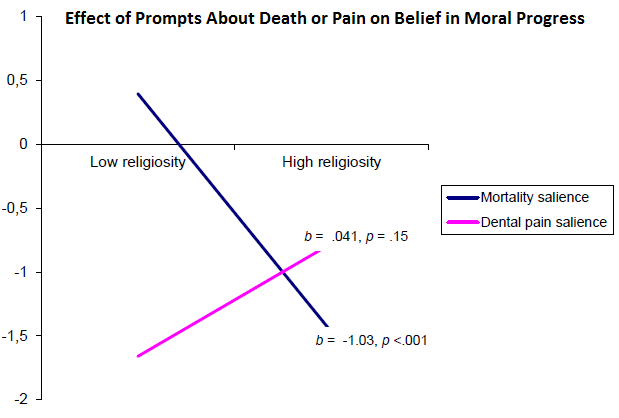 So what happens when you remind people about death? Well, it has no effect on belief in technological progress.
But reminding the nonreligious about death significantly increased their belief in moral progress.
Check out the graphic. What this shows is the result of a model based on the data.For people given death prompts (Mortality Salience in the graphic), belief in moral progress was much higher in those with lower than average strength of religious feeling (on the left hand side), compared with those high in religious feeling (on the right)
Prompts about dental pain had the same effect on both groups.
What this shows, Rutjens suggests, is that belief in progress can offer the nonreligious a buffer to existential threat similar to that offered by religious beliefs. But belief in progress in general is not enough – it has to be a belief that the essence of humanity will get better.
And what Rutjens and colleagues conclude from this is worth quoting in full:
From this perspective, the secularization of most western countries might in itself not lead to a better world6, but when people are motivated to search for existential meaning it at least triggers a motivated tendency to believe in a better world. Perhaps those adhering to or promoting a politics of progress can benefit from this idea, by providing people with the tools to find meaning in building a better future and seeking moral and societal progress.
 Rutjens, B., van Harreveld, F., van der Pligt, J., van Elk, M., & Pyszczynski, T. (2014). A march to a better world? Religiosity and the existential function of belief in social-moral progress The International Journal for the Psychology of Religion, 1-33 DOI: 10.1080/10508619.2014.990345
 This article by Tom Rees was first published on Epiphenom. It is licensed under Creative Commons.
Causes of religion - psychological
Next Post
March 4, 2015 Suicide in Northern Ireland is not linked to religious affiliation
Browse Our Archives
Select a Category Causes of religion - evolution Causes of religion - psychological Causes of religion - social Demographics Digest Effects of religion - health Effects of religion - psychological Effects of religion - social Notifications Politics Uncategorized
Select a Month March 2016 February 2016 January 2016 December 2015 November 2015 October 2015 September 2015 August 2015 July 2015 June 2015 May 2015 April 2015 March 2015 February 2015 January 2015 December 2014 November 2014 October 2014 September 2014 August 2014 July 2014 June 2014 May 2014 April 2014 March 2014 February 2014 January 2014 December 2013 November 2013 October 2013 September 2013 August 2013 July 2013 June 2013 May 2013 April 2013 March 2013 February 2013 January 2013 December 2012 November 2012 October 2012 September 2012 August 2012 July 2012 June 2012 May 2012 April 2012 March 2012 February 2012 January 2012 December 2011 November 2011 October 2011 September 2011 August 2011 July 2011 June 2011 May 2011 April 2011 March 2011 February 2011 January 2011 December 2010 November 2010 October 2010 September 2010 August 2010 July 2010 June 2010 May 2010 April 2010 March 2010 February 2010 January 2010 December 2009 November 2009 October 2009 September 2009 August 2009 July 2009 June 2009 May 2009 April 2009 March 2009 February 2009 January 2009 December 2008 November 2008 October 2008 September 2008 August 2008 July 2008 June 2008 May 2008 April 2008 March 2008 February 2008 January 2008 December 2007 November 2007 October 2007
Follow Us!
TAKE THE
Religious Wisdom Quiz
Who was known as a man after God’s own heart?
Select your answer to see how you score.
Moses Samuel David Solomon
Related posts from Epiphenom

Dogmatic atheism and fundamentalist Christianity: creating certainty in...
Religion linked to reduced levels of stress hormones...

A sense of mystery results from the brain...
Reminding people of mortality makes them more religious?...
TRENDING AT PATHEOS Nonreligious

Dethroning Jesus and Enthroning Yourself
Jesus Never Asked to Be Worshipped. He Asked to Be Understood. Christianity...

Why Most Christians are Really Paulians and Jobians
I Don't Care, But It Matters Let's get this out of the...

Essential Tips to Successfully Navigate the Selling Process
Selling a house can feel overwhelming, but it doesn’t have to be....

To Make Remote Work Effective, Think About Others
The COVID-19 pandemic forced many companies to rapidly transition to remote work....

Flexibility Is Key to Solving Problems of Tomorrow
The world of work is undergoing a dramatic transformation. The COVID-19 pandemic...
view all Nonreligious blogs
Ad-Free & Subscriber Log-In Subscription Support
- About Us
- 2026 Calendar
- Videos
- Podcasts
- Library of World Religions
- Faith In Media Tracker
- Advertise With Us
- Write for Us
- Privacy Policy
- Terms of Service
- Do Not Sell My Data
- Contact Us
- Radiant Digital
- Manage Newsletter Subscriptions
- Unsubscribe From Notifications
- Sitemap
Copyright 2008-2026, Patheos. All rights reserved.
Subscription Support Ad-Free & Subscriber Log-In
Follow Patheos