
BuddhistCatholicContemplativeEvangelicalGeneral ChristianHinduJewishLatter-day SaintMuslimNew VisionsProgressive Christian
Beliefs
- Buddhist
- Catholic
- Contemplative
- Evangelical
- General Christian
- Hindu
- Jewish
- Latter-day Saint
- More Voices
- Muslim
- New Visions
- Pagan
- Progressive Christian
Topics
- Religion News
- Food and Religion
- Sports and Religion
- Religious Art
- Religious Music and Entertainment
- Religious Events
- History and Religion
- Style and Religion
- Politics and Religion
- Women in Religion
- Recreation Outdoors and Religion
- Business Finance and Religion
- Careers Workplace and Religion
- Education and Religion
- Family Parenting and Religion
- Health Fitness and Religion
- Home and Religion
- Relationships and Religion
- Technology and Religion
- Travel and Religion
Columnists
- Buddhist Columnists
- Business Finance and Religion Columnists
- Careers Workplace and Religion Columnists
- Catholic Columnists
- Contemplative Columnists
- Education and Religion Columnists
- Evangelists Columnists
- Family Parenting and Religion Columnists
- General Christian Columnists
- Health Fitness and Religion Columnists
- Hindu Columnists
- History and Religion Columnists
- Home and Religion Columnists
- Jewish Columnists
- More Voices Columnists
- Latter Day Columnists
- Muslim Columnists
- New Visions Columnists
- Nonreligious Columnists
- Pagan Columnists
- Politics and Religion Columnists
- Progressive Columnists
- Recreation Outdoors and Religion Columnists
- Relationships and Religion Columnists
- Religion News Columnists
- Religious Art Columnists
- Religious Events Columnists
- Religious Music and Entertainment Columnists
- Sports and Religion Columnists
- Style and Religion Columnists
- Technology and Religion Columnists
- Travel and Religion Columnists
- Women in Religion Columnists
Resource Library
- 2026 Calendar
- Library of World Religions
- The 100 Most Holy Places on Earth
- Patheos Answers
- Podcasts
- Videos
- Faith Leaders Database
- Anglican Episcopalian
- Bahai
- Baptist
- Buddhism
- Christianity
- Confucianism
- Eastern Orthodoxy
- Hinduism
- Holiness and Pentecostal
- ISKCON
- Islam
- Judaism
- Lutheran
- Methodist
- The Church of Jesus Christ of Latter-day Saints
- New Age
- Paganism
- Presbytarian and Reformed
- Protestantism
- Religion Behind the Scenes
- Roman Catholic
- Scientology
- Shia Islam
- Sikhism
- Sufism
- Sunni Islam
- Taoism
- Zen
- See all religions
Research Tools
 Ad-Free & Subscriber Log-In Subscription Support
Ad-Free & Subscriber Log-In Subscription Support
Follow Patheos 

- Trending:
- Forgiveness
- |
- Marriage
- |
- Consciousness
- |
- Death Penalty
- |
- Election
- |
- Halloween
 Epiphenom
- Home
- Nonreligious
- Wealth and enlightenment in the Ancient World
Wealth and enlightenment in the Ancient World
Last updated on: January 27, 2015 at 10:09 pm by Epiphenom
Wealth and enlightenment in the Ancient World 2015-01-27T22:09:30+01:00 Epiphenom
Patheos Explore the world's faith through different perspectives on religion and spirituality! Patheos has the views of the prevalent religions and spiritualities of the world.
The period between the 5th and the 3rd century BCE was a fertile time for the world’s religions. In India, Buddhism and Jainism began to take hold. In China, Confucianism and Daoism likewise attracted mass appeal. And Europe saw the golden age of Greek philosophy.
What these movements have in common is that they all emphasize spirituality, self-discipline, and selflessness. And in doing so, they all are heavily moralizing.
According to a new study by Nicholas Baumard (University of Pennsylvania) and colleagues, this was no coincidence. In all cases, they suggest, it was driven by increasing affluence – specifically the increase in agricultural output that provided energy security and free time to ponder higher thoughts.
They compared these three regions with others that did not undergo enlightenment movements of this kind – in Egypt, Mesopotamia, Mesoamerica, and the Andes.
They looked at various factors including the population size of the various states and their surface area – which they took as a measure of political complexity. They also examined population growth and the population of the main city.
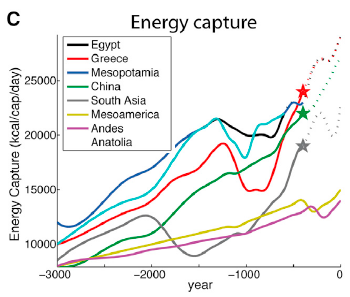 The final factor they looked at was energy capture. That’s how much energy – that’s how much energy (in the form of food – including animal feed – and other energy sources) is available per person.
They looked at how each of these factors had changed over 3000 years up till 0 CE. By plugging the data into a mathematical model, they could see how effective they were at predicted when and where the emergence of ‘axial’ religions occurred.
They found that political complexity did not predict the emergence of religions, but affluence did.
In particular, there was a sharp threshold in energy capture. Once a society crossed the 20,000kcal/day level, axial religions were much more likely to emerge.
The size of the largest city also emerged as an important factor. However, total population size and the surface area of the state were unimportant.
The authors suggest several possible explanations. Maybe the surplus energy enabled these cultures to create a class of individuals with enough leisure time to become scholars or priests – although they point out that this would not explain why these new ideologies had similar pro-social content. Another is that affluence promoted a new way of life that fitted better urban, cosmopolitan societies of the large city states.
Their preferred explanation is that energy security shifted society from a ‘fast’ strategy, focussed on high birth rates and less nurturing, to a ‘slow’ strategy focussed on long-term investment in co-operation and self-actualization.
Now, they’re quick to point out that the data are very rough. And Ed Slingerland, who has extensively studied Asian religions, argues that the whole concept of an ‘axial age’ is outdated.
These results directly contradict a school of thought that says moralising gods were invented early on, to strengthen group cohesion. For example, one recent study concluded that societies developing in tough environments were more likely to create moralizing gods.
However, that same study also linked moralising gods to socially stratified societies – as did another, looking also at early cultures. And a study of modern cultures linked belief in moralising gods to complex, large scale societies.
So there are some similarities to all these studies. Social stratification, after all, depends on surplus energy generation (so the wealthy can live off the work of the poor).
But where they disagree is over the timing and the implications. Did moralising Gods enable a wealthy, complex society – or are they simply a byproduct?
 Baumard, N., Hyafil, A., Morris, I., & Boyer, P. (2015). Increased Affluence Explains the Emergence of Ascetic Wisdoms and Moralizing Religions Current Biology, 25 (1), 10-15 DOI: 10.1016/j.cub.2014.10.063
 This article by Tom Rees was first published on Epiphenom. It is licensed under Creative Commons.
Previous Post

January 15, 2015
Why are American Atheists Disagreeable and Unconscientious?
Next Post

February 9, 2015 Most supernatural beliefs are about avoiding harm, not bringing benefit
Browse Our Archives
Select a Category Causes of religion - evolution Causes of religion - psychological Causes of religion - social Demographics Digest Effects of religion - health Effects of religion - psychological Effects of religion - social Notifications Politics Uncategorized
Select a Month March 2016 February 2016 January 2016 December 2015 November 2015 October 2015 September 2015 August 2015 July 2015 June 2015 May 2015 April 2015 March 2015 February 2015 January 2015 December 2014 November 2014 October 2014 September 2014 August 2014 July 2014 June 2014 May 2014 April 2014 March 2014 February 2014 January 2014 December 2013 November 2013 October 2013 September 2013 August 2013 July 2013 June 2013 May 2013 April 2013 March 2013 February 2013 January 2013 December 2012 November 2012 October 2012 September 2012 August 2012 July 2012 June 2012 May 2012 April 2012 March 2012 February 2012 January 2012 December 2011 November 2011 October 2011 September 2011 August 2011 July 2011 June 2011 May 2011 April 2011 March 2011 February 2011 January 2011 December 2010 November 2010 October 2010 September 2010 August 2010 July 2010 June 2010 May 2010 April 2010 March 2010 February 2010 January 2010 December 2009 November 2009 October 2009 September 2009 August 2009 July 2009 June 2009 May 2009 April 2009 March 2009 February 2009 January 2009 December 2008 November 2008 October 2008 September 2008 August 2008 July 2008 June 2008 May 2008 April 2008 March 2008 February 2008 January 2008 December 2007 November 2007 October 2007
Follow Us!
TAKE THE
Religious Wisdom Quiz
Which book of the Bible has the most chapters?
Select your answer to see how you score.
Isaiah Psalms Genesis Proverbs
Related posts from Epiphenom

Do social crises lead to religious revivals? Nah!

Do you wanna be in my clan? Moralising...

America is finally losing its religion - and...

Churchgoing has been on the decline for decades...
TRENDING AT PATHEOS Nonreligious

Dethroning Jesus and Enthroning Yourself
Jesus Never Asked to Be Worshipped. He Asked to Be Understood. Christianity...

Why Most Christians are Really Paulians and Jobians
I Don't Care, But It Matters Let's get this out of the...

Essential Tips to Successfully Navigate the Selling Process
Selling a house can feel overwhelming, but it doesn’t have to be....

To Make Remote Work Effective, Think About Others
The COVID-19 pandemic forced many companies to rapidly transition to remote work....

Flexibility Is Key to Solving Problems of Tomorrow
The world of work is undergoing a dramatic transformation. The COVID-19 pandemic...
view all Nonreligious blogs
Ad-Free & Subscriber Log-In Subscription Support
- About Us
- 2026 Calendar
- Videos
- Podcasts
- Library of World Religions
- Faith In Media Tracker
- Advertise With Us
- Write for Us
- Privacy Policy
- Terms of Service
- Do Not Sell My Data
- Contact Us
- Radiant Digital
- Manage Newsletter Subscriptions
- Unsubscribe From Notifications
- Sitemap
Copyright 2008-2026, Patheos. All rights reserved.
Subscription Support Ad-Free & Subscriber Log-In
Follow Patheos