
BuddhistCatholicContemplativeEvangelicalGeneral ChristianHinduJewishLatter-day SaintMuslimNew VisionsProgressive Christian
Beliefs
- Buddhist
- Catholic
- Contemplative
- Evangelical
- General Christian
- Hindu
- Jewish
- Latter-day Saint
- More Voices
- Muslim
- New Visions
- Pagan
- Progressive Christian
Topics
- Religion News
- Food and Religion
- Sports and Religion
- Religious Art
- Religious Music and Entertainment
- Religious Events
- History and Religion
- Style and Religion
- Politics and Religion
- Women in Religion
- Recreation Outdoors and Religion
- Business Finance and Religion
- Careers Workplace and Religion
- Education and Religion
- Family Parenting and Religion
- Health Fitness and Religion
- Home and Religion
- Relationships and Religion
- Technology and Religion
- Travel and Religion
Columnists
- Buddhist Columnists
- Business Finance and Religion Columnists
- Careers Workplace and Religion Columnists
- Catholic Columnists
- Contemplative Columnists
- Education and Religion Columnists
- Evangelists Columnists
- Family Parenting and Religion Columnists
- General Christian Columnists
- Health Fitness and Religion Columnists
- Hindu Columnists
- History and Religion Columnists
- Home and Religion Columnists
- Jewish Columnists
- More Voices Columnists
- Latter Day Columnists
- Muslim Columnists
- New Visions Columnists
- Nonreligious Columnists
- Pagan Columnists
- Politics and Religion Columnists
- Progressive Columnists
- Recreation Outdoors and Religion Columnists
- Relationships and Religion Columnists
- Religion News Columnists
- Religious Art Columnists
- Religious Events Columnists
- Religious Music and Entertainment Columnists
- Sports and Religion Columnists
- Style and Religion Columnists
- Technology and Religion Columnists
- Travel and Religion Columnists
- Women in Religion Columnists
Resource Library
- 2026 Calendar
- Library of World Religions
- The 100 Most Holy Places on Earth
- Patheos Answers
- Podcasts
- Videos
- Faith Leaders Database
- Anglican Episcopalian
- Bahai
- Baptist
- Buddhism
- Christianity
- Confucianism
- Eastern Orthodoxy
- Hinduism
- Holiness and Pentecostal
- ISKCON
- Islam
- Judaism
- Lutheran
- Methodist
- The Church of Jesus Christ of Latter-day Saints
- New Age
- Paganism
- Presbytarian and Reformed
- Protestantism
- Religion Behind the Scenes
- Roman Catholic
- Scientology
- Shia Islam
- Sikhism
- Sufism
- Sunni Islam
- Taoism
- Zen
- See all religions
Research Tools
 Ad-Free & Subscriber Log-In Subscription Support
Ad-Free & Subscriber Log-In Subscription Support
Follow Patheos 

- Trending:
- Forgiveness
- |
- Marriage
- |
- Consciousness
- |
- Death Penalty
- |
- Election
- |
- Halloween
 Epiphenom
- Home
- Nonreligious
- Why are unfalsifiable beliefs so attractive?
Why are unfalsifiable beliefs so attractive?
Last updated on: December 18, 2014 at 10:39 pm by Epiphenom
Why are unfalsifiable beliefs so attractive? 2014-12-18T22:39:37+01:00 Epiphenom
Patheos Explore the world's faith through different perspectives on religion and spirituality! Patheos has the views of the prevalent religions and spiritualities of the world.
Recently, Dr. John Wentworth, professor of physics at the Massachusetts Institute of Technology, argued that regardless of future advances, science will likely never discover whether the supernatural exists. He said,”almost always, our research raises more questions than it answers, therefore the question of God’s existence just isn’t scientifically testable.”
If you are religious, how does reading that make you feel about the validity of your religious beliefs? OK, so how about this version:
Recently, Dr. John Wentworth, professor of physics at the Massachusetts Institute of Technology argued that yes, one day science will be able to shed light on whether the supernatural exists. He said, “Eventually, we may be able to test scientifically whether or not God exists”
Of course, neither is true. Dr Wentworth is an invention, created for the purposes of a study by Justin Friesen (now at York University, Toronto) and colleagues.
When they gave expanded versions over those stories to a group of 103 American adults, they found that those who were highly religious reported stronger religious convictions after they read that science cannot disprove the existence of god
That seems an odd result, but the researchers reckoned it might be linked to a fundamental psychological drive that underpins religious and similar beliefs. Specifically, when people feel threatened or insecure, they latch on to beliefs they feel to be unshakeable.
To test this idea, they ran a similar experiment on a group of Canadian undergrads who were all at least slightly religious. This time, the news stories they were given to read were about the discovery of the Higgs Boson.
Half of them read that this discovery undermined religious belief (so their beliefs were threatened), while the other read that the results were consistent with religious beliefs.
Then, after giving them a few meaningless tasks so they wouldn’t guess the purpose of the study, they asked them about different reasons for believing in god. Most were unfalsifiable, such as “Living a moral life would be impossible without God”. But some were falsifiable, for example “Historical and archaeological evidence shows how God intervened in the world”.
Take a look at the graphs below, and I’ll walk you through them.
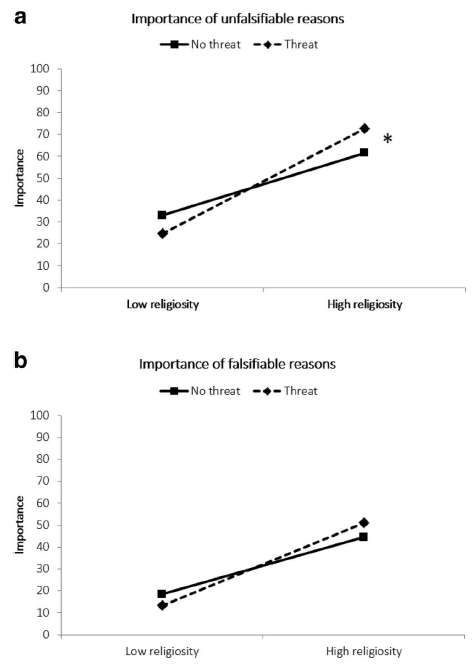
What’s shown is how important the students rated the unfalsifiable beliefs (top panel) and falsifiable beliefs (bottom panel). First think to note is that the basic pattern is the same in both panels.
Unlike the highly religious, students who were not very religious did not rate any of the reasons for belief as very compelling. But both the highly religious and the less religious rated the unfalsifiable beliefs as more compelling than the falsifiable ones.
When their beliefs were threatened (dotted line), the highly religious rate both kinds of reasons as more compelling, while the opposite happened with the less religious. The differences are statistically significant, but the trend is interesting anyway.
But the biggest increase was for the ratings the highly religious gave to unfalsifiable reasons for belief. When they felt their beliefs were threatened by evidence, they suddenly found unfalsifiable beliefs significantly more compelling.
Friesen and colleagues point out that, on their own, these data are not conclusive. It might be that the core beliefs of religion are unfalsifiable, and what we’re seeing here is simply people clinging to core beliefs when their belief system is threatened.
But they did similar experiments look at politics and found that, here too, people prefer unfalsifiable beliefs when they are challenged in some fundamental way.
They concluded that these beliefs, more than logic or reason, appeal to fundamental issues of the human condition. At at they end of the day, holding on to these fundamental issues is more important than fixating on reality:
We suggest that when people turn to unfalsifiability, it is because these “practical” issues—for us, existential motives—like having positive self-worth, being a valued group member, or obtaining symbolic immortality, have temporarily trumped questions of belief accuracy or testability.
 Friesen, J., Campbell, T., & Kay, A. (2014). The Psychological Advantage of Unfalsifiability: The Appeal of Untestable Religious and Political Ideologies. Journal of Personality and Social Psychology DOI: 10.1037/pspp0000018
 This article by Tom Rees was first published on Epiphenom. It is licensed under Creative Commons.
Causes of religion - psychological
Previous Post

December 8, 2014
Can religion reduce crime?
Next Post

January 2, 2015 The Best Science of Religion Stories of 2014
Browse Our Archives
Select a Category Causes of religion - evolution Causes of religion - psychological Causes of religion - social Demographics Digest Effects of religion - health Effects of religion - psychological Effects of religion - social Notifications Politics Uncategorized
Select a Month March 2016 February 2016 January 2016 December 2015 November 2015 October 2015 September 2015 August 2015 July 2015 June 2015 May 2015 April 2015 March 2015 February 2015 January 2015 December 2014 November 2014 October 2014 September 2014 August 2014 July 2014 June 2014 May 2014 April 2014 March 2014 February 2014 January 2014 December 2013 November 2013 October 2013 September 2013 August 2013 July 2013 June 2013 May 2013 April 2013 March 2013 February 2013 January 2013 December 2012 November 2012 October 2012 September 2012 August 2012 July 2012 June 2012 May 2012 April 2012 March 2012 February 2012 January 2012 December 2011 November 2011 October 2011 September 2011 August 2011 July 2011 June 2011 May 2011 April 2011 March 2011 February 2011 January 2011 December 2010 November 2010 October 2010 September 2010 August 2010 July 2010 June 2010 May 2010 April 2010 March 2010 February 2010 January 2010 December 2009 November 2009 October 2009 September 2009 August 2009 July 2009 June 2009 May 2009 April 2009 March 2009 February 2009 January 2009 December 2008 November 2008 October 2008 September 2008 August 2008 July 2008 June 2008 May 2008 April 2008 March 2008 February 2008 January 2008 December 2007 November 2007 October 2007
Follow Us!
TAKE THE
Religious Wisdom Quiz
What was Barnabas' original name?
Select your answer to see how you score.
Timothy Silas Joseph Mark
Related posts from Epiphenom

Dogmatic atheism and fundamentalist Christianity: creating certainty in...
Religion linked to reduced levels of stress hormones...

A sense of mystery results from the brain...
Reminding people of mortality makes them more religious?...
TRENDING AT PATHEOS Nonreligious

Dethroning Jesus and Enthroning Yourself
Jesus Never Asked to Be Worshipped. He Asked to Be Understood. Christianity...

Why Most Christians are Really Paulians and Jobians
I Don't Care, But It Matters Let's get this out of the...

Essential Tips to Successfully Navigate the Selling Process
Selling a house can feel overwhelming, but it doesn’t have to be....

To Make Remote Work Effective, Think About Others
The COVID-19 pandemic forced many companies to rapidly transition to remote work....

Flexibility Is Key to Solving Problems of Tomorrow
The world of work is undergoing a dramatic transformation. The COVID-19 pandemic...
view all Nonreligious blogs
Ad-Free & Subscriber Log-In Subscription Support
- About Us
- 2026 Calendar
- Videos
- Podcasts
- Library of World Religions
- Faith In Media Tracker
- Advertise With Us
- Write for Us
- Privacy Policy
- Terms of Service
- Do Not Sell My Data
- Contact Us
- Radiant Digital
- Manage Newsletter Subscriptions
- Unsubscribe From Notifications
- Sitemap
Copyright 2008-2026, Patheos. All rights reserved.
Subscription Support Ad-Free & Subscriber Log-In
Follow Patheos