
BuddhistCatholicContemplativeEvangelicalGeneral ChristianHinduJewishLatter-day SaintMuslimNew VisionsProgressive Christian
Beliefs
- Buddhist
- Catholic
- Contemplative
- Evangelical
- General Christian
- Hindu
- Jewish
- Latter-day Saint
- More Voices
- Muslim
- New Visions
- Pagan
- Progressive Christian
Topics
- Religion News
- Food and Religion
- Sports and Religion
- Religious Art
- Religious Music and Entertainment
- Religious Events
- History and Religion
- Style and Religion
- Politics and Religion
- Women in Religion
- Recreation Outdoors and Religion
- Business Finance and Religion
- Careers Workplace and Religion
- Education and Religion
- Family Parenting and Religion
- Health Fitness and Religion
- Home and Religion
- Relationships and Religion
- Technology and Religion
- Travel and Religion
Columnists
- Buddhist Columnists
- Business Finance and Religion Columnists
- Careers Workplace and Religion Columnists
- Catholic Columnists
- Contemplative Columnists
- Education and Religion Columnists
- Evangelists Columnists
- Family Parenting and Religion Columnists
- General Christian Columnists
- Health Fitness and Religion Columnists
- Hindu Columnists
- History and Religion Columnists
- Home and Religion Columnists
- Jewish Columnists
- More Voices Columnists
- Latter Day Columnists
- Muslim Columnists
- New Visions Columnists
- Nonreligious Columnists
- Pagan Columnists
- Politics and Religion Columnists
- Progressive Columnists
- Recreation Outdoors and Religion Columnists
- Relationships and Religion Columnists
- Religion News Columnists
- Religious Art Columnists
- Religious Events Columnists
- Religious Music and Entertainment Columnists
- Sports and Religion Columnists
- Style and Religion Columnists
- Technology and Religion Columnists
- Travel and Religion Columnists
- Women in Religion Columnists
Resource Library
- 2026 Calendar
- Library of World Religions
- The 100 Most Holy Places on Earth
- Patheos Answers
- Podcasts
- Videos
- Faith Leaders Database
- Anglican Episcopalian
- Bahai
- Baptist
- Buddhism
- Christianity
- Confucianism
- Eastern Orthodoxy
- Hinduism
- Holiness and Pentecostal
- ISKCON
- Islam
- Judaism
- Lutheran
- Methodist
- The Church of Jesus Christ of Latter-day Saints
- New Age
- Paganism
- Presbytarian and Reformed
- Protestantism
- Religion Behind the Scenes
- Roman Catholic
- Scientology
- Shia Islam
- Sikhism
- Sufism
- Sunni Islam
- Taoism
- Zen
- See all religions
Research Tools
 Ad-Free & Subscriber Log-In Subscription Support
Ad-Free & Subscriber Log-In Subscription Support
Follow Patheos 

- Trending:
- Forgiveness
- |
- Marriage
- |
- Consciousness
- |
- Death Penalty
- |
- Election
- |
- Halloween
 Epiphenom
- Home
- Nonreligious
- It hurts! Atheists and Christians don’t feel each others pain, but with a twist.
It hurts! Atheists and Christians don’t feel each others pain, but with a twist.
Last updated on: November 11, 2014 at 8:18 pm by Epiphenom
It hurts! Atheists and Christians don’t feel each others pain, but with a twist. 2014-11-11T20:18:22+01:00 Epiphenom
Patheos Explore the world's faith through different perspectives on religion and spirituality! Patheos has the views of the prevalent religions and spiritualities of the world.

Christians and atheist faces in pain
For many people, their religion is like a badge of social identity. You feel an affinity with people who share a religion – not surprising given that you will share many cultural and social touch points.
But will you feel their pain? If shown a picture of a Christian grimacing, will you mentally flinch? What about an atheist
Siyuan Huang & Shihui Han at Peking University, Beijing, strapped electrodes to the heads of a bunch of Christians and atheists to see how they reacted to pictures of people – Christians and atheists – in pain. To keep it balanced, they used the images of the same 10 models for both Christians and atheists. They just swapped the symbols hung round their necks for some participants.
What they found was that both Christians and atheists had an emotional reaction to the images of people in pain – but that, in both groups, the reaction was stronger for images of people from their own group.
So that’s interesting enough, but there’s a twist.
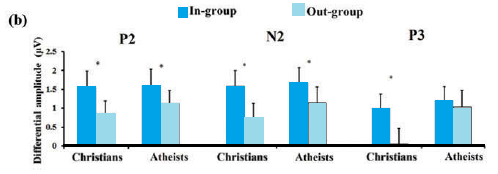
They measured the reaction at different time points. That’s what’s shown in the graph below. P2, N2 and P3 represent the magnitude of the response at different intervals – P3 is about 0.4 seconds after P2.
Neural responses to pain images
You can see that, at P2 and N2, Christians and atheists are quite similar. They have a response, but the response is greater to the ‘in-group’ – atheists respond more strongly to the images of atheists in pain, and Christians more strongly to the images of Christians in pain.
At P3 it’s quite difference. At this time point, the Christian response to atheists images virtually disappears. For atheists, remarkably, the response to christian images is as strong as the response to atheist images.
Huang and Han reckon that this is because the early responses are purely instinctive. The later response occurs after some mental and evaluation and appraisal. It reflects that the responder is applying some judgment beyond the instinctive.
Sounds like a gold star for atheists, right? I mean, instinctively they empathize less with Christians but at least after a moments reflection they share their pain.
But don’t forget that this study was done in China. In China, Christians are a decided minority whereas atheists – at least in terms of affiliation – are in the majority.
So maybe what we’re seeing here is simply that people from minority groups have a stronger in-group identity. That’s been shown in other studies – minorities tend to stick together. There’s one easy way to check this, of course, and that’s to do a similar study in a country where atheists are a minority.
But the take home from this, I think, is to be aware of just how powerful religious identity is as a component of our social identity.
 Huang, S., & Han, S. (2014). Shared beliefs enhance shared feelings: Religious/irreligious identifications modulate empathic neural responses Social Neuroscience, 1-11 DOI: 10.1080/17470919.2014.934396
 This article by Tom Rees was first published on Epiphenom. It is licensed under Creative Commons.
Effects of religion - psychological
Previous Post

November 3, 2014
Best of Epiphenom 2007-2014
Next Post
November 13, 2014 Hard times, tough gods
Browse Our Archives
Select a Category Causes of religion - evolution Causes of religion - psychological Causes of religion - social Demographics Digest Effects of religion - health Effects of religion - psychological Effects of religion - social Notifications Politics Uncategorized
Select a Month March 2016 February 2016 January 2016 December 2015 November 2015 October 2015 September 2015 August 2015 July 2015 June 2015 May 2015 April 2015 March 2015 February 2015 January 2015 December 2014 November 2014 October 2014 September 2014 August 2014 July 2014 June 2014 May 2014 April 2014 March 2014 February 2014 January 2014 December 2013 November 2013 October 2013 September 2013 August 2013 July 2013 June 2013 May 2013 April 2013 March 2013 February 2013 January 2013 December 2012 November 2012 October 2012 September 2012 August 2012 July 2012 June 2012 May 2012 April 2012 March 2012 February 2012 January 2012 December 2011 November 2011 October 2011 September 2011 August 2011 July 2011 June 2011 May 2011 April 2011 March 2011 February 2011 January 2011 December 2010 November 2010 October 2010 September 2010 August 2010 July 2010 June 2010 May 2010 April 2010 March 2010 February 2010 January 2010 December 2009 November 2009 October 2009 September 2009 August 2009 July 2009 June 2009 May 2009 April 2009 March 2009 February 2009 January 2009 December 2008 November 2008 October 2008 September 2008 August 2008 July 2008 June 2008 May 2008 April 2008 March 2008 February 2008 January 2008 December 2007 November 2007 October 2007
Follow Us!
TAKE THE
Religious Wisdom Quiz
I am bread from heaven that appeared with the morning dew six days a week. What am I?
Select your answer to see how you score.
God's provision Heavenly food Manna Bread of angels
Related posts from Epiphenom

Use of prayer by African-Americans can help explain...

Planned Parenthood is disgusting? What does that even...

Kids in atheist families are more altruistic! The...
Make people uncertain then remind them about God,...
TRENDING AT PATHEOS Nonreligious

Dethroning Jesus and Enthroning Yourself
Jesus Never Asked to Be Worshipped. He Asked to Be Understood. Christianity...

Why Most Christians are Really Paulians and Jobians
I Don't Care, But It Matters Let's get this out of the...

Essential Tips to Successfully Navigate the Selling Process
Selling a house can feel overwhelming, but it doesn’t have to be....

To Make Remote Work Effective, Think About Others
The COVID-19 pandemic forced many companies to rapidly transition to remote work....

Flexibility Is Key to Solving Problems of Tomorrow
The world of work is undergoing a dramatic transformation. The COVID-19 pandemic...
view all Nonreligious blogs
Ad-Free & Subscriber Log-In Subscription Support
- About Us
- 2026 Calendar
- Videos
- Podcasts
- Library of World Religions
- Faith In Media Tracker
- Advertise With Us
- Write for Us
- Privacy Policy
- Terms of Service
- Do Not Sell My Data
- Contact Us
- Radiant Digital
- Manage Newsletter Subscriptions
- Unsubscribe From Notifications
- Sitemap
Copyright 2008-2026, Patheos. All rights reserved.
Subscription Support Ad-Free & Subscriber Log-In
Follow Patheos