
BuddhistCatholicContemplativeEvangelicalGeneral ChristianHinduJewishLatter-day SaintMuslimNew VisionsProgressive Christian
Beliefs
- Buddhist
- Catholic
- Contemplative
- Evangelical
- General Christian
- Hindu
- Jewish
- Latter-day Saint
- More Voices
- Muslim
- New Visions
- Pagan
- Progressive Christian
Topics
- Religion News
- Food and Religion
- Sports and Religion
- Religious Art
- Religious Music and Entertainment
- Religious Events
- History and Religion
- Style and Religion
- Politics and Religion
- Women in Religion
- Recreation Outdoors and Religion
- Business Finance and Religion
- Careers Workplace and Religion
- Education and Religion
- Family Parenting and Religion
- Health Fitness and Religion
- Home and Religion
- Relationships and Religion
- Technology and Religion
- Travel and Religion
Columnists
- Buddhist Columnists
- Business Finance and Religion Columnists
- Careers Workplace and Religion Columnists
- Catholic Columnists
- Contemplative Columnists
- Education and Religion Columnists
- Evangelists Columnists
- Family Parenting and Religion Columnists
- General Christian Columnists
- Health Fitness and Religion Columnists
- Hindu Columnists
- History and Religion Columnists
- Home and Religion Columnists
- Jewish Columnists
- More Voices Columnists
- Latter Day Columnists
- Muslim Columnists
- New Visions Columnists
- Nonreligious Columnists
- Pagan Columnists
- Politics and Religion Columnists
- Progressive Columnists
- Recreation Outdoors and Religion Columnists
- Relationships and Religion Columnists
- Religion News Columnists
- Religious Art Columnists
- Religious Events Columnists
- Religious Music and Entertainment Columnists
- Sports and Religion Columnists
- Style and Religion Columnists
- Technology and Religion Columnists
- Travel and Religion Columnists
- Women in Religion Columnists
Resource Library
- 2026 Calendar
- Library of World Religions
- The 100 Most Holy Places on Earth
- Patheos Answers
- Podcasts
- Videos
- Faith Leaders Database
- Anglican Episcopalian
- Bahai
- Baptist
- Buddhism
- Christianity
- Confucianism
- Eastern Orthodoxy
- Hinduism
- Holiness and Pentecostal
- ISKCON
- Islam
- Judaism
- Lutheran
- Methodist
- The Church of Jesus Christ of Latter-day Saints
- New Age
- Paganism
- Presbytarian and Reformed
- Protestantism
- Religion Behind the Scenes
- Roman Catholic
- Scientology
- Shia Islam
- Sikhism
- Sufism
- Sunni Islam
- Taoism
- Zen
- See all religions
Research Tools
 Ad-Free & Subscriber Log-In Subscription Support
Ad-Free & Subscriber Log-In Subscription Support
Follow Patheos 

- Trending:
- Forgiveness
- |
- Marriage
- |
- Consciousness
- |
- Death Penalty
- |
- Election
- |
- Halloween
 Epiphenom
- Home
- Nonreligious
- Women can keep the vote!
Women can keep the vote!
Last updated on: November 11, 2014 at 8:59 pm by Epiphenom
Women can keep the vote! 2014-11-11T20:59:28+01:00 Epiphenom
Patheos Explore the world's faith through different perspectives on religion and spirituality! Patheos has the views of the prevalent religions and spiritualities of the world.
About this time last year I wrote about an interesting study that found that single women were less religious when they were most fertile, while women in a relationship were more religious.
Christine Harris (University of California, USA) and Laura Mickes (University of London, UK) also thought the results were pretty remarkable – and they set out to see if they could reproduce them.
So, repeated the study by Durante and colleagues, but with with a larger pool of responders. Like Durante, they recruited them using Amazon’s Mechanical Turk – 1,200 women, interviewed before the 2012 US presidential election.
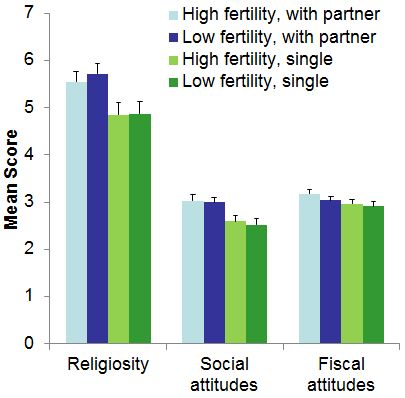
The results, shown in the figure, were clear: stage in the ovulatory cycle had no effect on religiosity or on social attitudes (or on fiscal attitudes, which was included as a kind of control).
So women, at least the ones interviewed for this study, do not turn to religion and social conservatism when they are at their most fertile. Social attitudes do not change on a whim.
The results did confirm that women in established relationships tend to be more religious and more socially conservative, which is pretty much would you’d expect from other data (but: is it cause or effect?).
So, two studies, with basically the same design, with different results. Should we be concerned?
Well, Harris and Mickes point out that this study is just one of “a growing number of failures to
replicate several menstrual cycle effects on preferences and attraction, which invites concerns that this literature as a whole may have a false-positive rate well above the widely presumed 5%.”
They suggest that the problem may be due to “data analysis flexibility”. Researchers often play around with the data, refining their analyses until they get something that clearly demonstrates the effect they’re looking for.
It’s a common temptation, but it renders any statistical analyses meaningless. The only way around this problem is to declare in advance exactly what you will do, and then follow that plan to the letter.
But this approach, while rigorous, means that you can’t go digging in the data to try to unearth useful stuff. The solution is to do an exploratory analysis, and then run another full study to confirm what you’ve found. But who has the time and money to do that (especially when academics are under immense pressure to pump out new study results, in order to keep their job).
Talking of which, Harris and Mickes did make one interesting finding. High-fertility women in established relationships were much less likely to say they intended voting for Obama than low fertility women or high fertility single women (around 58% of the high-fertile, paired women, versus around 77% of the other groups).
But when it came to actual voting (they ran the study again after the election), paired women voted for Obama at equal rates (about 68%), while single women were more likely to vote for Obama if they were highly fertile (90%) than if they were at a low-fertility stage of their cycle (75%)
Perhaps this has nothing to do with attitudes, though, and everything to do with whether they found Obama attractive (physical attractiveness is well known to influence the voting behaviour of both men and women).
Well, maybe. I guess someone will have to run another study to see if that’s true!

Harris, C., & Mickes, L. (2014). Women Can Keep the Vote: No Evidence That Hormonal Changes During the Menstrual Cycle Impact Political and Religious Beliefs Psychological Science, 25 (5), 1147-1149 DOI: 10.1177/0956797613520236
 This article by Tom Rees was first published on Epiphenom. It is licensed under Creative Commons.
Previous Post

May 6, 2014
Is the internet leading people away from religion?
Next Post
May 20, 2014 Religion and happiness: maybe it's not a country-specific effect after all
Browse Our Archives
Select a Category Causes of religion - evolution Causes of religion - psychological Causes of religion - social Demographics Digest Effects of religion - health Effects of religion - psychological Effects of religion - social Notifications Politics Uncategorized
Select a Month March 2016 February 2016 January 2016 December 2015 November 2015 October 2015 September 2015 August 2015 July 2015 June 2015 May 2015 April 2015 March 2015 February 2015 January 2015 December 2014 November 2014 October 2014 September 2014 August 2014 July 2014 June 2014 May 2014 April 2014 March 2014 February 2014 January 2014 December 2013 November 2013 October 2013 September 2013 August 2013 July 2013 June 2013 May 2013 April 2013 March 2013 February 2013 January 2013 December 2012 November 2012 October 2012 September 2012 August 2012 July 2012 June 2012 May 2012 April 2012 March 2012 February 2012 January 2012 December 2011 November 2011 October 2011 September 2011 August 2011 July 2011 June 2011 May 2011 April 2011 March 2011 February 2011 January 2011 December 2010 November 2010 October 2010 September 2010 August 2010 July 2010 June 2010 May 2010 April 2010 March 2010 February 2010 January 2010 December 2009 November 2009 October 2009 September 2009 August 2009 July 2009 June 2009 May 2009 April 2009 March 2009 February 2009 January 2009 December 2008 November 2008 October 2008 September 2008 August 2008 July 2008 June 2008 May 2008 April 2008 March 2008 February 2008 January 2008 December 2007 November 2007 October 2007
Follow Us!
TAKE THE
Religious Wisdom Quiz
What does "apostle" literally mean in Greek?
Select your answer to see how you score.
Leader Sent one Writer Friend
Related posts from Epiphenom

Do social crises lead to religious revivals? Nah!

What kind of woman would pray for health...

Can you use religion to change attitudes towards...

Dogmatic atheism and fundamentalist Christianity: creating certainty in...
TRENDING AT PATHEOS Nonreligious

Dethroning Jesus and Enthroning Yourself
Jesus Never Asked to Be Worshipped. He Asked to Be Understood. Christianity...

Why Most Christians are Really Paulians and Jobians
I Don't Care, But It Matters Let's get this out of the...

Essential Tips to Successfully Navigate the Selling Process
Selling a house can feel overwhelming, but it doesn’t have to be....

To Make Remote Work Effective, Think About Others
The COVID-19 pandemic forced many companies to rapidly transition to remote work....

Flexibility Is Key to Solving Problems of Tomorrow
The world of work is undergoing a dramatic transformation. The COVID-19 pandemic...
view all Nonreligious blogs
Ad-Free & Subscriber Log-In Subscription Support
- About Us
- 2026 Calendar
- Videos
- Podcasts
- Library of World Religions
- Faith In Media Tracker
- Advertise With Us
- Write for Us
- Privacy Policy
- Terms of Service
- Do Not Sell My Data
- Contact Us
- Radiant Digital
- Manage Newsletter Subscriptions
- Unsubscribe From Notifications
- Sitemap
Copyright 2008-2026, Patheos. All rights reserved.
Subscription Support Ad-Free & Subscriber Log-In
Follow Patheos