
BuddhistCatholicContemplativeEvangelicalGeneral ChristianHinduJewishLatter-day SaintMuslimNew VisionsProgressive Christian
Beliefs
- Buddhist
- Catholic
- Contemplative
- Evangelical
- General Christian
- Hindu
- Jewish
- Latter-day Saint
- More Voices
- Muslim
- New Visions
- Pagan
- Progressive Christian
Topics
- Religion News
- Food and Religion
- Sports and Religion
- Religious Art
- Religious Music and Entertainment
- Religious Events
- History and Religion
- Style and Religion
- Politics and Religion
- Women in Religion
- Recreation Outdoors and Religion
- Business Finance and Religion
- Careers Workplace and Religion
- Education and Religion
- Family Parenting and Religion
- Health Fitness and Religion
- Home and Religion
- Relationships and Religion
- Technology and Religion
- Travel and Religion
Columnists
- Buddhist Columnists
- Business Finance and Religion Columnists
- Careers Workplace and Religion Columnists
- Catholic Columnists
- Contemplative Columnists
- Education and Religion Columnists
- Evangelists Columnists
- Family Parenting and Religion Columnists
- General Christian Columnists
- Health Fitness and Religion Columnists
- Hindu Columnists
- History and Religion Columnists
- Home and Religion Columnists
- Jewish Columnists
- More Voices Columnists
- Latter Day Columnists
- Muslim Columnists
- New Visions Columnists
- Nonreligious Columnists
- Pagan Columnists
- Politics and Religion Columnists
- Progressive Columnists
- Recreation Outdoors and Religion Columnists
- Relationships and Religion Columnists
- Religion News Columnists
- Religious Art Columnists
- Religious Events Columnists
- Religious Music and Entertainment Columnists
- Sports and Religion Columnists
- Style and Religion Columnists
- Technology and Religion Columnists
- Travel and Religion Columnists
- Women in Religion Columnists
Resource Library
- 2026 Calendar
- Library of World Religions
- The 100 Most Holy Places on Earth
- Patheos Answers
- Podcasts
- Videos
- Faith Leaders Database
- Anglican Episcopalian
- Bahai
- Baptist
- Buddhism
- Christianity
- Confucianism
- Eastern Orthodoxy
- Hinduism
- Holiness and Pentecostal
- ISKCON
- Islam
- Judaism
- Lutheran
- Methodist
- The Church of Jesus Christ of Latter-day Saints
- New Age
- Paganism
- Presbytarian and Reformed
- Protestantism
- Religion Behind the Scenes
- Roman Catholic
- Scientology
- Shia Islam
- Sikhism
- Sufism
- Sunni Islam
- Taoism
- Zen
- See all religions
Research Tools
 Ad-Free & Subscriber Log-In Subscription Support
Ad-Free & Subscriber Log-In Subscription Support
Follow Patheos 

- Trending:
- Forgiveness
- |
- Marriage
- |
- Consciousness
- |
- Death Penalty
- |
- Election
- |
- Halloween
 Epiphenom
- Home
- Nonreligious
- Is the internet leading people away from religion?
Is the internet leading people away from religion?
Last updated on: November 11, 2014 at 9:00 pm by Epiphenom
Is the internet leading people away from religion? 2014-11-11T21:00:28+01:00 Epiphenom
Patheos Explore the world's faith through different perspectives on religion and spirituality! Patheos has the views of the prevalent religions and spiritualities of the world.
This is a story that has been circulating recently, so I thought I’d fact check it! The study, by Allen Downey, a Professor of Computer Science at Olin College of Engineering in the USA, hasn’t yet been formally published – but you can read a copy of it here.
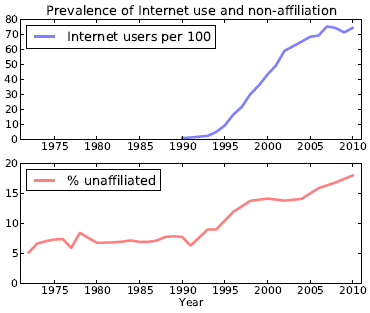 The spark for this study was data on US internet users from the World Bank and the religious disaffiliation from the US General Social Survey (GSS) – sown in the figure on the right. There’s a vague correlation, as you can see.
So Downey looked at religious preference data from 8951 participants in the GSS from 2000-2010. If the respondent said they had a religious preference, then they were counted as being religious – that’s a pretty low bar. The GSS also asked how many hours per week people spent on the internet.
Running a fairly straightforward linear regression model, he found that being born into a religion was the strongest predictor of whether or not you were religious. Richer people also were more religious. Younger people, and more educated people, were less religious.
But, after taking these factors into account, internet use still seemed to play a role.
It’s a meaningful role, but small. For example, using the internet for 2 hours a week was about as important as an extra year of education, or being one year younger.
The effect was strongest for people with a religious upbringing. So, for example, suppose someone had a religious upbringing and had an income in the top 75%, but also was born in 1970 and had gone to college. Well this person would have an 88% chance of being religious. If they used the internet at least 7 hours per week, then they would have an 81% chance of being religious.
So, which of these contributes most to the decline in religion? Fewer people have had a religious upbringing, and more people have had a college education.
By plugging in some hypothetical numbers, Downey reckons that internet use accounts for 20% of the change in religion, while increasing education accounts for 5%. Generational change accoutns for the rest.
Frankly, I think this last calculation is pretty suspect. He includes ‘generational change’ as a factor of the same kind as internet use – and it’s the biggest factor. But really this is just saying that younger people are different from older ones. So it seems a bit recursive.
There are other issues with using regression to try to tease out the relative effects of these different factors – mainly something called collinearity. For example, younger people are less religious, and use the internet more, and are better educated. Which one ends up correlating better could be down to the quality of measurement, rather than anything more profound.
Also, it could be that internet use is not a causal factor here. It may be that people who use the internet a lot are not inclined to go to Church (they are not dutiful or community minded). But then if there was no internet they would still not be going to Church – they’d find some other thing to do with their time.
Even so,this study does, support one counter-intuitive idea. That’s the idea that education decreases religion not by teaching specific facts.
That’s what was found in a study back in 2010. It found that the students who underwent the most dramatic decline in religious belief as a result of college were those who studied Humanities and the Social Science.
If that’s true, then the critical factor undermining faith is the opening of minds to alternative world views. Something that the internet does par excellence.
 This article by Tom Rees was first published on Epiphenom. It is licensed under Creative Commons.
Previous Post

April 29, 2014
Do religious people think they’re nice? It depends on the country
Next Post
May 14, 2014 Women can keep the vote!
Browse Our Archives
Select a Category Causes of religion - evolution Causes of religion - psychological Causes of religion - social Demographics Digest Effects of religion - health Effects of religion - psychological Effects of religion - social Notifications Politics Uncategorized
Select a Month March 2016 February 2016 January 2016 December 2015 November 2015 October 2015 September 2015 August 2015 July 2015 June 2015 May 2015 April 2015 March 2015 February 2015 January 2015 December 2014 November 2014 October 2014 September 2014 August 2014 July 2014 June 2014 May 2014 April 2014 March 2014 February 2014 January 2014 December 2013 November 2013 October 2013 September 2013 August 2013 July 2013 June 2013 May 2013 April 2013 March 2013 February 2013 January 2013 December 2012 November 2012 October 2012 September 2012 August 2012 July 2012 June 2012 May 2012 April 2012 March 2012 February 2012 January 2012 December 2011 November 2011 October 2011 September 2011 August 2011 July 2011 June 2011 May 2011 April 2011 March 2011 February 2011 January 2011 December 2010 November 2010 October 2010 September 2010 August 2010 July 2010 June 2010 May 2010 April 2010 March 2010 February 2010 January 2010 December 2009 November 2009 October 2009 September 2009 August 2009 July 2009 June 2009 May 2009 April 2009 March 2009 February 2009 January 2009 December 2008 November 2008 October 2008 September 2008 August 2008 July 2008 June 2008 May 2008 April 2008 March 2008 February 2008 January 2008 December 2007 November 2007 October 2007
Follow Us!
TAKE THE
Religious Wisdom Quiz
Who betrayed Jesus with a kiss?
Select your answer to see how you score.
Herod Peter Thomas Judas
Related posts from Epiphenom

Do social crises lead to religious revivals? Nah!

What kind of woman would pray for health...

Can you use religion to change attitudes towards...

Dogmatic atheism and fundamentalist Christianity: creating certainty in...
TRENDING AT PATHEOS Nonreligious

Dethroning Jesus and Enthroning Yourself
Jesus Never Asked to Be Worshipped. He Asked to Be Understood. Christianity...

Why Most Christians are Really Paulians and Jobians
I Don't Care, But It Matters Let's get this out of the...

Essential Tips to Successfully Navigate the Selling Process
Selling a house can feel overwhelming, but it doesn’t have to be....

To Make Remote Work Effective, Think About Others
The COVID-19 pandemic forced many companies to rapidly transition to remote work....

Flexibility Is Key to Solving Problems of Tomorrow
The world of work is undergoing a dramatic transformation. The COVID-19 pandemic...
view all Nonreligious blogs
Ad-Free & Subscriber Log-In Subscription Support
- About Us
- 2026 Calendar
- Videos
- Podcasts
- Library of World Religions
- Faith In Media Tracker
- Advertise With Us
- Write for Us
- Privacy Policy
- Terms of Service
- Do Not Sell My Data
- Contact Us
- Radiant Digital
- Manage Newsletter Subscriptions
- Unsubscribe From Notifications
- Sitemap
Copyright 2008-2026, Patheos. All rights reserved.
Subscription Support Ad-Free & Subscriber Log-In
Follow Patheos