
BuddhistCatholicContemplativeEvangelicalGeneral ChristianHinduJewishLatter-day SaintMuslimNew VisionsProgressive Christian
Beliefs
- Buddhist
- Catholic
- Contemplative
- Evangelical
- General Christian
- Hindu
- Jewish
- Latter-day Saint
- More Voices
- Muslim
- New Visions
- Pagan
- Progressive Christian
Topics
- Religion News
- Food and Religion
- Sports and Religion
- Religious Art
- Religious Music and Entertainment
- Religious Events
- History and Religion
- Style and Religion
- Politics and Religion
- Women in Religion
- Recreation Outdoors and Religion
- Business Finance and Religion
- Careers Workplace and Religion
- Education and Religion
- Family Parenting and Religion
- Health Fitness and Religion
- Home and Religion
- Relationships and Religion
- Technology and Religion
- Travel and Religion
Columnists
- Buddhist Columnists
- Business Finance and Religion Columnists
- Careers Workplace and Religion Columnists
- Catholic Columnists
- Contemplative Columnists
- Education and Religion Columnists
- Evangelists Columnists
- Family Parenting and Religion Columnists
- General Christian Columnists
- Health Fitness and Religion Columnists
- Hindu Columnists
- History and Religion Columnists
- Home and Religion Columnists
- Jewish Columnists
- More Voices Columnists
- Latter Day Columnists
- Muslim Columnists
- New Visions Columnists
- Nonreligious Columnists
- Pagan Columnists
- Politics and Religion Columnists
- Progressive Columnists
- Recreation Outdoors and Religion Columnists
- Relationships and Religion Columnists
- Religion News Columnists
- Religious Art Columnists
- Religious Events Columnists
- Religious Music and Entertainment Columnists
- Sports and Religion Columnists
- Style and Religion Columnists
- Technology and Religion Columnists
- Travel and Religion Columnists
- Women in Religion Columnists
Resource Library
- 2026 Calendar
- Library of World Religions
- The 100 Most Holy Places on Earth
- Patheos Answers
- Podcasts
- Videos
- Faith Leaders Database
- Anglican Episcopalian
- Bahai
- Baptist
- Buddhism
- Christianity
- Confucianism
- Eastern Orthodoxy
- Hinduism
- Holiness and Pentecostal
- ISKCON
- Islam
- Judaism
- Lutheran
- Methodist
- The Church of Jesus Christ of Latter-day Saints
- New Age
- Paganism
- Presbytarian and Reformed
- Protestantism
- Religion Behind the Scenes
- Roman Catholic
- Scientology
- Shia Islam
- Sikhism
- Sufism
- Sunni Islam
- Taoism
- Zen
- See all religions
Research Tools
 Ad-Free & Subscriber Log-In Subscription Support
Ad-Free & Subscriber Log-In Subscription Support
Follow Patheos 

- Trending:
- Forgiveness
- |
- Marriage
- |
- Consciousness
- |
- Death Penalty
- |
- Election
- |
- Halloween
 Epiphenom
- Home
- Nonreligious
- When it comes to religions, governmental regulation and social norms affect happiness
When it comes to religions, governmental regulation and social norms affect happiness
Last updated on: November 11, 2014 at 8:56 pm by Epiphenom
When it comes to religions, governmental regulation and social norms affect happiness 2014-11-11T20:56:44+01:00 Epiphenom
Patheos Explore the world's faith through different perspectives on religion and spirituality! Patheos has the views of the prevalent religions and spiritualities of the world.
If you read the last post you’ll know that the relationship between religion and happiness is complicated. When you look around the world, religious people tend to be happier than non-religious people.
However, it’s not straightforward. The effect is bigger in some countries than in others. But why? Possibly part of the reason is that religion makes people happier in countries that are more religious, but there seems to be more to it than this.
David Hayward (University of Michigan) and Marta Elliot (University of Nevada) are interested in how governmental regulation of religion affects attitudes towards it. Previously they’ve shown that the more government regulates religion, the less people are satisfied with it. Perhaps this effect is important here.
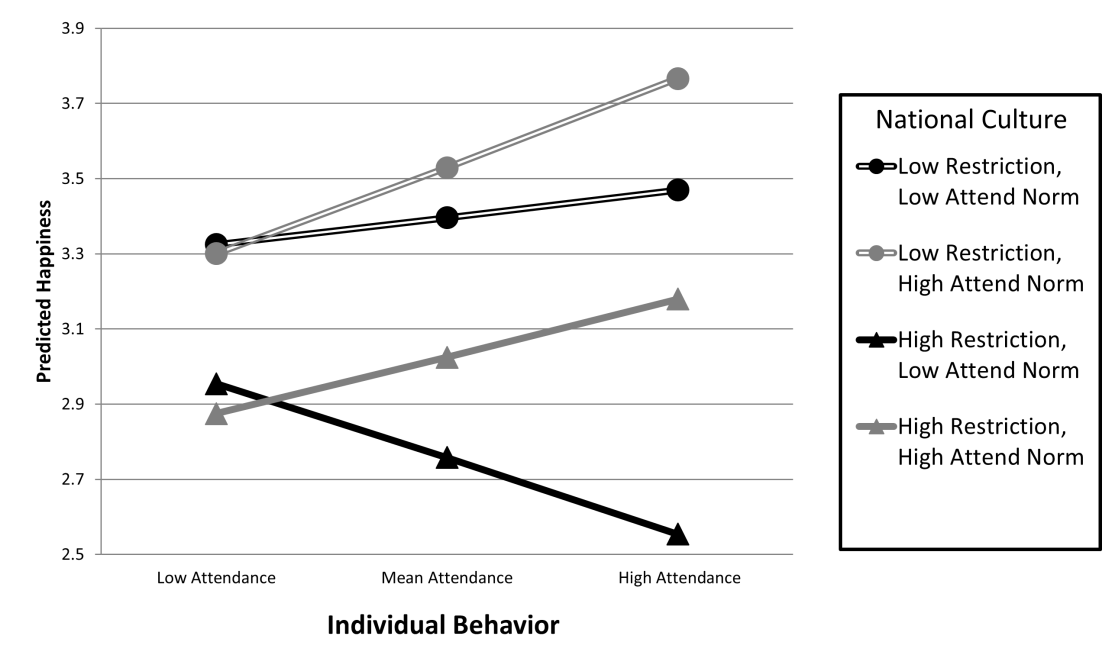
So they took data from the World Values Survey and created a model to predict how happy people are in countries with either few or lots of religious people, and either little or lots of governmental regulation of religion. They found there was quite a strong interaction.
Take, for example, the top graphic. This shows that, as religious service attendance goes up (left to right), so does happiness – except in countries with high levels of religious attendance and strong governmental regulation of religion. In these countries, people who attend a lot of services are actually less happy!
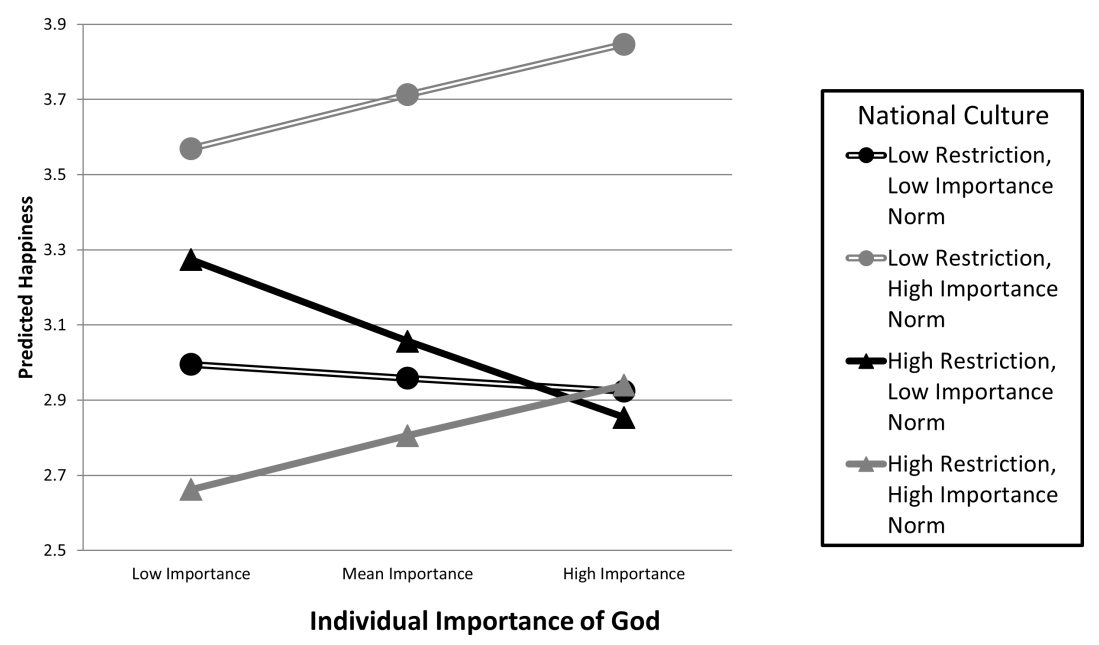
The next graphic down shows basically the same thing, but this time looking at the importance of God in people’s lives. For people living in countries where most people are not interested in God, stronger belief doesn’t lead to more happiness, and actually leads to less happiness in countries where governments control religion.
Here’s what Hayward and Elliot conclude:
It is true that in most instances, religion and well-being are positively associated. However, the strength of the association tends to increase as religion becomes more normative, and overall levels of health and happiness are lower when government regulation is high. The magnitude of these effects varies depending on the facet of religion in question and the type of well-being outcome, but in general it appears that high regulation tends to intensify the contrast between the effects of fitting in with or deviating from the religious norms of the nation.
To summarise, religious people do tend to be happier (and healthier), but this is only really true in countries where there is freedom of religion, and many people are religious.
I’m sure you can think of many countries that are highly religious and where government sticks its nose in religious affairs. But you may be wondering which countries are non religious and also regulated? Well, these are the ex-communist countries, where the new governments tend to use religion as a political tool.
Incidentally, as well as looking at how the lines slope, it’s also interesting to look at who is happiest in each of these different circumstances. For example, in countries where most people think god is unimportant, the least religious people are, for the most part at least as happy as the most religious.
So, what do these results mean in context?
Well, previous research using the World Values Survey has shown that religious people are happiest in countries where there are lots of religious people (Eichhorn and Diener). Also that being religious leads to more social recognition, in turn leading to more happiness – an effect is much stronger in the more religious countries (Stavrova).
It also seems that religious diversity is linked to unhappiness (Okulicz-Kozaryn).
When put together with this study, I would say that the overall pattern emerging is that the link between religion and happiness really seems to be about fitting in. The happiest countries are ones where everyone is highly religious, and it’s the same religion, and where the government doesn’t feel the need to interfere (presumably because the state and religion are aligned).
In other words, religion does lead to happiness, but the greatest effect is seen in conditions where everybody is of the same religion. A bit like things must’ve been in our tribal past.
But very rare conditions in the modern world!

Hayward, R.,& Elliott, M. (2013). Cross-National Analysis of the Influence of Cultural Norms and Government Restrictions on the Relationship Between Religion and Well-Being. Review of Religious Research, 56 (1), 23-43 DOI: 10.1007/s13644-013-0135-0
 This article by Tom Rees was first published on Epiphenom. It is licensed under Creative Commons.
Next Post

June 11, 2014 Atheism not linked to cognitive decline (but it is linked to intelligence)
Browse Our Archives
Select a Category Causes of religion - evolution Causes of religion - psychological Causes of religion - social Demographics Digest Effects of religion - health Effects of religion - psychological Effects of religion - social Notifications Politics Uncategorized
Select a Month March 2016 February 2016 January 2016 December 2015 November 2015 October 2015 September 2015 August 2015 July 2015 June 2015 May 2015 April 2015 March 2015 February 2015 January 2015 December 2014 November 2014 October 2014 September 2014 August 2014 July 2014 June 2014 May 2014 April 2014 March 2014 February 2014 January 2014 December 2013 November 2013 October 2013 September 2013 August 2013 July 2013 June 2013 May 2013 April 2013 March 2013 February 2013 January 2013 December 2012 November 2012 October 2012 September 2012 August 2012 July 2012 June 2012 May 2012 April 2012 March 2012 February 2012 January 2012 December 2011 November 2011 October 2011 September 2011 August 2011 July 2011 June 2011 May 2011 April 2011 March 2011 February 2011 January 2011 December 2010 November 2010 October 2010 September 2010 August 2010 July 2010 June 2010 May 2010 April 2010 March 2010 February 2010 January 2010 December 2009 November 2009 October 2009 September 2009 August 2009 July 2009 June 2009 May 2009 April 2009 March 2009 February 2009 January 2009 December 2008 November 2008 October 2008 September 2008 August 2008 July 2008 June 2008 May 2008 April 2008 March 2008 February 2008 January 2008 December 2007 November 2007 October 2007
Follow Us!
TAKE THE
Religious Wisdom Quiz
Who was the prophet that confronted King David about his sin with Bathsheba?
Select your answer to see how you score.
Isaiah Nathan Samuel Elijah
Related posts from Epiphenom

Do social crises lead to religious revivals? Nah!

What kind of woman would pray for health...

Can you use religion to change attitudes towards...

Dogmatic atheism and fundamentalist Christianity: creating certainty in...
TRENDING AT PATHEOS Nonreligious

Dethroning Jesus and Enthroning Yourself
Jesus Never Asked to Be Worshipped. He Asked to Be Understood. Christianity...

Why Most Christians are Really Paulians and Jobians
I Don't Care, But It Matters Let's get this out of the...

Essential Tips to Successfully Navigate the Selling Process
Selling a house can feel overwhelming, but it doesn’t have to be....

To Make Remote Work Effective, Think About Others
The COVID-19 pandemic forced many companies to rapidly transition to remote work....

Flexibility Is Key to Solving Problems of Tomorrow
The world of work is undergoing a dramatic transformation. The COVID-19 pandemic...
view all Nonreligious blogs
Ad-Free & Subscriber Log-In Subscription Support
- About Us
- 2026 Calendar
- Videos
- Podcasts
- Library of World Religions
- Faith In Media Tracker
- Advertise With Us
- Write for Us
- Privacy Policy
- Terms of Service
- Do Not Sell My Data
- Contact Us
- Radiant Digital
- Manage Newsletter Subscriptions
- Unsubscribe From Notifications
- Sitemap
Copyright 2008-2026, Patheos. All rights reserved.
Subscription Support Ad-Free & Subscriber Log-In
Follow Patheos