
BuddhistCatholicContemplativeEvangelicalGeneral ChristianHinduJewishLatter-day SaintMuslimNew VisionsProgressive Christian
Beliefs
- Buddhist
- Catholic
- Contemplative
- Evangelical
- General Christian
- Hindu
- Jewish
- Latter-day Saint
- More Voices
- Muslim
- New Visions
- Pagan
- Progressive Christian
Topics
- Religion News
- Food and Religion
- Sports and Religion
- Religious Art
- Religious Music and Entertainment
- Religious Events
- History and Religion
- Style and Religion
- Politics and Religion
- Women in Religion
- Recreation Outdoors and Religion
- Business Finance and Religion
- Careers Workplace and Religion
- Education and Religion
- Family Parenting and Religion
- Health Fitness and Religion
- Home and Religion
- Relationships and Religion
- Technology and Religion
- Travel and Religion
Columnists
- Buddhist Columnists
- Business Finance and Religion Columnists
- Careers Workplace and Religion Columnists
- Catholic Columnists
- Contemplative Columnists
- Education and Religion Columnists
- Evangelists Columnists
- Family Parenting and Religion Columnists
- General Christian Columnists
- Health Fitness and Religion Columnists
- Hindu Columnists
- History and Religion Columnists
- Home and Religion Columnists
- Jewish Columnists
- More Voices Columnists
- Latter Day Columnists
- Muslim Columnists
- New Visions Columnists
- Nonreligious Columnists
- Pagan Columnists
- Politics and Religion Columnists
- Progressive Columnists
- Recreation Outdoors and Religion Columnists
- Relationships and Religion Columnists
- Religion News Columnists
- Religious Art Columnists
- Religious Events Columnists
- Religious Music and Entertainment Columnists
- Sports and Religion Columnists
- Style and Religion Columnists
- Technology and Religion Columnists
- Travel and Religion Columnists
- Women in Religion Columnists
Resource Library
- 2026 Calendar
- Library of World Religions
- The 100 Most Holy Places on Earth
- Patheos Answers
- Podcasts
- Videos
- Faith Leaders Database
- Anglican Episcopalian
- Bahai
- Baptist
- Buddhism
- Christianity
- Confucianism
- Eastern Orthodoxy
- Hinduism
- Holiness and Pentecostal
- ISKCON
- Islam
- Judaism
- Lutheran
- Methodist
- The Church of Jesus Christ of Latter-day Saints
- New Age
- Paganism
- Presbytarian and Reformed
- Protestantism
- Religion Behind the Scenes
- Roman Catholic
- Scientology
- Shia Islam
- Sikhism
- Sufism
- Sunni Islam
- Taoism
- Zen
- See all religions
Research Tools
 Ad-Free & Subscriber Log-In Subscription Support
Ad-Free & Subscriber Log-In Subscription Support
Follow Patheos 

- Trending:
- Forgiveness
- |
- Marriage
- |
- Consciousness
- |
- Death Penalty
- |
- Election
- |
- Halloween
 Epiphenom
- Home
- Nonreligious
- Hell and happiness
Hell and happiness
Last updated on: February 26, 2014 at 10:48 pm by Epiphenom
Hell and happiness 2014-02-26T22:48:00+01:00 Epiphenom
Patheos Explore the world's faith through different perspectives on religion and spirituality! Patheos has the views of the prevalent religions and spiritualities of the world.
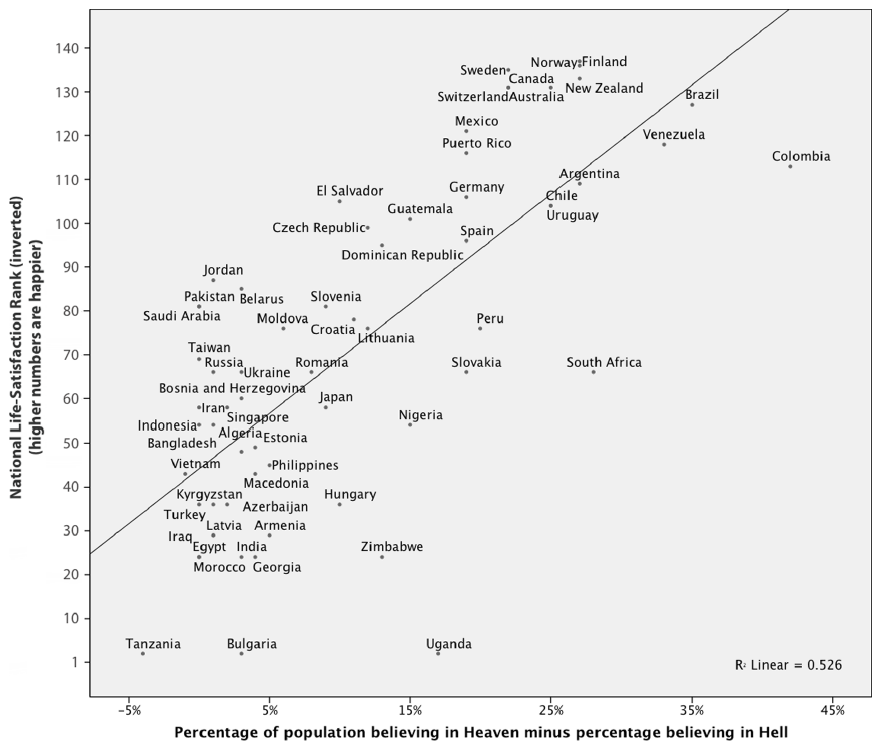
Believing in hell seems to make people unhappy. That’s the conclusion that Azim Shariff (University of Oregon, USA) and Lara Aknin (Simon Fraser University, Canada) have come to as a result of a series of studies. Now, that’s actually more surprising than you might at first imagine, so it’s worth checking out just what they did.
First off was a correlation among nations. They looked at how many people in each country believed in heaven, and subtracted from that the numbers that believed in hell – giving a number that perhaps reflects the ‘heaven surplus’. They found that countries with a high heaven surplus tended also to have a happier population.
Next they looked within the same database, but at individuals. They found that people who believed in hell tended to be less satisfied with their lives and tended to experience ‘well being’ less often. Belief in heaven had an equal and opposite effect.
You can probably think of quite a few alternative explanations for those correlations. So what they did next was a priming study.
They asked 422 American adults to write about hell, or heaven, or what they did yesterday. Then they asked about how happy they were feeling (ignoring the responses from those who guessed the underlying purpose of the study).
What they found was that “Participants who wrote about Hell reported significantly less happiness and more sadness than those who wrote about Heaven, or those in the neutral writing condition.” In fact, the interesting finding was that writing about heaven had no effect on happiness – all the differences were purely down to hell making people sad.
Atheists were also susceptible to the effect – writing about hell made them feel sad, too.
Now, Shariff and Aknin are quick to acknowledge that this study isn’t definitive. The first two studies were correlational (and in fact the first really looked at heaven beliefs, not hell beliefs), so you can’t rule out the possibility that sad people choose to believe in hell.
What’s more, there are enormous cultural differences in what is understood by the term ‘heaven’. Traditional Chinese religions don’t have the dualistic concepts familiar to us in the west.
And their priming study was done in the USA, so may not apply directly to other countries. And the magnitude of the effect was not huge.
Still, it’s hard to escape their conclusion that “Nevertheless, our finding that certain religious beliefs are consistently related to lower levels of well-being adds nuance to the general finding that religion is tied to greater well-being.”
That leads to the question: “why?”
They suggest that there is a trade off between the effect of hell belief on the individual, and the effect on societies. The individual takes on a hell belief that makes them unhappy, but makes society better (through inhibiting bad behaviour) and so provides a payoff in the long run.
There are holes that could be picked in this idea. The obvious one is that free-riders could feign belief in hell and so get the benefits without the costs. If the costs of hell belief were meaningful, in time everyone would be a free-rider (of course, it could be that the sadness induced by hell beliefs doesn’t have any meaningful effects on fitness, from an evolutionary perspective – evolution doesn’t care if you’re sad!).
Nevertheless, Shariff and Aknin reckon that this might explain why hell beliefs are on the wane. In the past people believed in hell in order to keep society safe. But, with the establishment of rule-following, well policed and governed nations, the need for hell ebbed away – so people dropped their sadness-inducing beliefs.
You could debate whether belief in hell actually reduces criminality – though Sharif has previously provided evidence that it does. Arguably, all that’s important for to maintain belief in hell is that people believe that it has this effect. So perhaps people give up on hell because they stop believing that it has any effect on behaviour.
And you need to consider other research that belief in hell is linked to fearfulness in general, and not to real, objective threats.
But it would help to explain what seems to be a real social phenomenon. The social function of religion is changing.

Shariff, A., & Aknin, L. (2014). The Emotional Toll of Hell: Cross-National and Experimental Evidence for the Negative Well-Being Effects of Hell Beliefs PLoS ONE, 9 (1) DOI: 10.1371/journal.pone.0085251
 This article by Tom Rees was first published on Epiphenom. It is licensed under Creative Commons.
Next Post

March 6, 2014 Do migraines cause religion?
Browse Our Archives
Select a Category Causes of religion - evolution Causes of religion - psychological Causes of religion - social Demographics Digest Effects of religion - health Effects of religion - psychological Effects of religion - social Notifications Politics Uncategorized
Select a Month March 2016 February 2016 January 2016 December 2015 November 2015 October 2015 September 2015 August 2015 July 2015 June 2015 May 2015 April 2015 March 2015 February 2015 January 2015 December 2014 November 2014 October 2014 September 2014 August 2014 July 2014 June 2014 May 2014 April 2014 March 2014 February 2014 January 2014 December 2013 November 2013 October 2013 September 2013 August 2013 July 2013 June 2013 May 2013 April 2013 March 2013 February 2013 January 2013 December 2012 November 2012 October 2012 September 2012 August 2012 July 2012 June 2012 May 2012 April 2012 March 2012 February 2012 January 2012 December 2011 November 2011 October 2011 September 2011 August 2011 July 2011 June 2011 May 2011 April 2011 March 2011 February 2011 January 2011 December 2010 November 2010 October 2010 September 2010 August 2010 July 2010 June 2010 May 2010 April 2010 March 2010 February 2010 January 2010 December 2009 November 2009 October 2009 September 2009 August 2009 July 2009 June 2009 May 2009 April 2009 March 2009 February 2009 January 2009 December 2008 November 2008 October 2008 September 2008 August 2008 July 2008 June 2008 May 2008 April 2008 March 2008 February 2008 January 2008 December 2007 November 2007 October 2007
Follow Us!
TAKE THE
Religious Wisdom Quiz
Who was the first king of Israel?
Select your answer to see how you score.
Solomon Saul David Josiah
Related posts from Epiphenom

Do social crises lead to religious revivals? Nah!

What kind of woman would pray for health...

Can you use religion to change attitudes towards...

Dogmatic atheism and fundamentalist Christianity: creating certainty in...
TRENDING AT PATHEOS Nonreligious

Dethroning Jesus and Enthroning Yourself
Jesus Never Asked to Be Worshipped. He Asked to Be Understood. Christianity...

Why Most Christians are Really Paulians and Jobians
I Don't Care, But It Matters Let's get this out of the...

Essential Tips to Successfully Navigate the Selling Process
Selling a house can feel overwhelming, but it doesn’t have to be....

To Make Remote Work Effective, Think About Others
The COVID-19 pandemic forced many companies to rapidly transition to remote work....

Flexibility Is Key to Solving Problems of Tomorrow
The world of work is undergoing a dramatic transformation. The COVID-19 pandemic...
view all Nonreligious blogs
Ad-Free & Subscriber Log-In Subscription Support
- About Us
- 2026 Calendar
- Videos
- Podcasts
- Library of World Religions
- Faith In Media Tracker
- Advertise With Us
- Write for Us
- Privacy Policy
- Terms of Service
- Do Not Sell My Data
- Contact Us
- Radiant Digital
- Manage Newsletter Subscriptions
- Unsubscribe From Notifications
- Sitemap
Copyright 2008-2026, Patheos. All rights reserved.
Subscription Support Ad-Free & Subscriber Log-In
Follow Patheos