
BuddhistCatholicContemplativeEvangelicalGeneral ChristianHinduJewishLatter-day SaintMuslimNew VisionsProgressive Christian
Beliefs
- Buddhist
- Catholic
- Contemplative
- Evangelical
- General Christian
- Hindu
- Jewish
- Latter-day Saint
- More Voices
- Muslim
- New Visions
- Pagan
- Progressive Christian
Topics
- Religion News
- Food and Religion
- Sports and Religion
- Religious Art
- Religious Music and Entertainment
- Religious Events
- History and Religion
- Style and Religion
- Politics and Religion
- Women in Religion
- Recreation Outdoors and Religion
- Business Finance and Religion
- Careers Workplace and Religion
- Education and Religion
- Family Parenting and Religion
- Health Fitness and Religion
- Home and Religion
- Relationships and Religion
- Technology and Religion
- Travel and Religion
Columnists
- Buddhist Columnists
- Business Finance and Religion Columnists
- Careers Workplace and Religion Columnists
- Catholic Columnists
- Contemplative Columnists
- Education and Religion Columnists
- Evangelists Columnists
- Family Parenting and Religion Columnists
- General Christian Columnists
- Health Fitness and Religion Columnists
- Hindu Columnists
- History and Religion Columnists
- Home and Religion Columnists
- Jewish Columnists
- More Voices Columnists
- Latter Day Columnists
- Muslim Columnists
- New Visions Columnists
- Nonreligious Columnists
- Pagan Columnists
- Politics and Religion Columnists
- Progressive Columnists
- Recreation Outdoors and Religion Columnists
- Relationships and Religion Columnists
- Religion News Columnists
- Religious Art Columnists
- Religious Events Columnists
- Religious Music and Entertainment Columnists
- Sports and Religion Columnists
- Style and Religion Columnists
- Technology and Religion Columnists
- Travel and Religion Columnists
- Women in Religion Columnists
Resource Library
- 2026 Calendar
- Library of World Religions
- The 100 Most Holy Places on Earth
- Patheos Answers
- Podcasts
- Videos
- Faith Leaders Database
- Anglican Episcopalian
- Bahai
- Baptist
- Buddhism
- Christianity
- Confucianism
- Eastern Orthodoxy
- Hinduism
- Holiness and Pentecostal
- ISKCON
- Islam
- Judaism
- Lutheran
- Methodist
- The Church of Jesus Christ of Latter-day Saints
- New Age
- Paganism
- Presbytarian and Reformed
- Protestantism
- Religion Behind the Scenes
- Roman Catholic
- Scientology
- Shia Islam
- Sikhism
- Sufism
- Sunni Islam
- Taoism
- Zen
- See all religions
Research Tools
 Ad-Free & Subscriber Log-In Subscription Support
Ad-Free & Subscriber Log-In Subscription Support
Follow Patheos 

- Trending:
- Forgiveness
- |
- Marriage
- |
- Consciousness
- |
- Death Penalty
- |
- Election
- |
- Halloween
 Epiphenom
- Home
- Nonreligious
- Extreme rituals promote prosociality
Extreme rituals promote prosociality
Last updated on: October 30, 2014 at 9:39 pm by Epiphenom
Extreme rituals promote prosociality 2014-10-30T21:39:16+01:00 Epiphenom
Patheos Explore the world's faith through different perspectives on religion and spirituality! Patheos has the views of the prevalent religions and spiritualities of the world.
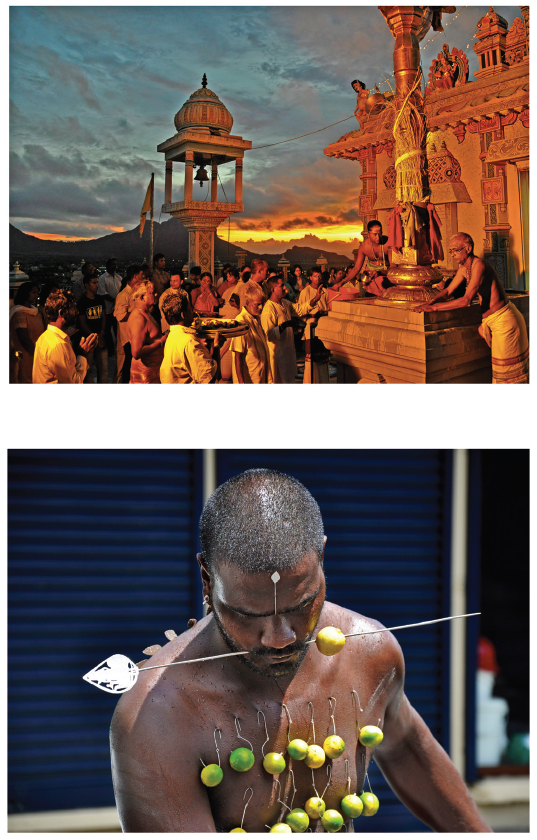
We last met Dimitris Xygalatas (Aarhus University, Denmark) on this blog back in January, with a study of how being in a religious location can affect generosity. What was interesting about that study was that it was done in a non-Western country (Mauritius), with people from a diverse range of religious backgrounds.
In a new study, he (along with colleagues from New Zealand, the Czech Republic, and Denmark) found evidence that extreme religious rituals can stimulate increased generosity – this time focussing on the Hindu community of Mauritius. The authors explain:
We examined two rituals that were part of the annual Hindu festival of Thaipusam, one of the most widely celebrated religious festivals the world over: a low-ordeal ritual involving singing and collective prayer (top picture) and a high-ordeal ritual (Kavadi; bottom picture) involving body piercing with multiple needles and skewers, carrying heavy bamboo structures, and dragging carts attached by hooks to the skin for over 4 hr before climbing a mountain barefooted to reach the temple of Murugan.
Along with the people who actually took part in the two different kinds of rituals, they also studied a group of Kavadi observers (nonperforming participants who walked alongside performers, are often related to them and have themselves previously taken part in he ritual).
After the event, all the participants and observers were given a questionnaire, and also given the opportunity to make an anonymous donation to the temple.
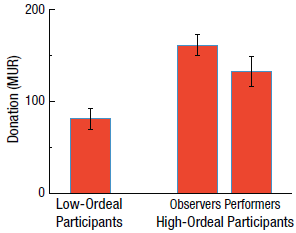
They found that those who had taken part in the extreme ritual, as well as those who had observed it, donated more to the temple (as shown in the chart, which shows the average amount of donation in Mauritian rupees).
And it seems the painfulness of the ordeal was an important factor – the more pain the worshipper reported, the higher the donations. That went for the observers, as well as the active participants!
Intriguingly, the high-ordeal participants also had a more inclusive social identity. They were more likely to say that they felt themselves to be Mauritian, rather than Hindu.
Now, of course it’s hard to tease out cause and effect in a study like this (are more generous, more inclusive people more likely to undertake painful rituals?). But either way, it’s a pretty remarkable result.
I would have predicted exactly the opposite. The high-ordeal participants have already made their contribution – and because people tend to total up their good deeds and balance them out with bad ones (which may be why Christians don’t tip so much after Church services), I would’ve expected those who had suffered for their faith to personally donate less.
The authors comment that:
These results suggest that costly displays of group commitment (though apparently wasteful) may be conserved because they intensify prosocial behaviors and attitudes among the wider community (Henrich, 2009; Sosis & Bressler, 2003).
Which is all well and good, but runs up against the basic evolutionary problem we always have when the group benefits but the individual suffers. The problem is that it’s always better for you as an individual to duck out (see: Religion as a costly signal: why the idea is bunk).
If, however, by undergoing a painful ritual you persuade others to make sacrifices that somehow (directly or indirectly) benefit you, then it might just work…
One last thing. Why, do you suppose, the extreme ritualists ended up feeling warmer to society as a whole, rather than just to their co-religionists? After all, someone dedicated enough to skewer themselves in the name of their gods must surely have religious identification pretty high on their list of priorities?
Well, perhaps it’s to do with the fact that Mauritius, although a pretty mixed society by global standards, is still predominantly Hindu. The authors say:
…identity always functions in a social context (Tajfel, 1984). In the context of a public ritual that recognizes the Hindu majority group, situated in a larger community whose members hold multiple identities, ritual intensity enhanced the superordinate national identity

Xygalatas, D., Mitkidis, P., Fischer, R., Reddish, P., Skewes, J., Geertz, A., Roepstorff, A., & Bulbulia, J. (2013). Extreme Rituals Promote Prosociality Psychological Science DOI: 10.1177/0956797612472910
 This article by Tom Rees was first published on Epiphenom. It is licensed under Creative Commons.
Previous Post

June 17, 2013
People reminded of religion become intolerant of ambiguity
Next Post
July 5, 2013 Regular churchgoers punish those who share their donuts
Browse Our Archives
Select a Category Causes of religion - evolution Causes of religion - psychological Causes of religion - social Demographics Digest Effects of religion - health Effects of religion - psychological Effects of religion - social Notifications Politics Uncategorized
Select a Month March 2016 February 2016 January 2016 December 2015 November 2015 October 2015 September 2015 August 2015 July 2015 June 2015 May 2015 April 2015 March 2015 February 2015 January 2015 December 2014 November 2014 October 2014 September 2014 August 2014 July 2014 June 2014 May 2014 April 2014 March 2014 February 2014 January 2014 December 2013 November 2013 October 2013 September 2013 August 2013 July 2013 June 2013 May 2013 April 2013 March 2013 February 2013 January 2013 December 2012 November 2012 October 2012 September 2012 August 2012 July 2012 June 2012 May 2012 April 2012 March 2012 February 2012 January 2012 December 2011 November 2011 October 2011 September 2011 August 2011 July 2011 June 2011 May 2011 April 2011 March 2011 February 2011 January 2011 December 2010 November 2010 October 2010 September 2010 August 2010 July 2010 June 2010 May 2010 April 2010 March 2010 February 2010 January 2010 December 2009 November 2009 October 2009 September 2009 August 2009 July 2009 June 2009 May 2009 April 2009 March 2009 February 2009 January 2009 December 2008 November 2008 October 2008 September 2008 August 2008 July 2008 June 2008 May 2008 April 2008 March 2008 February 2008 January 2008 December 2007 November 2007 October 2007
Follow Us!
TAKE THE
Religious Wisdom Quiz
Which writer besides Solomon and David contributed to Proverbs?
Select your answer to see how you score.
Asaph Moses Agur Nathan
Related posts from Epiphenom

Do social crises lead to religious revivals? Nah!

What kind of woman would pray for health...

Can you use religion to change attitudes towards...

Dogmatic atheism and fundamentalist Christianity: creating certainty in...
TRENDING AT PATHEOS Nonreligious

Dethroning Jesus and Enthroning Yourself
Jesus Never Asked to Be Worshipped. He Asked to Be Understood. Christianity...

Why Most Christians are Really Paulians and Jobians
I Don't Care, But It Matters Let's get this out of the...

Essential Tips to Successfully Navigate the Selling Process
Selling a house can feel overwhelming, but it doesn’t have to be....

To Make Remote Work Effective, Think About Others
The COVID-19 pandemic forced many companies to rapidly transition to remote work....

Flexibility Is Key to Solving Problems of Tomorrow
The world of work is undergoing a dramatic transformation. The COVID-19 pandemic...
view all Nonreligious blogs
Ad-Free & Subscriber Log-In Subscription Support
- About Us
- 2026 Calendar
- Videos
- Podcasts
- Library of World Religions
- Faith In Media Tracker
- Advertise With Us
- Write for Us
- Privacy Policy
- Terms of Service
- Do Not Sell My Data
- Contact Us
- Radiant Digital
- Manage Newsletter Subscriptions
- Unsubscribe From Notifications
- Sitemap
Copyright 2008-2026, Patheos. All rights reserved.
Subscription Support Ad-Free & Subscriber Log-In
Follow Patheos