
BuddhistCatholicContemplativeEvangelicalGeneral ChristianHinduJewishLatter-day SaintMuslimNew VisionsProgressive Christian
Beliefs
- Buddhist
- Catholic
- Contemplative
- Evangelical
- General Christian
- Hindu
- Jewish
- Latter-day Saint
- More Voices
- Muslim
- New Visions
- Pagan
- Progressive Christian
Topics
- Religion News
- Food and Religion
- Sports and Religion
- Religious Art
- Religious Music and Entertainment
- Religious Events
- History and Religion
- Style and Religion
- Politics and Religion
- Women in Religion
- Recreation Outdoors and Religion
- Business Finance and Religion
- Careers Workplace and Religion
- Education and Religion
- Family Parenting and Religion
- Health Fitness and Religion
- Home and Religion
- Relationships and Religion
- Technology and Religion
- Travel and Religion
Columnists
- Buddhist Columnists
- Business Finance and Religion Columnists
- Careers Workplace and Religion Columnists
- Catholic Columnists
- Contemplative Columnists
- Education and Religion Columnists
- Evangelists Columnists
- Family Parenting and Religion Columnists
- General Christian Columnists
- Health Fitness and Religion Columnists
- Hindu Columnists
- History and Religion Columnists
- Home and Religion Columnists
- Jewish Columnists
- More Voices Columnists
- Latter Day Columnists
- Muslim Columnists
- New Visions Columnists
- Nonreligious Columnists
- Pagan Columnists
- Politics and Religion Columnists
- Progressive Columnists
- Recreation Outdoors and Religion Columnists
- Relationships and Religion Columnists
- Religion News Columnists
- Religious Art Columnists
- Religious Events Columnists
- Religious Music and Entertainment Columnists
- Sports and Religion Columnists
- Style and Religion Columnists
- Technology and Religion Columnists
- Travel and Religion Columnists
- Women in Religion Columnists
Resource Library
- 2026 Calendar
- Library of World Religions
- The 100 Most Holy Places on Earth
- Patheos Answers
- Podcasts
- Videos
- Faith Leaders Database
- Anglican Episcopalian
- Bahai
- Baptist
- Buddhism
- Christianity
- Confucianism
- Eastern Orthodoxy
- Hinduism
- Holiness and Pentecostal
- ISKCON
- Islam
- Judaism
- Lutheran
- Methodist
- The Church of Jesus Christ of Latter-day Saints
- New Age
- Paganism
- Presbytarian and Reformed
- Protestantism
- Religion Behind the Scenes
- Roman Catholic
- Scientology
- Shia Islam
- Sikhism
- Sufism
- Sunni Islam
- Taoism
- Zen
- See all religions
Research Tools
 Ad-Free & Subscriber Log-In Subscription Support
Ad-Free & Subscriber Log-In Subscription Support
Follow Patheos 

- Trending:
- Forgiveness
- |
- Marriage
- |
- Consciousness
- |
- Death Penalty
- |
- Election
- |
- Halloween
 Epiphenom
- Home
- Nonreligious
- If your god didn’t care about right and wrong, would you still be good?
If your god didn’t care about right and wrong, would you still be good?
Last updated on: November 14, 2014 at 10:03 pm by Epiphenom
If your god didn’t care about right and wrong, would you still be good? 2014-11-14T22:03:53+01:00 Epiphenom
Patheos Explore the world's faith through different perspectives on religion and spirituality! Patheos has the views of the prevalent religions and spiritualities of the world.
Studies of religious belief that step outside of the Western bubble are rare, but particularly interesting for that very reason.There’s a lot of great work done that leaves you with a nagging doubt, because you can never be sure that it applies to the human race as a whole (although you can usually surmise that it does not!).
One particular gripe I have is with the idea that we invented gods to keep society functioning nicely by getting everyone to believe in a supernatural policeman. Sounds plausible, and yet when you look at many cultures outside the major monotheisms seems that their gods don’t really care much about morality. They’re interested in you giving them gifts, or looking after their waterhole, or whatever. But they don’t really care whether or not you love your neighbour.
Benjamin Purzycki, from the University of British Columbia in Canada, has been out and about among the people of the Tyva Republic in southern Siberia. Their religion is based around a mixed bag of animism, totemism, shamanism, and Buddhism. One ancient part of their religion involves the Cher eezi, the supernatural lords of resources (e.g., lakes, rivers, trees, etc.) and regions (e.g., kinbased territories, regions that are off-limits to human exploitation, and political districts).
Purzycki began by asking them simply to describe what makes a good or bad person, and also what angers or pleases the spirit masters. By way of a benchmark, he also interviewed anthropology undergraduates from the University of Connecticut – all of them believers in an omniscient god.
Overall, he found, the students were pretty clear and consistent – their God knows everything, but He cares only about the moral information (He knows what colour your shirt is, but he doesn’t care about such things). By contrast, Tyvans gave much more varied answers – suggesting that there’s no consensus about what the spirit masters know or care about.
The idea that the Spirit Masters are watching out for good behaviour just doesn’t seem to be part of their culture.
But he also asked both groups some specific questions – on questions of morality (for example, things like “e.g., Does the cher eezi of this place know if I stole from another person here?” or “…if I lied to someone when I am at home in America?”) as well as and also simple factual questions (e.g. “…that my eyes are blue?).
As well as asking the Tyvans if the spirit masters knew about these things, he also asked them if they cared (as you can see, he was interested to know if the Spirit Masters were only concerned with local misdeeds or whether they are omniscient, like the Western god).
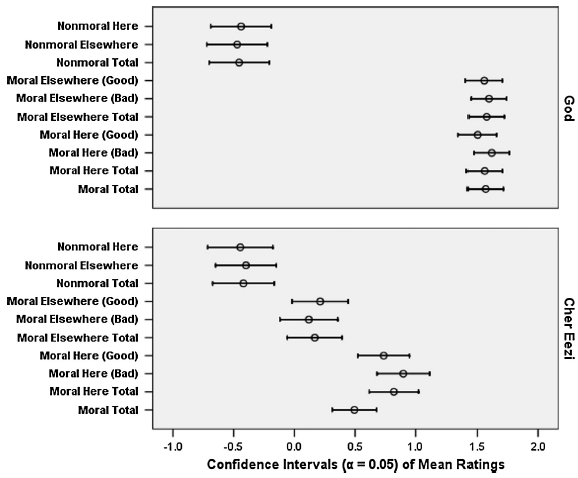
The aggregate numbers were convincing. Take a look at the graphic. It shows how concerned are the Western god and the Tyvan Spirit Masters about moral transgressions.
For the Westerners, god is concerned about all moral acts wherever they are committed. The Tyvan’s spirit masters are not only less concerned about moral transgressions, but that concern ebbs away with distance from their sacred place. Unlike the western gods, the Tyvan just aren’t omniscient.
So it seems that although Tyvan’s don’t really seem to think of moral concerns as a defining feature of the spirit masters, they still, when asked, think that they are concerned about moral behaviour.
Which is a little odd, if you think about it.
Maybe, Purzycki speculates, it’s just that Tyvan’s naturally attribute moral concerns to their Spirit Masters because that’s how other supernatural agents they know about think (e.g. “Buddha”).
To add to that, it strikes me that perhaps they just think the Spirit Master are a bit like people. Most people would not define themselves as being preoccupied by morality – though isf asked you would take a dim view of shoplifting, say.
Regardless, the implication is that nonmoral gods could provoke us into more moral behaviours – similar to the way people cheat less if they think there is a ghost in the room.
Which is intriguing but I wonder about the practical effects. Most people who lie or cheat usually believe that their behaviour is justified. It’s a small step from there to convincing yourself that the Spirit Master is on your side – especially if the terms of moral behaviour are not rigidly defined.
So, as Purzycki concludes:
…the ultimate question of whether or not various explicit conceptions of gods’ minds have particular behavioral and fitness effects requires further investigation. Is there variation in levels of prosociality for populations who explicitly moralize their deities?
Really, the problem depends a lot on the cultural context. And there’s going to be interplay between the cultural context and how the local gods come to be seen and defined. Maybe there’s more than one way to skin the “complex society” cat.

Purzycki BG (2013). The minds of gods: a comparative study of supernatural agency. Cognition, 129 (1), 163-79 PMID: 23891826
 This article by Tom Rees was first published on Epiphenom. It is licensed under Creative Commons.
Next Post

January 9, 2014 That was the year that was 2013
Browse Our Archives
Select a Category Causes of religion - evolution Causes of religion - psychological Causes of religion - social Demographics Digest Effects of religion - health Effects of religion - psychological Effects of religion - social Notifications Politics Uncategorized
Select a Month March 2016 February 2016 January 2016 December 2015 November 2015 October 2015 September 2015 August 2015 July 2015 June 2015 May 2015 April 2015 March 2015 February 2015 January 2015 December 2014 November 2014 October 2014 September 2014 August 2014 July 2014 June 2014 May 2014 April 2014 March 2014 February 2014 January 2014 December 2013 November 2013 October 2013 September 2013 August 2013 July 2013 June 2013 May 2013 April 2013 March 2013 February 2013 January 2013 December 2012 November 2012 October 2012 September 2012 August 2012 July 2012 June 2012 May 2012 April 2012 March 2012 February 2012 January 2012 December 2011 November 2011 October 2011 September 2011 August 2011 July 2011 June 2011 May 2011 April 2011 March 2011 February 2011 January 2011 December 2010 November 2010 October 2010 September 2010 August 2010 July 2010 June 2010 May 2010 April 2010 March 2010 February 2010 January 2010 December 2009 November 2009 October 2009 September 2009 August 2009 July 2009 June 2009 May 2009 April 2009 March 2009 February 2009 January 2009 December 2008 November 2008 October 2008 September 2008 August 2008 July 2008 June 2008 May 2008 April 2008 March 2008 February 2008 January 2008 December 2007 November 2007 October 2007
Follow Us!
TAKE THE
Religious Wisdom Quiz
Who was the only woman to rule as queen over Judah?
Select your answer to see how you score.
Bathsheba Jezebel Miriam Athaliah
Related posts from Epiphenom

Do social crises lead to religious revivals? Nah!

What kind of woman would pray for health...

Can you use religion to change attitudes towards...

Dogmatic atheism and fundamentalist Christianity: creating certainty in...
TRENDING AT PATHEOS Nonreligious

Dethroning Jesus and Enthroning Yourself
Jesus Never Asked to Be Worshipped. He Asked to Be Understood. Christianity...

Why Most Christians are Really Paulians and Jobians
I Don't Care, But It Matters Let's get this out of the...

Essential Tips to Successfully Navigate the Selling Process
Selling a house can feel overwhelming, but it doesn’t have to be....

To Make Remote Work Effective, Think About Others
The COVID-19 pandemic forced many companies to rapidly transition to remote work....

Flexibility Is Key to Solving Problems of Tomorrow
The world of work is undergoing a dramatic transformation. The COVID-19 pandemic...
view all Nonreligious blogs
Ad-Free & Subscriber Log-In Subscription Support
- About Us
- 2026 Calendar
- Videos
- Podcasts
- Library of World Religions
- Faith In Media Tracker
- Advertise With Us
- Write for Us
- Privacy Policy
- Terms of Service
- Do Not Sell My Data
- Contact Us
- Radiant Digital
- Manage Newsletter Subscriptions
- Unsubscribe From Notifications
- Sitemap
Copyright 2008-2026, Patheos. All rights reserved.
Subscription Support Ad-Free & Subscriber Log-In
Follow Patheos