
BuddhistCatholicContemplativeEvangelicalGeneral ChristianHinduJewishLatter-day SaintMuslimNew VisionsProgressive Christian
Beliefs
- Buddhist
- Catholic
- Contemplative
- Evangelical
- General Christian
- Hindu
- Jewish
- Latter-day Saint
- More Voices
- Muslim
- New Visions
- Pagan
- Progressive Christian
Topics
- Religion News
- Food and Religion
- Sports and Religion
- Religious Art
- Religious Music and Entertainment
- Religious Events
- History and Religion
- Style and Religion
- Politics and Religion
- Women in Religion
- Recreation Outdoors and Religion
- Business Finance and Religion
- Careers Workplace and Religion
- Education and Religion
- Family Parenting and Religion
- Health Fitness and Religion
- Home and Religion
- Relationships and Religion
- Technology and Religion
- Travel and Religion
Columnists
- Buddhist Columnists
- Business Finance and Religion Columnists
- Careers Workplace and Religion Columnists
- Catholic Columnists
- Contemplative Columnists
- Education and Religion Columnists
- Evangelists Columnists
- Family Parenting and Religion Columnists
- General Christian Columnists
- Health Fitness and Religion Columnists
- Hindu Columnists
- History and Religion Columnists
- Home and Religion Columnists
- Jewish Columnists
- More Voices Columnists
- Latter Day Columnists
- Muslim Columnists
- New Visions Columnists
- Nonreligious Columnists
- Pagan Columnists
- Politics and Religion Columnists
- Progressive Columnists
- Recreation Outdoors and Religion Columnists
- Relationships and Religion Columnists
- Religion News Columnists
- Religious Art Columnists
- Religious Events Columnists
- Religious Music and Entertainment Columnists
- Sports and Religion Columnists
- Style and Religion Columnists
- Technology and Religion Columnists
- Travel and Religion Columnists
- Women in Religion Columnists
Resource Library
- 2026 Calendar
- Library of World Religions
- The 100 Most Holy Places on Earth
- Patheos Answers
- Podcasts
- Videos
- Faith Leaders Database
- Anglican Episcopalian
- Bahai
- Baptist
- Buddhism
- Christianity
- Confucianism
- Eastern Orthodoxy
- Hinduism
- Holiness and Pentecostal
- ISKCON
- Islam
- Judaism
- Lutheran
- Methodist
- The Church of Jesus Christ of Latter-day Saints
- New Age
- Paganism
- Presbytarian and Reformed
- Protestantism
- Religion Behind the Scenes
- Roman Catholic
- Scientology
- Shia Islam
- Sikhism
- Sufism
- Sunni Islam
- Taoism
- Zen
- See all religions
Research Tools
 Ad-Free & Subscriber Log-In Subscription Support
Ad-Free & Subscriber Log-In Subscription Support
Follow Patheos 

- Trending:
- Forgiveness
- |
- Marriage
- |
- Consciousness
- |
- Death Penalty
- |
- Election
- |
- Halloween
 Epiphenom
- Home
- Nonreligious
- Cloud of dots or person walking in a snowstorm? Paranormal believers see people when they’re not there.
Cloud of dots or person walking in a snowstorm? Paranormal believers see people when they’re not there.
Last updated on: November 14, 2014 at 10:06 pm by Epiphenom
Cloud of dots or person walking in a snowstorm? Paranormal believers see people when they’re not there. 2014-11-14T22:06:21+01:00 Epiphenom
Patheos Explore the world's faith through different perspectives on religion and spirituality! Patheos has the views of the prevalent religions and spiritualities of the world.
Imagine yourself walking on your own through a dark forest. Each and every movement that you perceive will result in the feeling that another person or animal is present. From an evolutionary point of view, incorrectly assuming the presence of another agent while there is none (i.e. a false positive) is associated with only little costs, whereas the false belief that no other agent is present while in fact there is one (i.e. a false negative) can cost one’s life.
I’ve lifted that from the introduction to a new paper by Michiel van Elk (University of Amsterdam), because it rather beautifully describes a phenomenon that is often cited as contributing to religious belief.

Now, previous studies have already shown that believers in the paranormal are also more likely to see patterns, such as faces, in a jumble of stuff. But they haven’t looked at moving objects – i.e. things that are ‘agents’, actively doing stuff. So previous studies don’t directly support the theory.
what van Elk did was to show a group of subjects (a mix of local students or people visting a paranormal fair some moving point images of a person. You can see the kind of thing they saw in the graphic – although what they actually were shown was animated dots representing a person walking on a treadmill.
The walker could appear at different places on the screen, and was sometimes obscured by clouds of random dots. Sometimes there were random dots and no noise.
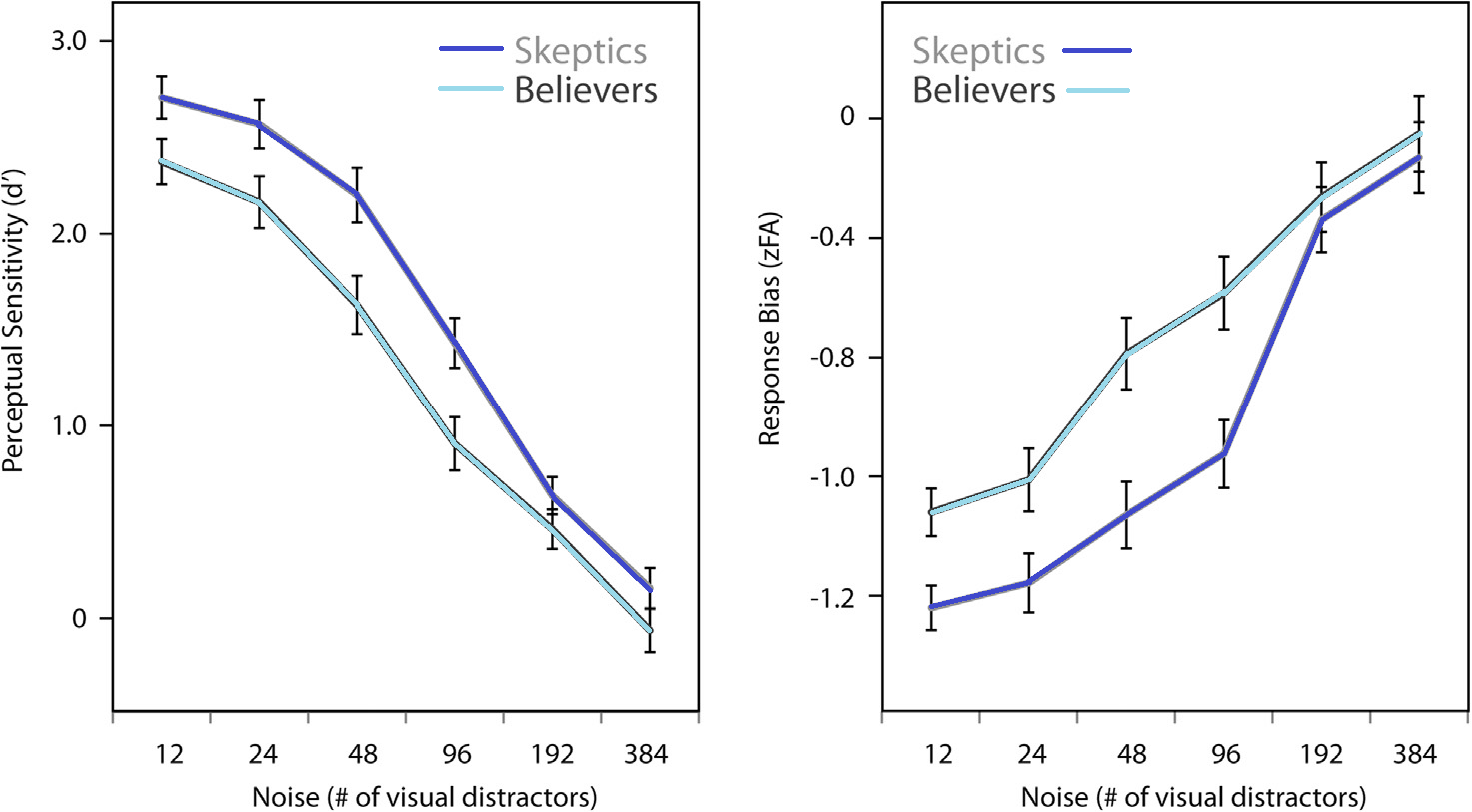
He found that perceptual sensitivity – the difference between ‘hit’ rates (when the viewer accurately spotted a real figure) and false alarm rates (when the viewer saw a figure that wasn’t there) went down as background noise levels increased (that’s what shown in the left-hand graphic). But overall, it was higher among the skeptics than among paranormal believers.
Skeptics also had lower response bias (shown in the graphic on the right) – that’s the tendency to say there is figure there when there is none (taking into account the average hit-and-miss guesswork of the group as a whole).
What was most interesting was that the difference in response bias between the paranormal believers and the skeptics was highest when background noise levels were in the mid-range.
van Elk has this to say about that finding:
paranormal believers show a stronger response bias than skeptics for stimuli that in principle could afford agency-detection (i.e. if a human agent is present, it should be detectable) but not for stimuli that are obviously too noisy (see also: Blackmore & Moore, 1993). In other words: illusory pattern perception seems limited to stimuli that in principle could be meaningful.
That fits in with other research that shows that paranormal believers tend have their ‘signal gain’ turned up to high. They strain to find evidence of agents at work – but only in circumstances where that could plausibly be the case.
Given that non-believers in the paranormal also tend to turn up their signal detection when they are distressed or anxious, this could help to explain the link between religious belief and tough environments.

van Elk M (2013). Paranormal believers are more prone to illusory agency detection than skeptics. Consciousness and cognition, 22 (3), 1041-6 PMID: 23933505
 This article by Tom Rees was first published on Epiphenom. It is licensed under Creative Commons.
Previous Post

November 19, 2013
Faith in god and faith in doctors
Next Post
December 18, 2013 If your god didn't care about right and wrong, would you still be good?
Browse Our Archives
Select a Category Causes of religion - evolution Causes of religion - psychological Causes of religion - social Demographics Digest Effects of religion - health Effects of religion - psychological Effects of religion - social Notifications Politics Uncategorized
Select a Month March 2016 February 2016 January 2016 December 2015 November 2015 October 2015 September 2015 August 2015 July 2015 June 2015 May 2015 April 2015 March 2015 February 2015 January 2015 December 2014 November 2014 October 2014 September 2014 August 2014 July 2014 June 2014 May 2014 April 2014 March 2014 February 2014 January 2014 December 2013 November 2013 October 2013 September 2013 August 2013 July 2013 June 2013 May 2013 April 2013 March 2013 February 2013 January 2013 December 2012 November 2012 October 2012 September 2012 August 2012 July 2012 June 2012 May 2012 April 2012 March 2012 February 2012 January 2012 December 2011 November 2011 October 2011 September 2011 August 2011 July 2011 June 2011 May 2011 April 2011 March 2011 February 2011 January 2011 December 2010 November 2010 October 2010 September 2010 August 2010 July 2010 June 2010 May 2010 April 2010 March 2010 February 2010 January 2010 December 2009 November 2009 October 2009 September 2009 August 2009 July 2009 June 2009 May 2009 April 2009 March 2009 February 2009 January 2009 December 2008 November 2008 October 2008 September 2008 August 2008 July 2008 June 2008 May 2008 April 2008 March 2008 February 2008 January 2008 December 2007 November 2007 October 2007
Follow Us!
TAKE THE
Religious Wisdom Quiz
According to Hebrews, without what is it impossible to please God?
Select your answer to see how you score.
Love Sacrifice Obedience Faith
Related posts from Epiphenom

Do social crises lead to religious revivals? Nah!

What kind of woman would pray for health...

Can you use religion to change attitudes towards...

Dogmatic atheism and fundamentalist Christianity: creating certainty in...
TRENDING AT PATHEOS Nonreligious

Dethroning Jesus and Enthroning Yourself
Jesus Never Asked to Be Worshipped. He Asked to Be Understood. Christianity...

Why Most Christians are Really Paulians and Jobians
I Don't Care, But It Matters Let's get this out of the...

Essential Tips to Successfully Navigate the Selling Process
Selling a house can feel overwhelming, but it doesn’t have to be....

To Make Remote Work Effective, Think About Others
The COVID-19 pandemic forced many companies to rapidly transition to remote work....

Flexibility Is Key to Solving Problems of Tomorrow
The world of work is undergoing a dramatic transformation. The COVID-19 pandemic...
view all Nonreligious blogs
Ad-Free & Subscriber Log-In Subscription Support
- About Us
- 2026 Calendar
- Videos
- Podcasts
- Library of World Religions
- Faith In Media Tracker
- Advertise With Us
- Write for Us
- Privacy Policy
- Terms of Service
- Do Not Sell My Data
- Contact Us
- Radiant Digital
- Manage Newsletter Subscriptions
- Unsubscribe From Notifications
- Sitemap
Copyright 2008-2026, Patheos. All rights reserved.
Subscription Support Ad-Free & Subscriber Log-In
Follow Patheos