
BuddhistCatholicContemplativeEvangelicalGeneral ChristianHinduJewishLatter-day SaintMuslimNew VisionsProgressive Christian
Beliefs
- Buddhist
- Catholic
- Contemplative
- Evangelical
- General Christian
- Hindu
- Jewish
- Latter-day Saint
- More Voices
- Muslim
- New Visions
- Pagan
- Progressive Christian
Topics
- Religion News
- Food and Religion
- Sports and Religion
- Religious Art
- Religious Music and Entertainment
- Religious Events
- History and Religion
- Style and Religion
- Politics and Religion
- Women in Religion
- Recreation Outdoors and Religion
- Business Finance and Religion
- Careers Workplace and Religion
- Education and Religion
- Family Parenting and Religion
- Health Fitness and Religion
- Home and Religion
- Relationships and Religion
- Technology and Religion
- Travel and Religion
Columnists
- Buddhist Columnists
- Business Finance and Religion Columnists
- Careers Workplace and Religion Columnists
- Catholic Columnists
- Contemplative Columnists
- Education and Religion Columnists
- Evangelists Columnists
- Family Parenting and Religion Columnists
- General Christian Columnists
- Health Fitness and Religion Columnists
- Hindu Columnists
- History and Religion Columnists
- Home and Religion Columnists
- Jewish Columnists
- More Voices Columnists
- Latter Day Columnists
- Muslim Columnists
- New Visions Columnists
- Nonreligious Columnists
- Pagan Columnists
- Politics and Religion Columnists
- Progressive Columnists
- Recreation Outdoors and Religion Columnists
- Relationships and Religion Columnists
- Religion News Columnists
- Religious Art Columnists
- Religious Events Columnists
- Religious Music and Entertainment Columnists
- Sports and Religion Columnists
- Style and Religion Columnists
- Technology and Religion Columnists
- Travel and Religion Columnists
- Women in Religion Columnists
Resource Library
- 2026 Calendar
- Library of World Religions
- The 100 Most Holy Places on Earth
- Patheos Answers
- Podcasts
- Videos
- Faith Leaders Database
- Anglican Episcopalian
- Bahai
- Baptist
- Buddhism
- Christianity
- Confucianism
- Eastern Orthodoxy
- Hinduism
- Holiness and Pentecostal
- ISKCON
- Islam
- Judaism
- Lutheran
- Methodist
- The Church of Jesus Christ of Latter-day Saints
- New Age
- Paganism
- Presbytarian and Reformed
- Protestantism
- Religion Behind the Scenes
- Roman Catholic
- Scientology
- Shia Islam
- Sikhism
- Sufism
- Sunni Islam
- Taoism
- Zen
- See all religions
Research Tools
 Ad-Free & Subscriber Log-In Subscription Support
Ad-Free & Subscriber Log-In Subscription Support
Follow Patheos 

- Trending:
- Forgiveness
- |
- Marriage
- |
- Consciousness
- |
- Death Penalty
- |
- Election
- |
- Halloween
 Epiphenom
- Home
- Nonreligious
- Non-religious jews are more likely to tell self-serving ‘white lies’ than religious jews
Non-religious jews are more likely to tell self-serving ‘white lies’ than religious jews
Last updated on: November 14, 2014 at 10:11 pm by Epiphenom
Non-religious jews are more likely to tell self-serving ‘white lies’ than religious jews 2014-11-14T22:11:52+01:00 Epiphenom
Patheos Explore the world's faith through different perspectives on religion and spirituality! Patheos has the views of the prevalent religions and spiritualities of the world.
What would you do if fate had been a little unkind to you, but you get the chance to make it up for yourself with a small lie?
Take, for example, the experimental setup that Shaul Shalvi and David Leiser, both at Ben Gurion University of the Negev used on two groups of Israeli students. One group was from a secular campus, the other from a ‘religious’ one – meaning that they were orthodox jews.
They asked them to roll a die by shaking it in a cup and then upending it. There was a small hole in the top of the cup, so the students – and no-one else – could see the results of the roll. They were told that they would get paid an amount proportional to the die roll. So if they rolled a 1, they would get 3 Shekels (about 75 US cents), but if they rolled a 6 they would get 18 shekels.
Then they rolled the die again – just to check that it wasn’t loaded. And once again, only they could see the results.
So, what happened? Did everyone faithfully report the number they got with the first die roll? Or did some people, dissatisfied with their luck the first time round, feel they deserved something better? Maybe they reported the second roll instead?
Well, this was a genuinely anonymous experiment, so Shalvi and Leiser couldn’t tell if any particular individual lied. But they could look at the statistics.
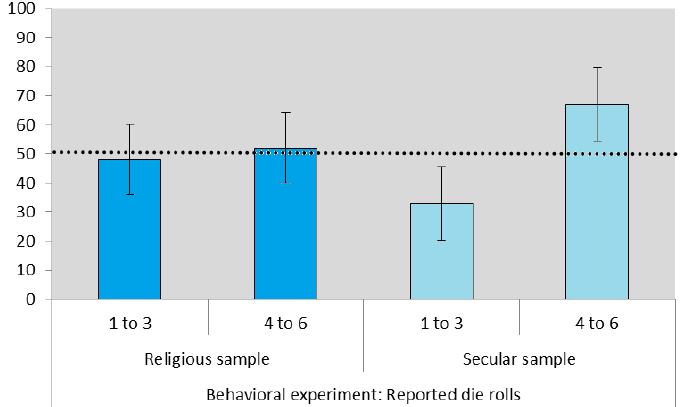
As you can see in the figure, the religious students reported rolling the same number of low (1-3) and high (4-6) numbers. In other words, what they reported was exactly what you would expect from chance.
The secular students, however, were much more likely to report rolling a 4-6. Some of them must be lying!
To understand why some secular students felt it was OK to lie, a week later Shalvi and Leiser asked some of the students to evaluate some examples of other people playing the die-rolling game.
These included examples in which the player was honest, examples in which the player was ‘justifiably’ dishonest (for example, they rolled a low number the first time, but honestly reported the higher number they got from the second roll), and ‘unjustifiably’ dishonest (in which the number to player reported was entirely fictional).
They found that religious students judged both kinds of lying more harshly than the secular students. But, more interestingly, while religious students were almost equally harsh in their judgement of justifiable and unjustifiable lies, or secular students there was a big difference between the two.
Secular students thought the the ‘justifiable’ lying really was justifiable! Religious students disagreed.
What this suggests is that secular student’s views of what is dishonest or not depends on the circumstances. If someone is feeling hard done by, it’s OK to tell a little lie to restore the balance. For religious students, lying is lying and that’s it.
Now, put this together with other research showing that religion and authoritarianism act together to stop people telling ‘white’ lies, and the previous post about research showing that religious people stick to the rules regardless of the consequences, and a picture begins to emerge.
Lying and trust go hand in hand. If everyone strictly follows the rules, then you know where you are. But if people are willing to bend the rules in their own interests, then communal life become much more tricky.
It seems to me that, while at first sight the rigid approach to moral rules seems harsh and possibly dangerous, it is probably essential for close communities. When you absolutely depend on your neighbours, you’d better be sure you know how they are going to behave!
So although it might seem crazy that religious people rely more on rules than on consequences when determining what is right and wrong, it might well be a sensible strategy when the circumstances are right.

Saul Shalvi, & David Leiser (2013). Moral Firmness Journal of Economic Behavior & Organization, 93, 400-4007 DOI: 10.1016/j.jebo.2013.03.014
 This article by Tom Rees was first published on Epiphenom. It is licensed under Creative Commons.
Previous Post

September 28, 2013
Do the right thing and hang the consequences!
Next Post
October 23, 2013 Drumming together
Browse Our Archives
Select a Category Causes of religion - evolution Causes of religion - psychological Causes of religion - social Demographics Digest Effects of religion - health Effects of religion - psychological Effects of religion - social Notifications Politics Uncategorized
Select a Month March 2016 February 2016 January 2016 December 2015 November 2015 October 2015 September 2015 August 2015 July 2015 June 2015 May 2015 April 2015 March 2015 February 2015 January 2015 December 2014 November 2014 October 2014 September 2014 August 2014 July 2014 June 2014 May 2014 April 2014 March 2014 February 2014 January 2014 December 2013 November 2013 October 2013 September 2013 August 2013 July 2013 June 2013 May 2013 April 2013 March 2013 February 2013 January 2013 December 2012 November 2012 October 2012 September 2012 August 2012 July 2012 June 2012 May 2012 April 2012 March 2012 February 2012 January 2012 December 2011 November 2011 October 2011 September 2011 August 2011 July 2011 June 2011 May 2011 April 2011 March 2011 February 2011 January 2011 December 2010 November 2010 October 2010 September 2010 August 2010 July 2010 June 2010 May 2010 April 2010 March 2010 February 2010 January 2010 December 2009 November 2009 October 2009 September 2009 August 2009 July 2009 June 2009 May 2009 April 2009 March 2009 February 2009 January 2009 December 2008 November 2008 October 2008 September 2008 August 2008 July 2008 June 2008 May 2008 April 2008 March 2008 February 2008 January 2008 December 2007 November 2007 October 2007
Follow Us!
TAKE THE
Religious Wisdom Quiz
Who helped Jesus carry His cross?
Select your answer to see how you score.
Peter Simon of Cyrene John Judas
Related posts from Epiphenom

Do social crises lead to religious revivals? Nah!

What kind of woman would pray for health...

Can you use religion to change attitudes towards...

Dogmatic atheism and fundamentalist Christianity: creating certainty in...
TRENDING AT PATHEOS Nonreligious

Dethroning Jesus and Enthroning Yourself
Jesus Never Asked to Be Worshipped. He Asked to Be Understood. Christianity...

Why Most Christians are Really Paulians and Jobians
I Don't Care, But It Matters Let's get this out of the...

Essential Tips to Successfully Navigate the Selling Process
Selling a house can feel overwhelming, but it doesn’t have to be....

To Make Remote Work Effective, Think About Others
The COVID-19 pandemic forced many companies to rapidly transition to remote work....

Flexibility Is Key to Solving Problems of Tomorrow
The world of work is undergoing a dramatic transformation. The COVID-19 pandemic...
view all Nonreligious blogs
Ad-Free & Subscriber Log-In Subscription Support
- About Us
- 2026 Calendar
- Videos
- Podcasts
- Library of World Religions
- Faith In Media Tracker
- Advertise With Us
- Write for Us
- Privacy Policy
- Terms of Service
- Do Not Sell My Data
- Contact Us
- Radiant Digital
- Manage Newsletter Subscriptions
- Unsubscribe From Notifications
- Sitemap
Copyright 2008-2026, Patheos. All rights reserved.
Subscription Support Ad-Free & Subscriber Log-In
Follow Patheos