
BuddhistCatholicContemplativeEvangelicalGeneral ChristianHinduJewishLatter-day SaintMuslimNew VisionsProgressive Christian
Beliefs
- Buddhist
- Catholic
- Contemplative
- Evangelical
- General Christian
- Hindu
- Jewish
- Latter-day Saint
- More Voices
- Muslim
- New Visions
- Pagan
- Progressive Christian
Topics
- Religion News
- Food and Religion
- Sports and Religion
- Religious Art
- Religious Music and Entertainment
- Religious Events
- History and Religion
- Style and Religion
- Politics and Religion
- Women in Religion
- Recreation Outdoors and Religion
- Business Finance and Religion
- Careers Workplace and Religion
- Education and Religion
- Family Parenting and Religion
- Health Fitness and Religion
- Home and Religion
- Relationships and Religion
- Technology and Religion
- Travel and Religion
Columnists
- Buddhist Columnists
- Business Finance and Religion Columnists
- Careers Workplace and Religion Columnists
- Catholic Columnists
- Contemplative Columnists
- Education and Religion Columnists
- Evangelists Columnists
- Family Parenting and Religion Columnists
- General Christian Columnists
- Health Fitness and Religion Columnists
- Hindu Columnists
- History and Religion Columnists
- Home and Religion Columnists
- Jewish Columnists
- More Voices Columnists
- Latter Day Columnists
- Muslim Columnists
- New Visions Columnists
- Nonreligious Columnists
- Pagan Columnists
- Politics and Religion Columnists
- Progressive Columnists
- Recreation Outdoors and Religion Columnists
- Relationships and Religion Columnists
- Religion News Columnists
- Religious Art Columnists
- Religious Events Columnists
- Religious Music and Entertainment Columnists
- Sports and Religion Columnists
- Style and Religion Columnists
- Technology and Religion Columnists
- Travel and Religion Columnists
- Women in Religion Columnists
Resource Library
- 2026 Calendar
- Library of World Religions
- The 100 Most Holy Places on Earth
- Patheos Answers
- Podcasts
- Videos
- Faith Leaders Database
- Anglican Episcopalian
- Bahai
- Baptist
- Buddhism
- Christianity
- Confucianism
- Eastern Orthodoxy
- Hinduism
- Holiness and Pentecostal
- ISKCON
- Islam
- Judaism
- Lutheran
- Methodist
- The Church of Jesus Christ of Latter-day Saints
- New Age
- Paganism
- Presbytarian and Reformed
- Protestantism
- Religion Behind the Scenes
- Roman Catholic
- Scientology
- Shia Islam
- Sikhism
- Sufism
- Sunni Islam
- Taoism
- Zen
- See all religions
Research Tools
 Ad-Free & Subscriber Log-In Subscription Support
Ad-Free & Subscriber Log-In Subscription Support
Follow Patheos 

- Trending:
- Forgiveness
- |
- Marriage
- |
- Consciousness
- |
- Death Penalty
- |
- Election
- |
- Halloween
 Epiphenom
- Home
- Nonreligious
- Do the right thing and hang the consequences!
Do the right thing and hang the consequences!
Last updated on: November 11, 2014 at 9:12 pm by Epiphenom
Do the right thing and hang the consequences! 2014-11-11T21:12:02+01:00 Epiphenom
Patheos Explore the world's faith through different perspectives on religion and spirituality! Patheos has the views of the prevalent religions and spiritualities of the world.
Is it ever OK to break the rules? Are some values simply sacred, never to be abandoned? When faced with a moral dilemma, do you always hold fast or do you sometimes bend?
We know from previous research that religious conservatives tend to favour moral absolutes. There are certain rules that must be adhered to, even if a clear justification seems hard to come by.
One theory about why this is so is that the religious don’t want to think to hard. It’s just easier to say that rules is rules.
But Jared Piazza (University of Pennsylvania) and Paulo Sousa (Queen’s University Belfast, UK) suspected something else is happening. They think that religious people believe that consequences are unimportant – adhering to taboos and conventions isthe objective, not optimising outcomes.
To test this, they ran three online studies putting some hypothetical scenarios to adults – mostly in the US but in the third study they extended their sample to India.
In the first study, they found that religious people were less likely to say that it is acceptable to break a promise if the result is to “produce greater good than bad”. OK, but feasibly that could happen if religious people simply don’t care much about what happens to other people.
So then they rephrased their questions, asking if it’s OK to break a rule if that means that the rule will be broken less in the future. For example, they asked if their subjects agreed that “If breaking the law will prevent even more law breaking, then it is morally permissible to break the law”
Still the religious subjects were less likely to approve of rule breaking. They were not ‘consequentialist’ thinkers.
But even so, this may all be something to do with not wanting to cause or permit something bad to happen. So in the final study, they asked about moral transgressions with no consequences at all, either good or ill.
They got their subjects to read a couple of scenarios – one depicting incest, and one depicting cannibalism. They asked them whether this was permissible or impermissible. If the subject said it was impermissible, then they went to extra lengths to explain to them that these were acts that don’t cause any harm, injustice or negative consequences
They found that the religiosity of their subjects was linked to the view that incest was impermissible, but not really to views about cannibalism. The political conservatism of their subjects, on the other hand, was linked to rejection of cannibalism but not of incest.
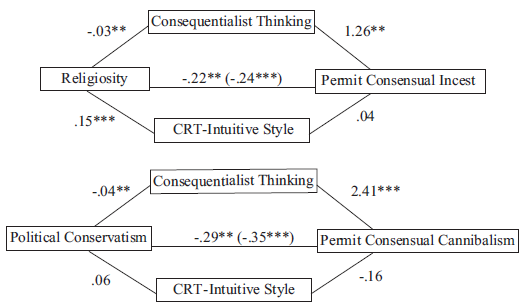 They also tested all their subjects for their thinking style. Whether or not they were intuitive thinkers (going by instinctive, gut feeling) and whether or not they were consequentialist thinkers(using the same tests that they used earlier).
They found that religiosity was linked to intuitive thinking and a disregard for consequences. Conservatism was also linked to disregard for consequences, but not to intuitive thinking.
When they put all these data into their model (shown in the figure), what popped out was that the lack of interest in consequences, rather than intuitive thinking, was the best explanation for the rejection of incest by the religious and of canabalism by political conservatives.
Interestingly, it didn’t matter whether their subjects were American or Indian – they saw the same pattern.
Piazza had previously shown that religious people are more likely to appeal to rules, rather than outcomes, when justifying their condemnation of wrongdoers. In this study, Piazza and Sousa say:
We have shown that both religious and conservative-minded individuals are reluctant to endorse the permissibility of various rule violations even when doing so optimizes the good (Study 1), prevents further wrongdoing (Study 2), or produces no negative consequences (Study 3).
That’s pretty powerfuls stuff. What’s more, it seems to be particularly linked to religion, rather than political conservatism – even though the two overlap to quite a degree.
So, after reading through all this, you’re probably thinking that this is one in the eye for religion. After all, it seems pretty simple not to bend the rules in order to get better outcomes. But this is one of those areas where it all depends on which lens you use to view the world – as the study that I’ll talk about in my next post will show!

Jared Piazza, & Paulo Sousa (2013). Religiosity, Political Orientation, and Consequentialist Moral Thinking Social Psychological and Personality Science DOI: 10.1177/1948550613492826
 This article by Tom Rees was first published on Epiphenom. It is licensed under Creative Commons.
Previous Post

September 18, 2013
Does science make you moral?
Browse Our Archives
Select a Category Causes of religion - evolution Causes of religion - psychological Causes of religion - social Demographics Digest Effects of religion - health Effects of religion - psychological Effects of religion - social Notifications Politics Uncategorized
Select a Month March 2016 February 2016 January 2016 December 2015 November 2015 October 2015 September 2015 August 2015 July 2015 June 2015 May 2015 April 2015 March 2015 February 2015 January 2015 December 2014 November 2014 October 2014 September 2014 August 2014 July 2014 June 2014 May 2014 April 2014 March 2014 February 2014 January 2014 December 2013 November 2013 October 2013 September 2013 August 2013 July 2013 June 2013 May 2013 April 2013 March 2013 February 2013 January 2013 December 2012 November 2012 October 2012 September 2012 August 2012 July 2012 June 2012 May 2012 April 2012 March 2012 February 2012 January 2012 December 2011 November 2011 October 2011 September 2011 August 2011 July 2011 June 2011 May 2011 April 2011 March 2011 February 2011 January 2011 December 2010 November 2010 October 2010 September 2010 August 2010 July 2010 June 2010 May 2010 April 2010 March 2010 February 2010 January 2010 December 2009 November 2009 October 2009 September 2009 August 2009 July 2009 June 2009 May 2009 April 2009 March 2009 February 2009 January 2009 December 2008 November 2008 October 2008 September 2008 August 2008 July 2008 June 2008 May 2008 April 2008 March 2008 February 2008 January 2008 December 2007 November 2007 October 2007
Follow Us!
TAKE THE
Religious Wisdom Quiz
Who interpreted Peter's vision about clean and unclean animals?
Select your answer to see how you score.
Barnabas Paul God Philip
Related posts from Epiphenom

Do social crises lead to religious revivals? Nah!

What kind of woman would pray for health...

Can you use religion to change attitudes towards...

Dogmatic atheism and fundamentalist Christianity: creating certainty in...
TRENDING AT PATHEOS Nonreligious

Dethroning Jesus and Enthroning Yourself
Jesus Never Asked to Be Worshipped. He Asked to Be Understood. Christianity...

Why Most Christians are Really Paulians and Jobians
I Don't Care, But It Matters Let's get this out of the...

Essential Tips to Successfully Navigate the Selling Process
Selling a house can feel overwhelming, but it doesn’t have to be....

To Make Remote Work Effective, Think About Others
The COVID-19 pandemic forced many companies to rapidly transition to remote work....

Flexibility Is Key to Solving Problems of Tomorrow
The world of work is undergoing a dramatic transformation. The COVID-19 pandemic...
view all Nonreligious blogs
Ad-Free & Subscriber Log-In Subscription Support
- About Us
- 2026 Calendar
- Videos
- Podcasts
- Library of World Religions
- Faith In Media Tracker
- Advertise With Us
- Write for Us
- Privacy Policy
- Terms of Service
- Do Not Sell My Data
- Contact Us
- Radiant Digital
- Manage Newsletter Subscriptions
- Unsubscribe From Notifications
- Sitemap
Copyright 2008-2026, Patheos. All rights reserved.
Subscription Support Ad-Free & Subscriber Log-In
Follow Patheos