
BuddhistCatholicContemplativeEvangelicalGeneral ChristianHinduJewishLatter-day SaintMuslimNew VisionsProgressive Christian
Beliefs
- Buddhist
- Catholic
- Contemplative
- Evangelical
- General Christian
- Hindu
- Jewish
- Latter-day Saint
- More Voices
- Muslim
- New Visions
- Pagan
- Progressive Christian
Topics
- Religion News
- Food and Religion
- Sports and Religion
- Religious Art
- Religious Music and Entertainment
- Religious Events
- History and Religion
- Style and Religion
- Politics and Religion
- Women in Religion
- Recreation Outdoors and Religion
- Business Finance and Religion
- Careers Workplace and Religion
- Education and Religion
- Family Parenting and Religion
- Health Fitness and Religion
- Home and Religion
- Relationships and Religion
- Technology and Religion
- Travel and Religion
Columnists
- Buddhist Columnists
- Business Finance and Religion Columnists
- Careers Workplace and Religion Columnists
- Catholic Columnists
- Contemplative Columnists
- Education and Religion Columnists
- Evangelists Columnists
- Family Parenting and Religion Columnists
- General Christian Columnists
- Health Fitness and Religion Columnists
- Hindu Columnists
- History and Religion Columnists
- Home and Religion Columnists
- Jewish Columnists
- More Voices Columnists
- Latter Day Columnists
- Muslim Columnists
- New Visions Columnists
- Nonreligious Columnists
- Pagan Columnists
- Politics and Religion Columnists
- Progressive Columnists
- Recreation Outdoors and Religion Columnists
- Relationships and Religion Columnists
- Religion News Columnists
- Religious Art Columnists
- Religious Events Columnists
- Religious Music and Entertainment Columnists
- Sports and Religion Columnists
- Style and Religion Columnists
- Technology and Religion Columnists
- Travel and Religion Columnists
- Women in Religion Columnists
Resource Library
- 2026 Calendar
- Library of World Religions
- The 100 Most Holy Places on Earth
- Patheos Answers
- Podcasts
- Videos
- Faith Leaders Database
- Anglican Episcopalian
- Bahai
- Baptist
- Buddhism
- Christianity
- Confucianism
- Eastern Orthodoxy
- Hinduism
- Holiness and Pentecostal
- ISKCON
- Islam
- Judaism
- Lutheran
- Methodist
- The Church of Jesus Christ of Latter-day Saints
- New Age
- Paganism
- Presbytarian and Reformed
- Protestantism
- Religion Behind the Scenes
- Roman Catholic
- Scientology
- Shia Islam
- Sikhism
- Sufism
- Sunni Islam
- Taoism
- Zen
- See all religions
Research Tools
 Ad-Free & Subscriber Log-In Subscription Support
Ad-Free & Subscriber Log-In Subscription Support
Follow Patheos 

- Trending:
- Forgiveness
- |
- Marriage
- |
- Consciousness
- |
- Death Penalty
- |
- Election
- |
- Halloween
 Epiphenom
- Home
- Nonreligious
- Atheists are more intelligent – but why?
Atheists are more intelligent – but why?
Last updated on: October 30, 2014 at 9:36 pm by Epiphenom
Atheists are more intelligent – but why? 2014-10-30T21:36:17+01:00 Epiphenom
Patheos Explore the world's faith through different perspectives on religion and spirituality! Patheos has the views of the prevalent religions and spiritualities of the world.
When psychologists first studied the connection between religion and intelligence, in the 1920s and 30s, they came to the conclusion that atheists were more intelligent, on average, than their religious counterparts. But further research showed a murkier picture, and by the 1970s the general conclusion was that there was no difference between atheists and the religious.
More recent studies have started to shove opinion back. They seem to be showing that there is, after all, a difference – albeit with some caveats and nuances. Here’s a couple of recent ones.
Miron Zuckerman, at the University of Rochester in New York State, USA, along with colleagues has conducted a meta-analysis of all the previously-published studies. A meta-analysis is a statistical tool used to pool together different studies, so that you can see the overall picture.
Altogether, Zuckerman dug up 63 studies, dating back to the 1920s. He found that, although there was a lot of variation, there was clear evidence that “the higher a person’s intelligence, the lower the person scored on the religiosity measures”.
With this much data, Zuckerman was also able to dig a bit deeper into what factors affect the relationship. He found that the relationship is weakest in pre-college (i.e. young) individuals, and stronger for religious beliefs than for religious behaviour (i.e. church going).
Now, there are several theories on why intelligent people are less religious.
One idea is that religion is irrational, so intelligent, educated people simply ‘know better’. It’s also been suggested that intelligent people are more likely to be unorthodox. In a similar vein, Satoshi Kanazawa has suggested that religion is an evolutionary adaptation – and therefore instinctive. It takes intelligence, he suggests, to break free of our instincts. An alternative, more radical idea from Darren Sherkat is that the culture of religious fundamentalists actually impedes their intellectual development.
Zuckerman and colleagues looked at four so-called ‘time-gap’ studies, in which intelligence was measured at an early age and then religion was assessed later. Taken together, these suggest that intelligence can predict your religiosity in later life.
They also looked at two studies of gifted children. These studies found that intelligent children were less likely to be religious later – but that the religiosity of their upbringing had little influence over their religion in later life.
Now, you should take these findings with a pinch of salt in light of other research which shows the powerful influence of upbringing on religious belief – and given that in the US (where these studies were conducted) people usually have a religious upbringing. That limits the possibilities for intelligent people to become more religious!
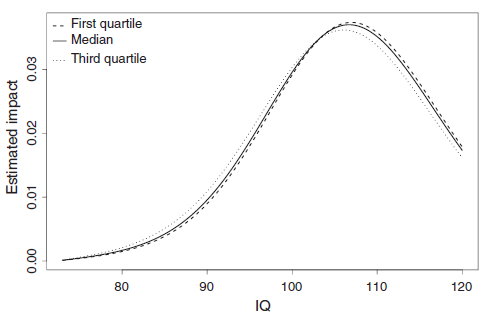
But the idea that intelligence turns people off religion fits nicely with the results of the second study.
Francisco Cribari-Neto and Tatiene Souza are statisticians at the Universidade Federal de Pernambuco and the Universidade Federal da Paraíba, respectively, in Brazil.
They’ve taken a look at a how the average IQ seen in different countries varies with average religiosity. The idea is to see whether religious culture is related generally to intellectual life. Now, this has been done before (by Richard Lynn in 2009), but Cribari-Neto and Souza have taken a rather more sophisticated approach.
They were able to show that the link is real, and that it is independent of economic development (both intelligence and loss of religion are independently linked to economic development, but there is something additional to that). What’s more, the effect is strongest in nations at middling levels of average IQ – as shown in the figure.
The reason for this, they suggest, is that at low IQs there is little scope for critical reasoning. And at high IQs most of the potential effect of critical reasoning have already happened (as the nation transitioned from lower IQs. So it is the middle range of IQs that the effect of increasing IQ is most clearly seen.
Of course, because it’s a correlation you can’t rule out the reverse effect. But it does all seem to fit together nicely.

Zuckerman M, Silberman J, & Hall JA (2013). The Relation Between Intelligence and Religiosity: A Meta-Analysis and Some Proposed Explanations. Personality and social psychology review : an official journal of the Society for Personality and Social Psychology, Inc PMID: 23921675
Francisco Cribari-Neto, & Tatiene C. Souza (2013). Religious belief and intelligence: Worldwide evidence Intelligence, 482-489 DOI: 10.1016/j.intell.2013.06.011
 This article by Tom Rees was first published on Epiphenom. It is licensed under Creative Commons.
Next Post

September 18, 2013 Does science make you moral?
Browse Our Archives
Select a Category Causes of religion - evolution Causes of religion - psychological Causes of religion - social Demographics Digest Effects of religion - health Effects of religion - psychological Effects of religion - social Notifications Politics Uncategorized
Select a Month March 2016 February 2016 January 2016 December 2015 November 2015 October 2015 September 2015 August 2015 July 2015 June 2015 May 2015 April 2015 March 2015 February 2015 January 2015 December 2014 November 2014 October 2014 September 2014 August 2014 July 2014 June 2014 May 2014 April 2014 March 2014 February 2014 January 2014 December 2013 November 2013 October 2013 September 2013 August 2013 July 2013 June 2013 May 2013 April 2013 March 2013 February 2013 January 2013 December 2012 November 2012 October 2012 September 2012 August 2012 July 2012 June 2012 May 2012 April 2012 March 2012 February 2012 January 2012 December 2011 November 2011 October 2011 September 2011 August 2011 July 2011 June 2011 May 2011 April 2011 March 2011 February 2011 January 2011 December 2010 November 2010 October 2010 September 2010 August 2010 July 2010 June 2010 May 2010 April 2010 March 2010 February 2010 January 2010 December 2009 November 2009 October 2009 September 2009 August 2009 July 2009 June 2009 May 2009 April 2009 March 2009 February 2009 January 2009 December 2008 November 2008 October 2008 September 2008 August 2008 July 2008 June 2008 May 2008 April 2008 March 2008 February 2008 January 2008 December 2007 November 2007 October 2007
Follow Us!
TAKE THE
Religious Wisdom Quiz
What did God place on Jeremiah’s mouth as a sign of his calling?
Select your answer to see how you score.
A staff His words Burning coal A scroll
Related posts from Epiphenom

Do social crises lead to religious revivals? Nah!

What kind of woman would pray for health...

Can you use religion to change attitudes towards...

Dogmatic atheism and fundamentalist Christianity: creating certainty in...
TRENDING AT PATHEOS Nonreligious

Dethroning Jesus and Enthroning Yourself
Jesus Never Asked to Be Worshipped. He Asked to Be Understood. Christianity...

Why Most Christians are Really Paulians and Jobians
I Don't Care, But It Matters Let's get this out of the...

Essential Tips to Successfully Navigate the Selling Process
Selling a house can feel overwhelming, but it doesn’t have to be....

To Make Remote Work Effective, Think About Others
The COVID-19 pandemic forced many companies to rapidly transition to remote work....

Flexibility Is Key to Solving Problems of Tomorrow
The world of work is undergoing a dramatic transformation. The COVID-19 pandemic...
view all Nonreligious blogs
Ad-Free & Subscriber Log-In Subscription Support
- About Us
- 2026 Calendar
- Videos
- Podcasts
- Library of World Religions
- Faith In Media Tracker
- Advertise With Us
- Write for Us
- Privacy Policy
- Terms of Service
- Do Not Sell My Data
- Contact Us
- Radiant Digital
- Manage Newsletter Subscriptions
- Unsubscribe From Notifications
- Sitemap
Copyright 2008-2026, Patheos. All rights reserved.
Subscription Support Ad-Free & Subscriber Log-In
Follow Patheos