
BuddhistCatholicContemplativeEvangelicalGeneral ChristianHinduJewishLatter-day SaintMuslimNew VisionsProgressive Christian
Beliefs
- Buddhist
- Catholic
- Contemplative
- Evangelical
- General Christian
- Hindu
- Jewish
- Latter-day Saint
- More Voices
- Muslim
- New Visions
- Pagan
- Progressive Christian
Topics
- Religion News
- Food and Religion
- Sports and Religion
- Religious Art
- Religious Music and Entertainment
- Religious Events
- History and Religion
- Style and Religion
- Politics and Religion
- Women in Religion
- Recreation Outdoors and Religion
- Business Finance and Religion
- Careers Workplace and Religion
- Education and Religion
- Family Parenting and Religion
- Health Fitness and Religion
- Home and Religion
- Relationships and Religion
- Technology and Religion
- Travel and Religion
Columnists
- Buddhist Columnists
- Business Finance and Religion Columnists
- Careers Workplace and Religion Columnists
- Catholic Columnists
- Contemplative Columnists
- Education and Religion Columnists
- Evangelists Columnists
- Family Parenting and Religion Columnists
- General Christian Columnists
- Health Fitness and Religion Columnists
- Hindu Columnists
- History and Religion Columnists
- Home and Religion Columnists
- Jewish Columnists
- More Voices Columnists
- Latter Day Columnists
- Muslim Columnists
- New Visions Columnists
- Nonreligious Columnists
- Pagan Columnists
- Politics and Religion Columnists
- Progressive Columnists
- Recreation Outdoors and Religion Columnists
- Relationships and Religion Columnists
- Religion News Columnists
- Religious Art Columnists
- Religious Events Columnists
- Religious Music and Entertainment Columnists
- Sports and Religion Columnists
- Style and Religion Columnists
- Technology and Religion Columnists
- Travel and Religion Columnists
- Women in Religion Columnists
Resource Library
- 2026 Calendar
- Library of World Religions
- The 100 Most Holy Places on Earth
- Patheos Answers
- Podcasts
- Videos
- Faith Leaders Database
- Anglican Episcopalian
- Bahai
- Baptist
- Buddhism
- Christianity
- Confucianism
- Eastern Orthodoxy
- Hinduism
- Holiness and Pentecostal
- ISKCON
- Islam
- Judaism
- Lutheran
- Methodist
- The Church of Jesus Christ of Latter-day Saints
- New Age
- Paganism
- Presbytarian and Reformed
- Protestantism
- Religion Behind the Scenes
- Roman Catholic
- Scientology
- Shia Islam
- Sikhism
- Sufism
- Sunni Islam
- Taoism
- Zen
- See all religions
Research Tools
 Ad-Free & Subscriber Log-In Subscription Support
Ad-Free & Subscriber Log-In Subscription Support
Follow Patheos 

- Trending:
- Forgiveness
- |
- Marriage
- |
- Consciousness
- |
- Death Penalty
- |
- Election
- |
- Halloween
 Epiphenom
- Home
- Nonreligious
- What’s the optimal level of weirdness for a memorable children’s character?
What’s the optimal level of weirdness for a memorable children’s character?
Last updated on: November 11, 2014 at 9:22 pm by Epiphenom
What’s the optimal level of weirdness for a memorable children’s character? 2014-11-11T21:22:43+01:00 Epiphenom
Patheos Explore the world's faith through different perspectives on religion and spirituality! Patheos has the views of the prevalent religions and spiritualities of the world.
Regular readers of this blog will be familiar with minimally counterintuitive ideas. That’s the theory that, for a fictional character or object to be memorable, it needs to have remarkable characteristics that make it stand out – but not too many, or it becomes impossible to remember.
In other words, the supposition is that we’re geared up to look out for and remember things that seem normal but which break the rules in some important way.
Now, although this effect has bee shown in adults, it’s less clear whether children’s minds work the same way.
Konika Banerjee, a psychologist formerly at Harvard (but now at Yale), along with colleagues ran a series of experiments in which they sought to find out just how counterintuitive a concept should be to make it really memorable to children.
They took groups of children aged seven to nine years and read them a story about a child walking around its neighbourhood and encountering a series of objects, some of which had normal characteristics and some of which had counterintuitive characteristics.
They varied the number of countintuitive characteristics per object from one in the first study up to three in the third study. Then they asked the kids which objects they could remember, and what they could remember about them. They did this straight after the study and also a week later.
These were an exceptionally well designed experiments. They made multiple version of the stories, in which they mixed around the objects so they could be sure that it wasn’t the objects themselves that were affecting recall. So, for instance, one version of the story ran like this:
In the bedroom, they saw a rake lying on the carpet. The rake had a wooden handle and could breathe well underwater. After leaving the bedroom, the kids continued on into the basement, where they noticed a hammer on top of a table. The hammer felt heavy to hold and was brown in color.
While the second version ran like this:
In the bedroom, they saw a hammer lying on the carpet. The hammer had a wooden handle and could breathe well underwater. After leaving the bedroom, the kids continued on into the basement, where they noticed a rake on top of a table. The rake felt heavy to hold and was brown in color.
They also carefully mixed up the nature of the counterintuitive ideas. They hypothesized that there were basically three varieties of rules to be broken – physics, biology, and psychology. In the third trial, the objects broke all three rules. So, for example, the hammer/rake was described as one that could “that could see into the future, could breathe well underwater, and could travel back and forth in time”.
What they found was that counterintuitive objects were indeed more memorable than normal objects. Not only could the children remember the objects better, but they could list around 50% more of their characteristics. Although their memory faded over the next week, it did so at the same rate for normal and counterintuitive objects.
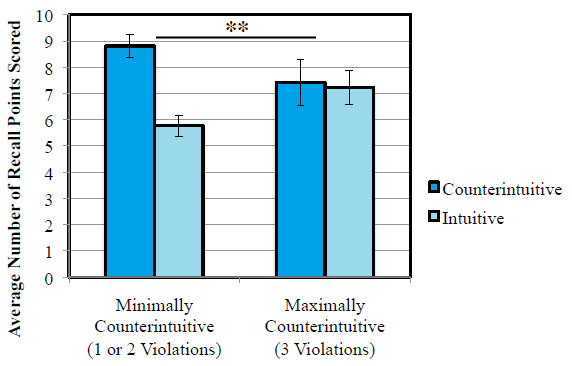
They got pretty much the same result for the first two experiments, in which the abnormal objects had either one or two counterintuitive characteristics. But, surprisingly, there was no effect in the third. As you can see in the graphic (which pools experiments one and two), they recalled normal objects equally well as those which and those which violate all three rules (physical, biological, and psychological).
The authors explain these results in terms of relevance theory. What they say is that there is nothing particularly magical about having two, rather than three, counterintuitive characteristics.
Rather, what is important is that the children can understand the relevance of the object – and to do that they need to combine what they hear with their prior knowledge. When all three rules were violated, there were no ‘natural’ domains left for the generation of inferences.
And the relevance of all this to religion? Well, they conclude that:
Like adults, children demonstrate superior immediate as well as delayed recall of minimally counterintuitive concepts, but not extremely counterintuitive concepts, compared to intuitive concepts embedded in the context of a fictional narrative. Children therefore seem to be sensitive to conceptual counterintuitiveness, an important developmental continuity in specific cognitive biases that account for supernatural beliefs.

Banerjee K, Haque OS, Spelke ES (2013). Melting Lizards and Crying Mailboxes: Children’s Preferential Recall of Minimally Counterintuitive Concepts. Cognitive science PMID: 23631765
 This article by Tom Rees was first published on Epiphenom. It is licensed under Creative Commons.
Next Post

June 5, 2013 Does hallucinations + happiness = spirituality?
Browse Our Archives
Select a Category Causes of religion - evolution Causes of religion - psychological Causes of religion - social Demographics Digest Effects of religion - health Effects of religion - psychological Effects of religion - social Notifications Politics Uncategorized
Select a Month March 2016 February 2016 January 2016 December 2015 November 2015 October 2015 September 2015 August 2015 July 2015 June 2015 May 2015 April 2015 March 2015 February 2015 January 2015 December 2014 November 2014 October 2014 September 2014 August 2014 July 2014 June 2014 May 2014 April 2014 March 2014 February 2014 January 2014 December 2013 November 2013 October 2013 September 2013 August 2013 July 2013 June 2013 May 2013 April 2013 March 2013 February 2013 January 2013 December 2012 November 2012 October 2012 September 2012 August 2012 July 2012 June 2012 May 2012 April 2012 March 2012 February 2012 January 2012 December 2011 November 2011 October 2011 September 2011 August 2011 July 2011 June 2011 May 2011 April 2011 March 2011 February 2011 January 2011 December 2010 November 2010 October 2010 September 2010 August 2010 July 2010 June 2010 May 2010 April 2010 March 2010 February 2010 January 2010 December 2009 November 2009 October 2009 September 2009 August 2009 July 2009 June 2009 May 2009 April 2009 March 2009 February 2009 January 2009 December 2008 November 2008 October 2008 September 2008 August 2008 July 2008 June 2008 May 2008 April 2008 March 2008 February 2008 January 2008 December 2007 November 2007 October 2007
Follow Us!
TAKE THE
Religious Wisdom Quiz
What did the devil tempt Jesus to turn into bread?
Select your answer to see how you score.
Stones Sand Fish Wood
Related posts from Epiphenom

Do social crises lead to religious revivals? Nah!

What kind of woman would pray for health...

Can you use religion to change attitudes towards...

Dogmatic atheism and fundamentalist Christianity: creating certainty in...
TRENDING AT PATHEOS Nonreligious

Dethroning Jesus and Enthroning Yourself
Jesus Never Asked to Be Worshipped. He Asked to Be Understood. Christianity...

Why Most Christians are Really Paulians and Jobians
I Don't Care, But It Matters Let's get this out of the...

Essential Tips to Successfully Navigate the Selling Process
Selling a house can feel overwhelming, but it doesn’t have to be....

To Make Remote Work Effective, Think About Others
The COVID-19 pandemic forced many companies to rapidly transition to remote work....

Flexibility Is Key to Solving Problems of Tomorrow
The world of work is undergoing a dramatic transformation. The COVID-19 pandemic...
view all Nonreligious blogs
Ad-Free & Subscriber Log-In Subscription Support
- About Us
- 2026 Calendar
- Videos
- Podcasts
- Library of World Religions
- Faith In Media Tracker
- Advertise With Us
- Write for Us
- Privacy Policy
- Terms of Service
- Do Not Sell My Data
- Contact Us
- Radiant Digital
- Manage Newsletter Subscriptions
- Unsubscribe From Notifications
- Sitemap
Copyright 2008-2026, Patheos. All rights reserved.
Subscription Support Ad-Free & Subscriber Log-In
Follow Patheos