
BuddhistCatholicContemplativeEvangelicalGeneral ChristianHinduJewishLatter-day SaintMuslimNew VisionsProgressive Christian
Beliefs
- Buddhist
- Catholic
- Contemplative
- Evangelical
- General Christian
- Hindu
- Jewish
- Latter-day Saint
- More Voices
- Muslim
- New Visions
- Pagan
- Progressive Christian
Topics
- Religion News
- Food and Religion
- Sports and Religion
- Religious Art
- Religious Music and Entertainment
- Religious Events
- History and Religion
- Style and Religion
- Politics and Religion
- Women in Religion
- Recreation Outdoors and Religion
- Business Finance and Religion
- Careers Workplace and Religion
- Education and Religion
- Family Parenting and Religion
- Health Fitness and Religion
- Home and Religion
- Relationships and Religion
- Technology and Religion
- Travel and Religion
Columnists
- Buddhist Columnists
- Business Finance and Religion Columnists
- Careers Workplace and Religion Columnists
- Catholic Columnists
- Contemplative Columnists
- Education and Religion Columnists
- Evangelists Columnists
- Family Parenting and Religion Columnists
- General Christian Columnists
- Health Fitness and Religion Columnists
- Hindu Columnists
- History and Religion Columnists
- Home and Religion Columnists
- Jewish Columnists
- More Voices Columnists
- Latter Day Columnists
- Muslim Columnists
- New Visions Columnists
- Nonreligious Columnists
- Pagan Columnists
- Politics and Religion Columnists
- Progressive Columnists
- Recreation Outdoors and Religion Columnists
- Relationships and Religion Columnists
- Religion News Columnists
- Religious Art Columnists
- Religious Events Columnists
- Religious Music and Entertainment Columnists
- Sports and Religion Columnists
- Style and Religion Columnists
- Technology and Religion Columnists
- Travel and Religion Columnists
- Women in Religion Columnists
Resource Library
- 2026 Calendar
- Library of World Religions
- The 100 Most Holy Places on Earth
- Patheos Answers
- Podcasts
- Videos
- Faith Leaders Database
- Anglican Episcopalian
- Bahai
- Baptist
- Buddhism
- Christianity
- Confucianism
- Eastern Orthodoxy
- Hinduism
- Holiness and Pentecostal
- ISKCON
- Islam
- Judaism
- Lutheran
- Methodist
- The Church of Jesus Christ of Latter-day Saints
- New Age
- Paganism
- Presbytarian and Reformed
- Protestantism
- Religion Behind the Scenes
- Roman Catholic
- Scientology
- Shia Islam
- Sikhism
- Sufism
- Sunni Islam
- Taoism
- Zen
- See all religions
Research Tools
 Ad-Free & Subscriber Log-In Subscription Support
Ad-Free & Subscriber Log-In Subscription Support
Follow Patheos 

- Trending:
- Forgiveness
- |
- Marriage
- |
- Consciousness
- |
- Death Penalty
- |
- Election
- |
- Halloween
 Epiphenom
- Home
- Nonreligious
- Religion is halfway between a fact and an opinion – according to kids and adults
Religion is halfway between a fact and an opinion – according to kids and adults
Last updated on: November 11, 2014 at 9:23 pm by Epiphenom
Religion is halfway between a fact and an opinion – according to kids and adults 2014-11-11T21:23:29+01:00 Epiphenom
Patheos Explore the world's faith through different perspectives on religion and spirituality! Patheos has the views of the prevalent religions and spiritualities of the world.
Is it possible for two people to disagree, and for both to be right?
Well it depends, of course, on what they’re disagreeing about. If it’s a matter of fact (‘Dinosaurs are extinct’), then the answer is ‘no’. On the other hand, if the discussion is about what flavour of ice cream is best then, well we are probably going to have to agree to differ.
But is religion a fact or an opinion? And do kids draw the same distinction as adults? To find out, Larisa Heiphetz (a psychologist at Harvard University in the USA) and colleagues quizzed 100 children about a faraway planet, Tamsena.
The children of planet Tamsena have a lot of conflicting opinions about things like the spirit world (“All of the invisible spirits on Tamsena live under the ground” vs. “All of the invisible spirits on Tamsena live in the tops of the trees”), matters of fact (“The first king of Tamsena was called Benjamin Smith” vs. “The first king of Tamsena was called Daniel Jones”), and matters of opinion (“Mankala is the most fun game to play” vs. “Ubuthi is the most fun game to play”).
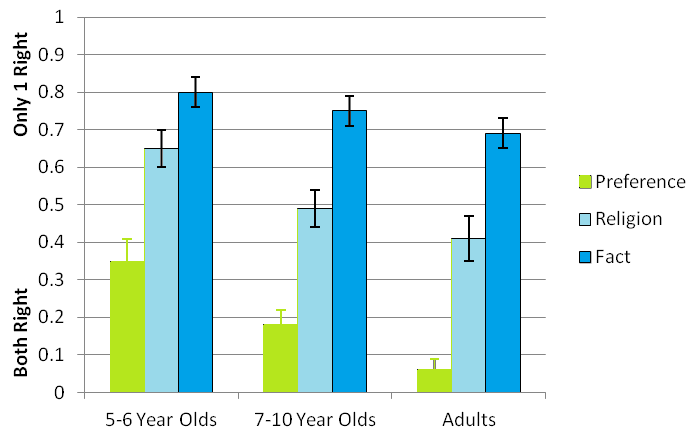
The kids were asked whether or not the two Tamsenites could both be right about these matters, or if only one of them could be right. They asked 37 adults (average age 27 years) the same questions.
The results suggested that, although seemed to be a trend with increasing age, the same pattern of results was seen in all age groups.
While most people believed that only one person can be right about factual questions, most also believed that both could be right about matters of preference.
And questions involving mystical beings were half way between the two.
Interestingly, there seemed to be a trend towards ambivalence with increasing age – although this wasn’t really confirmed statistically. It looks like older people are more likely to accept that there are many issues about which multiple opinions may be correct (or, at least, about which it’s not possible to tell).
So that’s a fantasy planet? What about questions about the real world?
Well they did a similar study but instead involving real questions of fact and preference, and about religion. They got pretty much the same results, although a little less clear cut (that’s probably because having some knowledge of the answers to the questions helped the children to judge whether they were matters of fact or opinion).
Heiphetz and colleagues conclude that:
Children as young as 5 years seem to represent other minds as capable of containing conflicting beliefs. Additionally, around the age of 7 years, children become more likely to say that two people whose preferences conflict can both be right. This developmental shift may reflect children’s increasing experience with contradictory preferences as they begin elementary school and learn to navigate the conflicting preferences of their peers.
So it seems that children do have to learn (or develop the ability) to understand that differences of opinion can be legitimate.
But at every age, both children and adults seem to agree that religion occupies some kind of half-way house between fact and opinion!

Heiphetz, L., Spelke, E., Harris, P., & Banaji, M. (2013). The development of reasoning about beliefs: Fact, preference, and ideology Journal of Experimental Social Psychology, 49 (3), 559-565 DOI: 10.1016/j.jesp.2012.09.005
 This article by Tom Rees was first published on Epiphenom. It is licensed under Creative Commons.
Next Post

May 30, 2013 What's the optimal level of weirdness for a memorable children's character?
Browse Our Archives
Select a Category Causes of religion - evolution Causes of religion - psychological Causes of religion - social Demographics Digest Effects of religion - health Effects of religion - psychological Effects of religion - social Notifications Politics Uncategorized
Select a Month March 2016 February 2016 January 2016 December 2015 November 2015 October 2015 September 2015 August 2015 July 2015 June 2015 May 2015 April 2015 March 2015 February 2015 January 2015 December 2014 November 2014 October 2014 September 2014 August 2014 July 2014 June 2014 May 2014 April 2014 March 2014 February 2014 January 2014 December 2013 November 2013 October 2013 September 2013 August 2013 July 2013 June 2013 May 2013 April 2013 March 2013 February 2013 January 2013 December 2012 November 2012 October 2012 September 2012 August 2012 July 2012 June 2012 May 2012 April 2012 March 2012 February 2012 January 2012 December 2011 November 2011 October 2011 September 2011 August 2011 July 2011 June 2011 May 2011 April 2011 March 2011 February 2011 January 2011 December 2010 November 2010 October 2010 September 2010 August 2010 July 2010 June 2010 May 2010 April 2010 March 2010 February 2010 January 2010 December 2009 November 2009 October 2009 September 2009 August 2009 July 2009 June 2009 May 2009 April 2009 March 2009 February 2009 January 2009 December 2008 November 2008 October 2008 September 2008 August 2008 July 2008 June 2008 May 2008 April 2008 March 2008 February 2008 January 2008 December 2007 November 2007 October 2007
Follow Us!
TAKE THE
Religious Wisdom Quiz
What Christian group follows the Augsburg Confession?
Select your answer to see how you score.
Methodists Pentecostals Lutherans Presbyterians
Related posts from Epiphenom

Do social crises lead to religious revivals? Nah!

What kind of woman would pray for health...

Can you use religion to change attitudes towards...

Dogmatic atheism and fundamentalist Christianity: creating certainty in...
TRENDING AT PATHEOS Nonreligious

Dethroning Jesus and Enthroning Yourself
Jesus Never Asked to Be Worshipped. He Asked to Be Understood. Christianity...

Why Most Christians are Really Paulians and Jobians
I Don't Care, But It Matters Let's get this out of the...

Essential Tips to Successfully Navigate the Selling Process
Selling a house can feel overwhelming, but it doesn’t have to be....

To Make Remote Work Effective, Think About Others
The COVID-19 pandemic forced many companies to rapidly transition to remote work....

Flexibility Is Key to Solving Problems of Tomorrow
The world of work is undergoing a dramatic transformation. The COVID-19 pandemic...
view all Nonreligious blogs
Ad-Free & Subscriber Log-In Subscription Support
- About Us
- 2026 Calendar
- Videos
- Podcasts
- Library of World Religions
- Faith In Media Tracker
- Advertise With Us
- Write for Us
- Privacy Policy
- Terms of Service
- Do Not Sell My Data
- Contact Us
- Radiant Digital
- Manage Newsletter Subscriptions
- Unsubscribe From Notifications
- Sitemap
Copyright 2008-2026, Patheos. All rights reserved.
Subscription Support Ad-Free & Subscriber Log-In
Follow Patheos