
BuddhistCatholicContemplativeEvangelicalGeneral ChristianHinduJewishLatter-day SaintMuslimNew VisionsProgressive Christian
Beliefs
- Buddhist
- Catholic
- Contemplative
- Evangelical
- General Christian
- Hindu
- Jewish
- Latter-day Saint
- More Voices
- Muslim
- New Visions
- Pagan
- Progressive Christian
Topics
- Religion News
- Food and Religion
- Sports and Religion
- Religious Art
- Religious Music and Entertainment
- Religious Events
- History and Religion
- Style and Religion
- Politics and Religion
- Women in Religion
- Recreation Outdoors and Religion
- Business Finance and Religion
- Careers Workplace and Religion
- Education and Religion
- Family Parenting and Religion
- Health Fitness and Religion
- Home and Religion
- Relationships and Religion
- Technology and Religion
- Travel and Religion
Columnists
- Buddhist Columnists
- Business Finance and Religion Columnists
- Careers Workplace and Religion Columnists
- Catholic Columnists
- Contemplative Columnists
- Education and Religion Columnists
- Evangelists Columnists
- Family Parenting and Religion Columnists
- General Christian Columnists
- Health Fitness and Religion Columnists
- Hindu Columnists
- History and Religion Columnists
- Home and Religion Columnists
- Jewish Columnists
- More Voices Columnists
- Latter Day Columnists
- Muslim Columnists
- New Visions Columnists
- Nonreligious Columnists
- Pagan Columnists
- Politics and Religion Columnists
- Progressive Columnists
- Recreation Outdoors and Religion Columnists
- Relationships and Religion Columnists
- Religion News Columnists
- Religious Art Columnists
- Religious Events Columnists
- Religious Music and Entertainment Columnists
- Sports and Religion Columnists
- Style and Religion Columnists
- Technology and Religion Columnists
- Travel and Religion Columnists
- Women in Religion Columnists
Resource Library
- 2026 Calendar
- Library of World Religions
- The 100 Most Holy Places on Earth
- Patheos Answers
- Podcasts
- Videos
- Faith Leaders Database
- Anglican Episcopalian
- Bahai
- Baptist
- Buddhism
- Christianity
- Confucianism
- Eastern Orthodoxy
- Hinduism
- Holiness and Pentecostal
- ISKCON
- Islam
- Judaism
- Lutheran
- Methodist
- The Church of Jesus Christ of Latter-day Saints
- New Age
- Paganism
- Presbytarian and Reformed
- Protestantism
- Religion Behind the Scenes
- Roman Catholic
- Scientology
- Shia Islam
- Sikhism
- Sufism
- Sunni Islam
- Taoism
- Zen
- See all religions
Research Tools
 Ad-Free & Subscriber Log-In Subscription Support
Ad-Free & Subscriber Log-In Subscription Support
Follow Patheos 

- Trending:
- Forgiveness
- |
- Marriage
- |
- Consciousness
- |
- Death Penalty
- |
- Election
- |
- Halloween
 Epiphenom
- Home
- Nonreligious
- In West and East, it’s easier to remember things that are a bit weird
In West and East, it’s easier to remember things that are a bit weird
Last updated on: November 11, 2014 at 9:26 pm by Epiphenom
In West and East, it’s easier to remember things that are a bit weird 2014-11-11T21:26:51+01:00 Epiphenom
Patheos Explore the world's faith through different perspectives on religion and spirituality! Patheos has the views of the prevalent religions and spiritualities of the world.
Look around the world, and you’ll find that most gods and magical entities are surprisingly similar to regular people, but with one or two magical powers. The same goes for most works of fiction – your typical superhero is, in most respects, a pretty regular guy.
At first sight, the Judaeo-Christian god seems to be an exception to this rule. But if you look at how Christians often relate to their god, never mind how it is portrayed in the Bible, it’s not really such an anomaly.
Back in 2002, Pascal Boyer proposed that this was not an accident. He suggested that mundane, everyday objects are instantly forgettable, and that really weird stuff is just to hard to remember. What really stands out, and what our brains intuitively latch onto, are things that deviate only a bit from the normal. He called these ‘minimally counterintuitive ideas’ (MCI).
Over the past 10 years, research into this idea has produced some support, but also some experimental results that didn’t fit the predictions.
The most recent experiment has taken advantage of the virtual reality world of Second Life. By using a virtual environment, they able not only to create a set-up that would be impossible in the real world, but to study people from different cultures and people who don’t typically participate as subjects (i.e. people other than students).
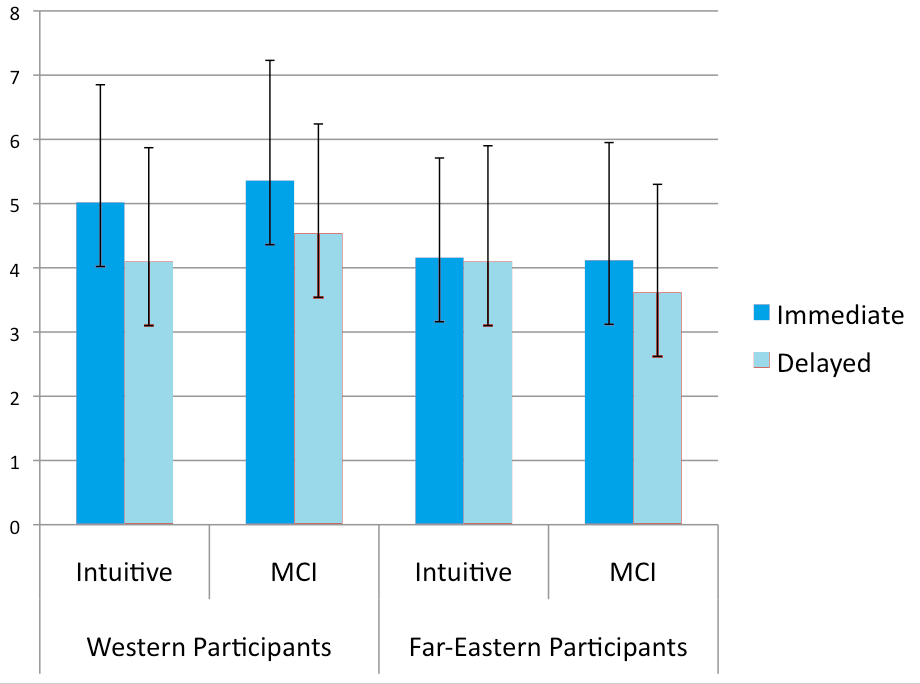
The experimenters, Ryan Hornbeck at the University of Oxford, UK, and Justin Barrett (now at the Fuller Theological Seminary in California) created a kind of virtual museum containing 18 objects. Half of these were everyday (such as a ball hitting a wall) and half had something weird about them (such as a parrot that disappears).
They lead their study subjects (50 native-English speakers living in the West and 50 native-Chinese speakers living in Asia) round this museum, and let them briefly view each object. Afterwards they tested them on how many they could remember. After a while (up to 15 days later) they were invited to be tested again.
As shown in the graphic, the Westerners were more likely to remember the ‘minimally counterintuitive’ objects than the intuitive objects – whether tested immediately or after a period of days. For the Chinese speakers, there was no difference in immediate recall, but there was a difference in the delayed recall.
They found that the longer the period until the second test, the more likely it was that the intuitive items would be forgotten. That’s what you would expect – but that’s not what they found for the MCI objects. For these, memorisation seemed to be constant, whatever the delay.
That suggests that MCIs that actually get remembered are less likely to be forgotten, compared with intuitive memories.
Intriguingly, they also found that age had an effect.The older participants were equally good at remembering MCI and intuitive objects. Younger participants, however, were significantly better at remembering the MCI objects.
The researchers were intrigued by why that might be. What they end up suggesting is that, for young adults who are still learning about the world, it pays off to devote a lot of mental energy to memorising and assessing things that deviate from the expected.
By later adulthood, however, “the most important exceptions are likely to have already been encountered”. As a result, anything that turns up that looks weird and out of place to an older person is likely just to be a one-off aberration, and so not worth paying too much attention too.
A sobering thought!

Hornbeck, R., & Barrett, J. (2013). Refining and Testing “Counterintuitiveness” in Virtual Reality: Cross-Cultural Evidence for Recall of Counterintuitive Representations International Journal for the Psychology of Religion, 23 (1), 15-28 DOI: 10.1080/10508619.2013.735192
 This article by Tom Rees was first published on Epiphenom. It is licensed under Creative Commons.
Next Post

April 6, 2013 International trade fractures along religious fault lines
Browse Our Archives
Select a Category Causes of religion - evolution Causes of religion - psychological Causes of religion - social Demographics Digest Effects of religion - health Effects of religion - psychological Effects of religion - social Notifications Politics Uncategorized
Select a Month March 2016 February 2016 January 2016 December 2015 November 2015 October 2015 September 2015 August 2015 July 2015 June 2015 May 2015 April 2015 March 2015 February 2015 January 2015 December 2014 November 2014 October 2014 September 2014 August 2014 July 2014 June 2014 May 2014 April 2014 March 2014 February 2014 January 2014 December 2013 November 2013 October 2013 September 2013 August 2013 July 2013 June 2013 May 2013 April 2013 March 2013 February 2013 January 2013 December 2012 November 2012 October 2012 September 2012 August 2012 July 2012 June 2012 May 2012 April 2012 March 2012 February 2012 January 2012 December 2011 November 2011 October 2011 September 2011 August 2011 July 2011 June 2011 May 2011 April 2011 March 2011 February 2011 January 2011 December 2010 November 2010 October 2010 September 2010 August 2010 July 2010 June 2010 May 2010 April 2010 March 2010 February 2010 January 2010 December 2009 November 2009 October 2009 September 2009 August 2009 July 2009 June 2009 May 2009 April 2009 March 2009 February 2009 January 2009 December 2008 November 2008 October 2008 September 2008 August 2008 July 2008 June 2008 May 2008 April 2008 March 2008 February 2008 January 2008 December 2007 November 2007 October 2007
Follow Us!
TAKE THE
Religious Wisdom Quiz
What did Jesus do for His disciples at the Last Supper?
Select your answer to see how you score.
Gave them money Fed them fish Washed their feet Sent them away
Related posts from Epiphenom

Do social crises lead to religious revivals? Nah!

What kind of woman would pray for health...

Can you use religion to change attitudes towards...

Dogmatic atheism and fundamentalist Christianity: creating certainty in...
TRENDING AT PATHEOS Nonreligious

Dethroning Jesus and Enthroning Yourself
Jesus Never Asked to Be Worshipped. He Asked to Be Understood. Christianity...

Why Most Christians are Really Paulians and Jobians
I Don't Care, But It Matters Let's get this out of the...

Essential Tips to Successfully Navigate the Selling Process
Selling a house can feel overwhelming, but it doesn’t have to be....

To Make Remote Work Effective, Think About Others
The COVID-19 pandemic forced many companies to rapidly transition to remote work....

Flexibility Is Key to Solving Problems of Tomorrow
The world of work is undergoing a dramatic transformation. The COVID-19 pandemic...
view all Nonreligious blogs
Ad-Free & Subscriber Log-In Subscription Support
- About Us
- 2026 Calendar
- Videos
- Podcasts
- Library of World Religions
- Faith In Media Tracker
- Advertise With Us
- Write for Us
- Privacy Policy
- Terms of Service
- Do Not Sell My Data
- Contact Us
- Radiant Digital
- Manage Newsletter Subscriptions
- Unsubscribe From Notifications
- Sitemap
Copyright 2008-2026, Patheos. All rights reserved.
Subscription Support Ad-Free & Subscriber Log-In
Follow Patheos