
BuddhistCatholicContemplativeEvangelicalGeneral ChristianHinduJewishLatter-day SaintMuslimNew VisionsProgressive Christian
Beliefs
- Buddhist
- Catholic
- Contemplative
- Evangelical
- General Christian
- Hindu
- Jewish
- Latter-day Saint
- More Voices
- Muslim
- New Visions
- Pagan
- Progressive Christian
Topics
- Religion News
- Food and Religion
- Sports and Religion
- Religious Art
- Religious Music and Entertainment
- Religious Events
- History and Religion
- Style and Religion
- Politics and Religion
- Women in Religion
- Recreation Outdoors and Religion
- Business Finance and Religion
- Careers Workplace and Religion
- Education and Religion
- Family Parenting and Religion
- Health Fitness and Religion
- Home and Religion
- Relationships and Religion
- Technology and Religion
- Travel and Religion
Columnists
- Buddhist Columnists
- Business Finance and Religion Columnists
- Careers Workplace and Religion Columnists
- Catholic Columnists
- Contemplative Columnists
- Education and Religion Columnists
- Evangelists Columnists
- Family Parenting and Religion Columnists
- General Christian Columnists
- Health Fitness and Religion Columnists
- Hindu Columnists
- History and Religion Columnists
- Home and Religion Columnists
- Jewish Columnists
- More Voices Columnists
- Latter Day Columnists
- Muslim Columnists
- New Visions Columnists
- Nonreligious Columnists
- Pagan Columnists
- Politics and Religion Columnists
- Progressive Columnists
- Recreation Outdoors and Religion Columnists
- Relationships and Religion Columnists
- Religion News Columnists
- Religious Art Columnists
- Religious Events Columnists
- Religious Music and Entertainment Columnists
- Sports and Religion Columnists
- Style and Religion Columnists
- Technology and Religion Columnists
- Travel and Religion Columnists
- Women in Religion Columnists
Resource Library
- 2026 Calendar
- Library of World Religions
- The 100 Most Holy Places on Earth
- Patheos Answers
- Podcasts
- Videos
- Faith Leaders Database
- Anglican Episcopalian
- Bahai
- Baptist
- Buddhism
- Christianity
- Confucianism
- Eastern Orthodoxy
- Hinduism
- Holiness and Pentecostal
- ISKCON
- Islam
- Judaism
- Lutheran
- Methodist
- The Church of Jesus Christ of Latter-day Saints
- New Age
- Paganism
- Presbytarian and Reformed
- Protestantism
- Religion Behind the Scenes
- Roman Catholic
- Scientology
- Shia Islam
- Sikhism
- Sufism
- Sunni Islam
- Taoism
- Zen
- See all religions
Research Tools
 Ad-Free & Subscriber Log-In Subscription Support
Ad-Free & Subscriber Log-In Subscription Support
Follow Patheos 

- Trending:
- Forgiveness
- |
- Marriage
- |
- Consciousness
- |
- Death Penalty
- |
- Election
- |
- Halloween
 Epiphenom
- Home
- Nonreligious
- In Burkino Faso, traditional beliefs encourage trust and fair-play in the small-business community
In Burkino Faso, traditional beliefs encourage trust and fair-play in the small-business community
Last updated on: November 12, 2014 at 2:48 am by Epiphenom
In Burkino Faso, traditional beliefs encourage trust and fair-play in the small-business community 2014-11-12T02:48:55+01:00 Epiphenom
Patheos Explore the world's faith through different perspectives on religion and spirituality! Patheos has the views of the prevalent religions and spiritualities of the world.
Village life in sub-Saharan Africa is governed by a moral code enforced by customs, regulations, and taboos. Because communities are close-knit, large discrepancies in wealth are frowned upon, and the accumulation of private wealth is regarded as anti-social.
Locals believe that spirits and ancestors enforce this moral code, and that transgressors will be punished by misfortune, business failure, and severe illnesses or accidents. But does this actually have any effect on behaviour?
Myriam Hadnes and Heiner Schumacher, at the University of Frankfurt, recruited a bunch of ‘micro-entrepreneurs’ from the villages around Ouagadougou and asked them to play an economic transaction game, to see how generous and trusting they were towards others.
The game has two players – both anonymous, both given 1000 West African Francs (worth just over 2 dollars – about a day’s pay at minimum wage levels). Player A could either keep his money (in which case both went home with their 1,000 Fcfa) or give it all to Player B.
If Player A chose to send the money, then it was doubled so that Player B now had 3000 Fcfa. Player B could then send back as much as he or she wanted. After that, they went home.
Before playing the game, the players were interviewed about their businesses. For half the participants, the interviewers asked about jealousy and traditional rules about conduct, and deliberately steered the conversation towards supernatural topics. For the other half, they focussed on practical issues of business – and deliberately avoided anything related to supernatural topics.
They found that, in the group that avoided supernatural topics, 69% of ‘Player A’ participants handed their 1,000 Fcfa to Player B. In the group that did discuss the traditional beliefs, that figure rose to 87%. That suggests that these players were more trusting that Player B would play fair.
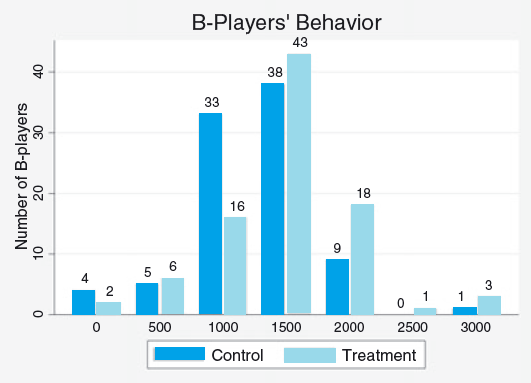
Then they looked at what Player B gave back in return, and found that they were significantly more likely to give higher amounts (see graphic). In fact, while the group that did not discuss the supernatural returned on average 1,261 Fcfa (or 42 percent), those primed with traditional beliefs returned 1,471 Fcfa (or 49 percent).
That suggests that, in both groups, the A players’ trust was well placed – but that this was particularly so in the group primed with tradition. That difference was statistically significant, even after adjusting for other differences between the groups.
The authors point out that this is unlikely to be simply due to increased trust (because they found that the A players didn’t actually expect more in return, and also that doesn’t explain why the B players were more generous). Nor was it because they were less risk-averse (again, that can’t explain the B-players response).
Instead, they say that:
… our results suggest another factor as the driving force of both the A- and B-players’ behavior.
In the postexperimental questionnaire, one-third of all participants explicitly cited illness, accidents, or death as direct consequence of dishonest behavior. In the interviews of the treatment group, participants shared their experiences with supernatural forces intervening into worldly life to punish those who did not respect the ancestors’ will. Almost half of the participants stated having witnessed a case of supernatural punishment aftermisbehavior.
Also, we learned that participants trust witch doctors to influence their business success, and fear the neighbors’ and competitors’ envy if they are successful without caring for their kith and kin.
In line with these observations, we argue that A- and B-players’ behavior was driven by the combination of prevailing sharing norms and the belief in supernatural punishment whenever these norms are violated.
Because of the design of this study, we can’t tease out whether this was a direct effect of supernatural fears or not. The interviews of the A players covered both social norms and supernatural topics (they couldn’t use the more usual priming technique of asking the participants to do a word game, because most were illiterate), so either or both could be affecting the result.
But as the first evidence that reminders of traditional moral beliefs, coupled with supernatural threats, can result in behaviour that’s significantly more pro-social!

Hadnes, M., & Schumacher, H. (2012). The Gods Are Watching: An Experimental Study of Religion and Traditional Belief in Burkina Faso Journal for the Scientific Study of Religion, 51 (4), 689-704 DOI: 10.1111/j.1468-5906.2012.01676.x
 This article by Tom Rees was first published on Epiphenom. It is licensed under Creative Commons.
Previous Post

February 24, 2013
Why do the religious have a problem with outsiders
Next Post
March 10, 2013 Calvinists can wait, but Catholics live for the moment
Browse Our Archives
Select a Category Causes of religion - evolution Causes of religion - psychological Causes of religion - social Demographics Digest Effects of religion - health Effects of religion - psychological Effects of religion - social Notifications Politics Uncategorized
Select a Month March 2016 February 2016 January 2016 December 2015 November 2015 October 2015 September 2015 August 2015 July 2015 June 2015 May 2015 April 2015 March 2015 February 2015 January 2015 December 2014 November 2014 October 2014 September 2014 August 2014 July 2014 June 2014 May 2014 April 2014 March 2014 February 2014 January 2014 December 2013 November 2013 October 2013 September 2013 August 2013 July 2013 June 2013 May 2013 April 2013 March 2013 February 2013 January 2013 December 2012 November 2012 October 2012 September 2012 August 2012 July 2012 June 2012 May 2012 April 2012 March 2012 February 2012 January 2012 December 2011 November 2011 October 2011 September 2011 August 2011 July 2011 June 2011 May 2011 April 2011 March 2011 February 2011 January 2011 December 2010 November 2010 October 2010 September 2010 August 2010 July 2010 June 2010 May 2010 April 2010 March 2010 February 2010 January 2010 December 2009 November 2009 October 2009 September 2009 August 2009 July 2009 June 2009 May 2009 April 2009 March 2009 February 2009 January 2009 December 2008 November 2008 October 2008 September 2008 August 2008 July 2008 June 2008 May 2008 April 2008 March 2008 February 2008 January 2008 December 2007 November 2007 October 2007
Follow Us!
TAKE THE
Religious Wisdom Quiz
Who interpreted a dream about a tree that reached heaven?
Select your answer to see how you score.
Amos Joel Ezekiel Daniel
Related posts from Epiphenom

Do social crises lead to religious revivals? Nah!

What kind of woman would pray for health...

Can you use religion to change attitudes towards...

Dogmatic atheism and fundamentalist Christianity: creating certainty in...
TRENDING AT PATHEOS Nonreligious

Dethroning Jesus and Enthroning Yourself
Jesus Never Asked to Be Worshipped. He Asked to Be Understood. Christianity...

Why Most Christians are Really Paulians and Jobians
I Don't Care, But It Matters Let's get this out of the...

Essential Tips to Successfully Navigate the Selling Process
Selling a house can feel overwhelming, but it doesn’t have to be....

To Make Remote Work Effective, Think About Others
The COVID-19 pandemic forced many companies to rapidly transition to remote work....

Flexibility Is Key to Solving Problems of Tomorrow
The world of work is undergoing a dramatic transformation. The COVID-19 pandemic...
view all Nonreligious blogs
Ad-Free & Subscriber Log-In Subscription Support
- About Us
- 2026 Calendar
- Videos
- Podcasts
- Library of World Religions
- Faith In Media Tracker
- Advertise With Us
- Write for Us
- Privacy Policy
- Terms of Service
- Do Not Sell My Data
- Contact Us
- Radiant Digital
- Manage Newsletter Subscriptions
- Unsubscribe From Notifications
- Sitemap
Copyright 2008-2026, Patheos. All rights reserved.
Subscription Support Ad-Free & Subscriber Log-In
Follow Patheos