
BuddhistCatholicContemplativeEvangelicalGeneral ChristianHinduJewishLatter-day SaintMuslimNew VisionsProgressive Christian
Beliefs
- Buddhist
- Catholic
- Contemplative
- Evangelical
- General Christian
- Hindu
- Jewish
- Latter-day Saint
- More Voices
- Muslim
- New Visions
- Pagan
- Progressive Christian
Topics
- Religion News
- Food and Religion
- Sports and Religion
- Religious Art
- Religious Music and Entertainment
- Religious Events
- History and Religion
- Style and Religion
- Politics and Religion
- Women in Religion
- Recreation Outdoors and Religion
- Business Finance and Religion
- Careers Workplace and Religion
- Education and Religion
- Family Parenting and Religion
- Health Fitness and Religion
- Home and Religion
- Relationships and Religion
- Technology and Religion
- Travel and Religion
Columnists
- Buddhist Columnists
- Business Finance and Religion Columnists
- Careers Workplace and Religion Columnists
- Catholic Columnists
- Contemplative Columnists
- Education and Religion Columnists
- Evangelists Columnists
- Family Parenting and Religion Columnists
- General Christian Columnists
- Health Fitness and Religion Columnists
- Hindu Columnists
- History and Religion Columnists
- Home and Religion Columnists
- Jewish Columnists
- More Voices Columnists
- Latter Day Columnists
- Muslim Columnists
- New Visions Columnists
- Nonreligious Columnists
- Pagan Columnists
- Politics and Religion Columnists
- Progressive Columnists
- Recreation Outdoors and Religion Columnists
- Relationships and Religion Columnists
- Religion News Columnists
- Religious Art Columnists
- Religious Events Columnists
- Religious Music and Entertainment Columnists
- Sports and Religion Columnists
- Style and Religion Columnists
- Technology and Religion Columnists
- Travel and Religion Columnists
- Women in Religion Columnists
Resource Library
- 2026 Calendar
- Library of World Religions
- The 100 Most Holy Places on Earth
- Patheos Answers
- Podcasts
- Videos
- Faith Leaders Database
- Anglican Episcopalian
- Bahai
- Baptist
- Buddhism
- Christianity
- Confucianism
- Eastern Orthodoxy
- Hinduism
- Holiness and Pentecostal
- ISKCON
- Islam
- Judaism
- Lutheran
- Methodist
- The Church of Jesus Christ of Latter-day Saints
- New Age
- Paganism
- Presbytarian and Reformed
- Protestantism
- Religion Behind the Scenes
- Roman Catholic
- Scientology
- Shia Islam
- Sikhism
- Sufism
- Sunni Islam
- Taoism
- Zen
- See all religions
Research Tools
 Ad-Free & Subscriber Log-In Subscription Support
Ad-Free & Subscriber Log-In Subscription Support
Follow Patheos 

- Trending:
- Forgiveness
- |
- Marriage
- |
- Consciousness
- |
- Death Penalty
- |
- Election
- |
- Halloween
 Epiphenom
- Home
- Nonreligious
- Iconic religious images affect the attitudes of Protestants, but not Catholics.
Iconic religious images affect the attitudes of Protestants, but not Catholics.
Last updated on: November 14, 2014 at 10:17 pm by Epiphenom
Iconic religious images affect the attitudes of Protestants, but not Catholics. 2014-11-14T22:17:11+01:00 Epiphenom
Patheos Explore the world's faith through different perspectives on religion and spirituality! Patheos has the views of the prevalent religions and spiritualities of the world.
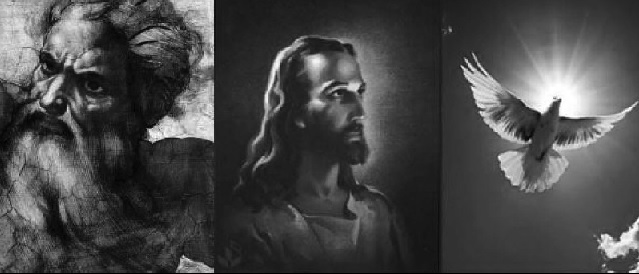
The Christian God comes in different flavours. Most notably, while it’s sometimes portrayed as a benevolent, forgiving entity, at other times the imagery is of a vengeful, retributive god.
We already know that how Christians view their god is related to other aspects of their psychology (for example, fear and anxiety). But is this cause or effect? It’s hard to say, because what hasn’t been much investigated is whether implanting different ideas about God can change attitudes.
Kathryn Johnson and colleagues from Arizona State University showed religious imagery (like the pictures above) to 363 Christian students (120 Catholics). One quarter of them were shown images of a Authoritarian God (like the leftmost one above, described in an earlier pilot study as “punishing”or angry) while one quarter were shown images of a Benevolent God (middle image, described as “loving”, “compassionate”, and “forgiving”). The others were shown spiritual images (llike the one on the right) or abstract art.
They students were told that they were taking part in a memory test, and that while they were waiting for the recall challenge they would be doing a ‘filler’ task. In this filler task, they were given a couple of scenarios to read, and then asked about anger and forgiveness. For example, in the first they:
…were told to imagine themselves at a party at which a same-sex student carelessly spills a drink on them without apologizing. They were asked to rate (on a 7-point Likert scale) the likelihood of engaging in eight aggressive behaviors toward this person.
And a second one,
in which a friend offers, but then carelessly fails, to deliver an important package to the post office, resulting in the loss of a job for the participant. Three items measured willingness to forgive, forget, and help the friend in the future (e.g., how likely would you be forgive your friend)
They were also asked about their “willingness to conserve water when taking showers”, their “willingness to sign up immediately after the survey to package personal hygiene items for distribution to natural disaster victims”, and their “willingness to ship blankets to natural disaster victims in Israel” (a religious outgroup).
Unfortunately the researchers don’t reveal whether Catholics or Protestants were the most angry or forgiving. But they do say that the Catholic responses were basically the same regardless of the kind of god they had been shown.
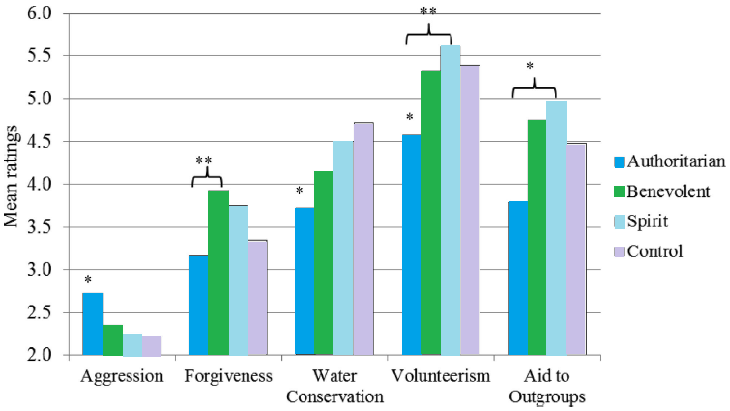
Among the Protestants, however, it was a different matter.
Protestants shown an authoritarian god were more aggressive and less altruistic (see graphic). On the other hand, showing the benevolent god, or spiritual images, to Protestants seemed to make them more forgiving.
This is one of only a few studies to use religious imagery to provoke a psychological response, so the fact that Catholics and Protestant responded differently is very interesting. The authors suspect that the difference occurred because Catholics are regularly exposed to such imagery, and so they may have become somewhat immune to it.
They do also point out that, because there were fewer Catholics in their study, the power to detect an effect was lower – they may have just lucked out. And they float the suggestion that maybe other images would maybe have more effect on Catholics – images of the Virgin Mary, for example (that’s what was used in a 2008 study of religiously-inspired pain relief in Catholics).
In other studies they showed that people who hold beliefs about a vengeful god were also more aggressive towards offenders, and that those who held beliefs about a loving god were more forgiving. Interestingly, these beliefs were independent – so a single person could hold both beliefs and be simultaneously more aggressive and more forgiving, depending on the scenario.
So, coming back to the original point, regarding cause and effect. Well, it seems that for Protestants at least, yes – the particular kind of god they believe in seems to be fairly easily manipulated!

Johnson, K., Li, Y., Cohen, A., & Okun, M. (2013). Friends in high places: The influence of authoritarian and benevolent god-concepts on social attitudes and behaviors. Psychology of Religion and Spirituality, 5 (1), 15-22 DOI: 10.1037/a0030138
 This article by Tom Rees was first published on Epiphenom. It is licensed under Creative Commons.
Previous Post

March 10, 2013
Calvinists can wait, but Catholics live for the moment
Next Post
March 24, 2013 In West and East, it's easier to remember things that are a bit weird
Browse Our Archives
Select a Category Causes of religion - evolution Causes of religion - psychological Causes of religion - social Demographics Digest Effects of religion - health Effects of religion - psychological Effects of religion - social Notifications Politics Uncategorized
Select a Month March 2016 February 2016 January 2016 December 2015 November 2015 October 2015 September 2015 August 2015 July 2015 June 2015 May 2015 April 2015 March 2015 February 2015 January 2015 December 2014 November 2014 October 2014 September 2014 August 2014 July 2014 June 2014 May 2014 April 2014 March 2014 February 2014 January 2014 December 2013 November 2013 October 2013 September 2013 August 2013 July 2013 June 2013 May 2013 April 2013 March 2013 February 2013 January 2013 December 2012 November 2012 October 2012 September 2012 August 2012 July 2012 June 2012 May 2012 April 2012 March 2012 February 2012 January 2012 December 2011 November 2011 October 2011 September 2011 August 2011 July 2011 June 2011 May 2011 April 2011 March 2011 February 2011 January 2011 December 2010 November 2010 October 2010 September 2010 August 2010 July 2010 June 2010 May 2010 April 2010 March 2010 February 2010 January 2010 December 2009 November 2009 October 2009 September 2009 August 2009 July 2009 June 2009 May 2009 April 2009 March 2009 February 2009 January 2009 December 2008 November 2008 October 2008 September 2008 August 2008 July 2008 June 2008 May 2008 April 2008 March 2008 February 2008 January 2008 December 2007 November 2007 October 2007
Follow Us!
TAKE THE
Religious Wisdom Quiz
What Christian group worships on Saturday instead of Sunday?
Select your answer to see how you score.
Seventh-day Adventists Baptists Pentecostals Presbyterians
Related posts from Epiphenom

Do social crises lead to religious revivals? Nah!

What kind of woman would pray for health...

Can you use religion to change attitudes towards...

Dogmatic atheism and fundamentalist Christianity: creating certainty in...
TRENDING AT PATHEOS Nonreligious

Dethroning Jesus and Enthroning Yourself
Jesus Never Asked to Be Worshipped. He Asked to Be Understood. Christianity...

Why Most Christians are Really Paulians and Jobians
I Don't Care, But It Matters Let's get this out of the...

Essential Tips to Successfully Navigate the Selling Process
Selling a house can feel overwhelming, but it doesn’t have to be....

To Make Remote Work Effective, Think About Others
The COVID-19 pandemic forced many companies to rapidly transition to remote work....

Flexibility Is Key to Solving Problems of Tomorrow
The world of work is undergoing a dramatic transformation. The COVID-19 pandemic...
view all Nonreligious blogs
Ad-Free & Subscriber Log-In Subscription Support
- About Us
- 2026 Calendar
- Videos
- Podcasts
- Library of World Religions
- Faith In Media Tracker
- Advertise With Us
- Write for Us
- Privacy Policy
- Terms of Service
- Do Not Sell My Data
- Contact Us
- Radiant Digital
- Manage Newsletter Subscriptions
- Unsubscribe From Notifications
- Sitemap
Copyright 2008-2026, Patheos. All rights reserved.
Subscription Support Ad-Free & Subscriber Log-In
Follow Patheos