
BuddhistCatholicContemplativeEvangelicalGeneral ChristianHinduJewishLatter-day SaintMuslimNew VisionsProgressive Christian
Beliefs
- Buddhist
- Catholic
- Contemplative
- Evangelical
- General Christian
- Hindu
- Jewish
- Latter-day Saint
- More Voices
- Muslim
- New Visions
- Pagan
- Progressive Christian
Topics
- Religion News
- Food and Religion
- Sports and Religion
- Religious Art
- Religious Music and Entertainment
- Religious Events
- History and Religion
- Style and Religion
- Politics and Religion
- Women in Religion
- Recreation Outdoors and Religion
- Business Finance and Religion
- Careers Workplace and Religion
- Education and Religion
- Family Parenting and Religion
- Health Fitness and Religion
- Home and Religion
- Relationships and Religion
- Technology and Religion
- Travel and Religion
Columnists
- Buddhist Columnists
- Business Finance and Religion Columnists
- Careers Workplace and Religion Columnists
- Catholic Columnists
- Contemplative Columnists
- Education and Religion Columnists
- Evangelists Columnists
- Family Parenting and Religion Columnists
- General Christian Columnists
- Health Fitness and Religion Columnists
- Hindu Columnists
- History and Religion Columnists
- Home and Religion Columnists
- Jewish Columnists
- More Voices Columnists
- Latter Day Columnists
- Muslim Columnists
- New Visions Columnists
- Nonreligious Columnists
- Pagan Columnists
- Politics and Religion Columnists
- Progressive Columnists
- Recreation Outdoors and Religion Columnists
- Relationships and Religion Columnists
- Religion News Columnists
- Religious Art Columnists
- Religious Events Columnists
- Religious Music and Entertainment Columnists
- Sports and Religion Columnists
- Style and Religion Columnists
- Technology and Religion Columnists
- Travel and Religion Columnists
- Women in Religion Columnists
Resource Library
- 2026 Calendar
- Library of World Religions
- The 100 Most Holy Places on Earth
- Patheos Answers
- Podcasts
- Videos
- Faith Leaders Database
- Anglican Episcopalian
- Bahai
- Baptist
- Buddhism
- Christianity
- Confucianism
- Eastern Orthodoxy
- Hinduism
- Holiness and Pentecostal
- ISKCON
- Islam
- Judaism
- Lutheran
- Methodist
- The Church of Jesus Christ of Latter-day Saints
- New Age
- Paganism
- Presbytarian and Reformed
- Protestantism
- Religion Behind the Scenes
- Roman Catholic
- Scientology
- Shia Islam
- Sikhism
- Sufism
- Sunni Islam
- Taoism
- Zen
- See all religions
Research Tools
 Ad-Free & Subscriber Log-In Subscription Support
Ad-Free & Subscriber Log-In Subscription Support
Follow Patheos 

- Trending:
- Forgiveness
- |
- Marriage
- |
- Consciousness
- |
- Death Penalty
- |
- Election
- |
- Halloween
 Epiphenom
- Home
- Nonreligious
- Atheists prefer video games over board games
Atheists prefer video games over board games
Last updated on: November 12, 2014 at 2:52 am by Epiphenom
Atheists prefer video games over board games 2014-11-12T02:52:06+01:00 Epiphenom
Patheos Explore the world's faith through different perspectives on religion and spirituality! Patheos has the views of the prevalent religions and spiritualities of the world.
Chris Burris, at St. Jerome’s University in Canada, has been quizzing students at “a southwestern Ontario university” about their interests in video games and board games. He’s found that atheists were more likely to prefer video games, and his hypothesis as to why this should be is really rather interesting.
So, along with Elyse Redden at the University of Guelph, here’s what they did. They asked 228 students to complete an online survey that asked, among other things, about their liking for four different kinds of video games (strategy, role-play, a narrative [i.e., a story or world to discover], and simulated violence) and the same types of board games.
There were 51 students who said they had “no religion” and the 31 outright atheists. Everyone else (Christians Jews, Muslims, whatever) went into the “religious” bucket.
All groups preferred video games over board games, but for the atheists the gap was much larger. Also worth noting is that the atheists liked both kinds of game more than the religious did – although the difference was pretty marginal for board games.
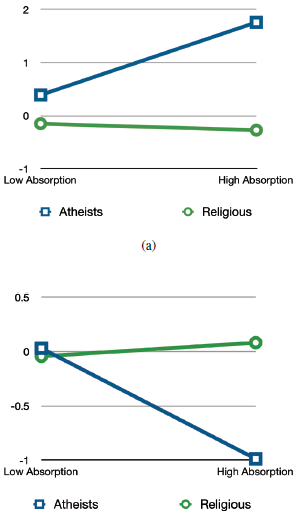
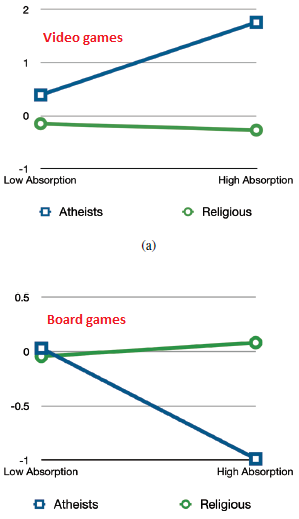 But Burris noticed something else. Alongside game preferences, he also asked questions that sought to uncover their imaginative involvement and the tendency to become mentally absorbed in everyday activities (the Tellegen Absorption Scale).
As illustrated in the graphic, what he found was that religious people had the same interest in video games and board games regardless of their tendency towards absorption. (The graphic shows the results after controlling for overall interest in gaming.)
For atheists, however, video games were more attractive and board games less attractive to those who easily become absorbed in what they’re doing.
What Burris thinks is happening is that atheists are less capable of “generating emotionally evocative internal simulations of experience” – they are less imaginative, at least when it comes to imgaining mental states and situations. This follows on from previous research he did which found that, when asked to recall emotionally-laden events in the past, “atheists’ experiences appeared to be less vivid and less emotionally evocative relative to those of religious individuals.”
They conclude that:
Even in a play context, atheists showed a much greater preference for the WYSIWYG virtual environment compared to the tabletop format wherein imagination is more central. Like tabletop gaming, many articulations of religion require that an individual behave “as if” a set of propositions concerning an unseen realm is true. If the “atheist brain” and the “religious brain” have different processing strengths and weaknesses, as Burris and Petrican (2011) suggested, then rejecting the unseen may be a logical outcome of atheists’ relative inability to generate “as if” experiences in the absence of multisensory “proof” of the sort provided by immersive, externally imposed virtual environments. Indeed, based on the results of the present research, we suspect that if Doubting Thomas were alive today, he would be an avid video gamer.
It’s a really interesting idea, and plausible, but I have a few niggling doubts. Why, for instance, does “absorption” not play a role in the preferences of religious people? And why do atheists have a greater liking for board games than religious people, if they are less capable of imaginative play?
And most importantly, I’m wondering if the preference for video games is linked to the well known phenomenon that North American atheists are more likely to be loners, and less likely to engage in group activities. I can well imagine that, among those 31 atheistic undergraduates, there were more than a few who like to shut themselves away and immerse themselves in an alternate reality provided by an online video game (Word of Warcraft, anyone?) – especially those who can become almost hypnotised by such things (which is what the Tellegen Scale measures).
In other words, religious affiliation might actually be preventing this kind of behaviour from manifesting. Or, alternatively, those who have these tendencies may shun religion.
I’m old enough to remember the good old days of Dungeons and Dragons – a kind of fantasy role playing game which involved creating imaginary worlds and acting out quests. And I also remember tat it was wildly popular among my non-religious friends (Christians hated it, of course).
 Burris, C., & Redden, E. (2012). No Other Gods Before Mario?: Game Preferences Among Atheistic and Religious Individuals International Journal for the Psychology of Religion, 22 (4), 243-251 DOI: 10.1080/10508619.2011.638606
 This article by Tom Rees was first published on Epiphenom. It is licensed under Creative Commons.
Previous Post

January 12, 2013
In Mauritius, religious locations increase generosity
Next Post
January 27, 2013 In Iran and the USA, the "religious person" has a similar personality
Browse Our Archives
Select a Category Causes of religion - evolution Causes of religion - psychological Causes of religion - social Demographics Digest Effects of religion - health Effects of religion - psychological Effects of religion - social Notifications Politics Uncategorized
Select a Month March 2016 February 2016 January 2016 December 2015 November 2015 October 2015 September 2015 August 2015 July 2015 June 2015 May 2015 April 2015 March 2015 February 2015 January 2015 December 2014 November 2014 October 2014 September 2014 August 2014 July 2014 June 2014 May 2014 April 2014 March 2014 February 2014 January 2014 December 2013 November 2013 October 2013 September 2013 August 2013 July 2013 June 2013 May 2013 April 2013 March 2013 February 2013 January 2013 December 2012 November 2012 October 2012 September 2012 August 2012 July 2012 June 2012 May 2012 April 2012 March 2012 February 2012 January 2012 December 2011 November 2011 October 2011 September 2011 August 2011 July 2011 June 2011 May 2011 April 2011 March 2011 February 2011 January 2011 December 2010 November 2010 October 2010 September 2010 August 2010 July 2010 June 2010 May 2010 April 2010 March 2010 February 2010 January 2010 December 2009 November 2009 October 2009 September 2009 August 2009 July 2009 June 2009 May 2009 April 2009 March 2009 February 2009 January 2009 December 2008 November 2008 October 2008 September 2008 August 2008 July 2008 June 2008 May 2008 April 2008 March 2008 February 2008 January 2008 December 2007 November 2007 October 2007
Follow Us!
TAKE THE
Religious Wisdom Quiz
Which was the day that God ended His creation and rested?
Select your answer to see how you score.
On the 5th day On the 6th day On the 7th day He never rested
Related posts from Epiphenom

Do social crises lead to religious revivals? Nah!

What kind of woman would pray for health...

Can you use religion to change attitudes towards...

Dogmatic atheism and fundamentalist Christianity: creating certainty in...
TRENDING AT PATHEOS Nonreligious

Dethroning Jesus and Enthroning Yourself
Jesus Never Asked to Be Worshipped. He Asked to Be Understood. Christianity...

Why Most Christians are Really Paulians and Jobians
I Don't Care, But It Matters Let's get this out of the...

Essential Tips to Successfully Navigate the Selling Process
Selling a house can feel overwhelming, but it doesn’t have to be....

To Make Remote Work Effective, Think About Others
The COVID-19 pandemic forced many companies to rapidly transition to remote work....

Flexibility Is Key to Solving Problems of Tomorrow
The world of work is undergoing a dramatic transformation. The COVID-19 pandemic...
view all Nonreligious blogs
Ad-Free & Subscriber Log-In Subscription Support
- About Us
- 2026 Calendar
- Videos
- Podcasts
- Library of World Religions
- Faith In Media Tracker
- Advertise With Us
- Write for Us
- Privacy Policy
- Terms of Service
- Do Not Sell My Data
- Contact Us
- Radiant Digital
- Manage Newsletter Subscriptions
- Unsubscribe From Notifications
- Sitemap
Copyright 2008-2026, Patheos. All rights reserved.
Subscription Support Ad-Free & Subscriber Log-In
Follow Patheos