
BuddhistCatholicContemplativeEvangelicalGeneral ChristianHinduJewishLatter-day SaintMuslimNew VisionsProgressive Christian
Beliefs
- Buddhist
- Catholic
- Contemplative
- Evangelical
- General Christian
- Hindu
- Jewish
- Latter-day Saint
- More Voices
- Muslim
- New Visions
- Pagan
- Progressive Christian
Topics
- Religion News
- Food and Religion
- Sports and Religion
- Religious Art
- Religious Music and Entertainment
- Religious Events
- History and Religion
- Style and Religion
- Politics and Religion
- Women in Religion
- Recreation Outdoors and Religion
- Business Finance and Religion
- Careers Workplace and Religion
- Education and Religion
- Family Parenting and Religion
- Health Fitness and Religion
- Home and Religion
- Relationships and Religion
- Technology and Religion
- Travel and Religion
Columnists
- Buddhist Columnists
- Business Finance and Religion Columnists
- Careers Workplace and Religion Columnists
- Catholic Columnists
- Contemplative Columnists
- Education and Religion Columnists
- Evangelists Columnists
- Family Parenting and Religion Columnists
- General Christian Columnists
- Health Fitness and Religion Columnists
- Hindu Columnists
- History and Religion Columnists
- Home and Religion Columnists
- Jewish Columnists
- More Voices Columnists
- Latter Day Columnists
- Muslim Columnists
- New Visions Columnists
- Nonreligious Columnists
- Pagan Columnists
- Politics and Religion Columnists
- Progressive Columnists
- Recreation Outdoors and Religion Columnists
- Relationships and Religion Columnists
- Religion News Columnists
- Religious Art Columnists
- Religious Events Columnists
- Religious Music and Entertainment Columnists
- Sports and Religion Columnists
- Style and Religion Columnists
- Technology and Religion Columnists
- Travel and Religion Columnists
- Women in Religion Columnists
Resource Library
- 2026 Calendar
- Library of World Religions
- The 100 Most Holy Places on Earth
- Patheos Answers
- Podcasts
- Videos
- Faith Leaders Database
- Anglican Episcopalian
- Bahai
- Baptist
- Buddhism
- Christianity
- Confucianism
- Eastern Orthodoxy
- Hinduism
- Holiness and Pentecostal
- ISKCON
- Islam
- Judaism
- Lutheran
- Methodist
- The Church of Jesus Christ of Latter-day Saints
- New Age
- Paganism
- Presbytarian and Reformed
- Protestantism
- Religion Behind the Scenes
- Roman Catholic
- Scientology
- Shia Islam
- Sikhism
- Sufism
- Sunni Islam
- Taoism
- Zen
- See all religions
Research Tools
 Ad-Free & Subscriber Log-In Subscription Support
Ad-Free & Subscriber Log-In Subscription Support
Follow Patheos 

- Trending:
- Forgiveness
- |
- Marriage
- |
- Consciousness
- |
- Death Penalty
- |
- Election
- |
- Halloween
 Epiphenom
- Home
- Nonreligious
- Under pressure, even scientists say things exist for a purpose
Under pressure, even scientists say things exist for a purpose
Last updated on: November 12, 2014 at 2:58 am by Epiphenom
Under pressure, even scientists say things exist for a purpose 2014-11-12T02:58:43+01:00 Epiphenom
Patheos Explore the world's faith through different perspectives on religion and spirituality! Patheos has the views of the prevalent religions and spiritualities of the world.
Promiscuous teleology is the natty term given to the tendency many people have to see purpose in the world around them. Teleology just means an explaining things in terms of goals or function, and it’s not always wrong. It’s perfectly correct, for example, to say that children wear mittens to keep their hands warm.
But whenever you hear someone say something like “The sun shines on us to keep us warm”, or “Plants make oxygen for us to breath”, that’s promiscuous teleology.
These kinds of explanations are particularly attractive to children, but earlier research by Deborah Keleman at Boston university has shown that even adults succumb to these ideas, particularly when put under time pressure.
Maybe, though, this is just because a lot of adults have dumb ideas about how the world works. What about hard-headed, rational, scientists? Say, physicists – if any group of people in the world knows about cause and effect, it would be them, right?
So Kelemen tested 79 active, publishing physicists at high-ranking US universities, and compared their results with 73 actively-publishing humanities scholars, 49 age-matched Bostonians who had bachelor’s degrees, and 179 Boston undergrads.
The set-up was straightforward. A series of statements were flashed up on the computer screen, and the participants had to say if the statements were true or false. The statements they were shown included:
- True, causal explanations, e.g. “Conception occurs because sperm and eggs fuse together”
- True, teleological explanations, e.g. “Children wear mittens in the winter in order to keep their hands warm”
- False, causal explanations, e.g. “Snowflakes are white because they are symmetrical”, and
- False, teleological explanations “Window blinds have slats so that they can capture dust”
In each group, half the subjects were given as much time as they wanted to come up with the right answer. The other half were put under pressure – they each had 3.2 seconds (carefully calibrated to be just enough time for almost everybody to read the sentences, but no more).
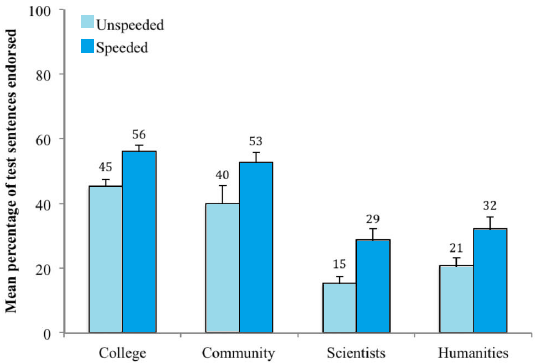
So, on to the results!
Well, the good news is that the physicists did better than the undergrads or the local Bostonians. They were significantly less prone than the others to say the false teleological statements were true.
Score 1 for the physicists!
But hold on a moment. Just like everyone else, the physicists were more likely to think that the promiscuous teleological explanations were correct when they put under time pressure. Even though they still did better than the other groups, they were much more likely to get it wrong if they didn’t have time to stop and think.
Why is that? They didn’t have this problem with the causal explanations – they got them right pretty much regardless of the time pressure.
This suggests that even physicists have a sneaking feeling that teleological explanations are right. Even though they know better.
However based on these results, you might conclude that maybe all those years spent studying science and physics have paid off. They’ve given the physicists a better, intuitive understanding of how the world works.
Except that they were no better than the humanities scholars!
Kelemen assessed the scientific knowledge of both groups, and the physicists scored much higher. So, whatever it is that made the scientists better judges than the non-scholars of the true nature of cause and effect, it wasn’t their scientific training.
Perhaps simply being in the habit of spending your time thinking through problems is enough, or maybe it’s down to innate intelligence. Who knows!
But what this does suggest is that there is some kind of ‘default’ predisposition to fall for this kind of dodgy thinking. Even the most hardened rationalists are susceptible, at least to some extent.
Kelemen did discover one other thing. Across all the groups, people who believed strongly in God or who believed that “Nature is a powerful thing” were significantly more likely to be taken in by the false teleology statements.
And that gives us another pointer to why some people believe in god and others do not. And it fits in with earlier research which found that people who have faulty ideas about cause and effect were also more likely to believe in the paranormal.

Kelemen, D., Rottman, J., & Seston, R. (2012). Professional Physical Scientists Display Tenacious Teleological Tendencies: Purpose-Based Reasoning as a Cognitive Default. Journal of Experimental Psychology: General DOI: 10.1037/a0030399
 This article by Tom Rees was first published on Epiphenom. It is licensed under Creative Commons.
Previous Post

November 10, 2012
Hare Krishna devotees are prone to jump to conclusions
Next Post
November 21, 2012 I'm gonna wash that god right into my hair!
Browse Our Archives
Select a Category Causes of religion - evolution Causes of religion - psychological Causes of religion - social Demographics Digest Effects of religion - health Effects of religion - psychological Effects of religion - social Notifications Politics Uncategorized
Select a Month March 2016 February 2016 January 2016 December 2015 November 2015 October 2015 September 2015 August 2015 July 2015 June 2015 May 2015 April 2015 March 2015 February 2015 January 2015 December 2014 November 2014 October 2014 September 2014 August 2014 July 2014 June 2014 May 2014 April 2014 March 2014 February 2014 January 2014 December 2013 November 2013 October 2013 September 2013 August 2013 July 2013 June 2013 May 2013 April 2013 March 2013 February 2013 January 2013 December 2012 November 2012 October 2012 September 2012 August 2012 July 2012 June 2012 May 2012 April 2012 March 2012 February 2012 January 2012 December 2011 November 2011 October 2011 September 2011 August 2011 July 2011 June 2011 May 2011 April 2011 March 2011 February 2011 January 2011 December 2010 November 2010 October 2010 September 2010 August 2010 July 2010 June 2010 May 2010 April 2010 March 2010 February 2010 January 2010 December 2009 November 2009 October 2009 September 2009 August 2009 July 2009 June 2009 May 2009 April 2009 March 2009 February 2009 January 2009 December 2008 November 2008 October 2008 September 2008 August 2008 July 2008 June 2008 May 2008 April 2008 March 2008 February 2008 January 2008 December 2007 November 2007 October 2007
Follow Us!
TAKE THE
Religious Wisdom Quiz
How did Jesus die?
Select your answer to see how you score.
Hanging Crucifixion Spearing Stoning
Related posts from Epiphenom

Do social crises lead to religious revivals? Nah!

What kind of woman would pray for health...

Can you use religion to change attitudes towards...

Dogmatic atheism and fundamentalist Christianity: creating certainty in...
TRENDING AT PATHEOS Nonreligious

Dethroning Jesus and Enthroning Yourself
Jesus Never Asked to Be Worshipped. He Asked to Be Understood. Christianity...

Why Most Christians are Really Paulians and Jobians
I Don't Care, But It Matters Let's get this out of the...

Essential Tips to Successfully Navigate the Selling Process
Selling a house can feel overwhelming, but it doesn’t have to be....

To Make Remote Work Effective, Think About Others
The COVID-19 pandemic forced many companies to rapidly transition to remote work....

Flexibility Is Key to Solving Problems of Tomorrow
The world of work is undergoing a dramatic transformation. The COVID-19 pandemic...
view all Nonreligious blogs
Ad-Free & Subscriber Log-In Subscription Support
- About Us
- 2026 Calendar
- Videos
- Podcasts
- Library of World Religions
- Faith In Media Tracker
- Advertise With Us
- Write for Us
- Privacy Policy
- Terms of Service
- Do Not Sell My Data
- Contact Us
- Radiant Digital
- Manage Newsletter Subscriptions
- Unsubscribe From Notifications
- Sitemap
Copyright 2008-2026, Patheos. All rights reserved.
Subscription Support Ad-Free & Subscriber Log-In
Follow Patheos