
BuddhistCatholicContemplativeEvangelicalGeneral ChristianHinduJewishLatter-day SaintMuslimNew VisionsProgressive Christian
Beliefs
- Buddhist
- Catholic
- Contemplative
- Evangelical
- General Christian
- Hindu
- Jewish
- Latter-day Saint
- More Voices
- Muslim
- New Visions
- Pagan
- Progressive Christian
Topics
- Religion News
- Food and Religion
- Sports and Religion
- Religious Art
- Religious Music and Entertainment
- Religious Events
- History and Religion
- Style and Religion
- Politics and Religion
- Women in Religion
- Recreation Outdoors and Religion
- Business Finance and Religion
- Careers Workplace and Religion
- Education and Religion
- Family Parenting and Religion
- Health Fitness and Religion
- Home and Religion
- Relationships and Religion
- Technology and Religion
- Travel and Religion
Columnists
- Buddhist Columnists
- Business Finance and Religion Columnists
- Careers Workplace and Religion Columnists
- Catholic Columnists
- Contemplative Columnists
- Education and Religion Columnists
- Evangelists Columnists
- Family Parenting and Religion Columnists
- General Christian Columnists
- Health Fitness and Religion Columnists
- Hindu Columnists
- History and Religion Columnists
- Home and Religion Columnists
- Jewish Columnists
- More Voices Columnists
- Latter Day Columnists
- Muslim Columnists
- New Visions Columnists
- Nonreligious Columnists
- Pagan Columnists
- Politics and Religion Columnists
- Progressive Columnists
- Recreation Outdoors and Religion Columnists
- Relationships and Religion Columnists
- Religion News Columnists
- Religious Art Columnists
- Religious Events Columnists
- Religious Music and Entertainment Columnists
- Sports and Religion Columnists
- Style and Religion Columnists
- Technology and Religion Columnists
- Travel and Religion Columnists
- Women in Religion Columnists
Resource Library
- 2026 Calendar
- Library of World Religions
- The 100 Most Holy Places on Earth
- Patheos Answers
- Podcasts
- Videos
- Faith Leaders Database
- Anglican Episcopalian
- Bahai
- Baptist
- Buddhism
- Christianity
- Confucianism
- Eastern Orthodoxy
- Hinduism
- Holiness and Pentecostal
- ISKCON
- Islam
- Judaism
- Lutheran
- Methodist
- The Church of Jesus Christ of Latter-day Saints
- New Age
- Paganism
- Presbytarian and Reformed
- Protestantism
- Religion Behind the Scenes
- Roman Catholic
- Scientology
- Shia Islam
- Sikhism
- Sufism
- Sunni Islam
- Taoism
- Zen
- See all religions
Research Tools
 Ad-Free & Subscriber Log-In Subscription Support
Ad-Free & Subscriber Log-In Subscription Support
Follow Patheos 

- Trending:
- Forgiveness
- |
- Marriage
- |
- Consciousness
- |
- Death Penalty
- |
- Election
- |
- Halloween
 Epiphenom
- Home
- Nonreligious
- The rising tide of religious protectionism in the West
The rising tide of religious protectionism in the West
Last updated on: November 12, 2014 at 3:18 am by Epiphenom
The rising tide of religious protectionism in the West 2014-11-12T03:18:55+01:00 Epiphenom
Patheos Explore the world's faith through different perspectives on religion and spirituality! Patheos has the views of the prevalent religions and spiritualities of the world.
In the West these days we’re used to a familiar narrative about growing rise of non-belief. Poll after poll has been clear: most countries in Europe, as well as Australasia, are either largely non-religious or becoming markedly less so. Even in the USA, there is now a clear trend towards lower levels of personal belief, especially among the young.
 But that’s not the full picture, not by a long chalk. There are many different ways to look at whether society is ‘secular’, and one of the is to consider whether religion plays a role in the public sphere.
To assess this, Jonathan Fox, a Political Scientist at Bar-Ilan University in Ramat Gan, Israel, has looked at trends in governmental religious policy over recent years (Fox was also the author of the ‘clash of civilizations’ study that I wrote about back in July).
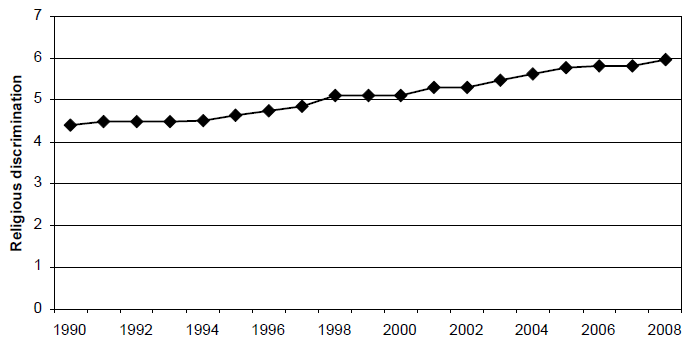
When he looked at discrimination against minority religions, he found a clear trend. As shown in the graphic, the average level of religious favouritism in the west has been increasing. Fox found that:
The most common restrictions are on building, maintaining or repairing places of worship and registration requirements for minority religious institutions. Also, over a quarter of Western European countries place restrictions on proselytizing by foreigners. For example, Austria, Belgium, Denmark, Switzerland, and the UK require special visas for missionaries and/or religious workers and/or have denied such entry to some missionaries or religious workers.
He also found that this trend is quite widespread. Almost all countries (including the USA) engage in at least some form of religious discrimination, and since 1990 discrimination has increased in 12 out of 27 countries assessed (and gone down in only 2).
The second of Fox’s findings was that, on average, governmental support for religion has remained constant over this period – although it increased in seven countries and decreased in eight. He comments:
For instance in 2008 Spain stopped making direct payments to the Catholic Church and Sweden, in the context of removing its official religion in 2000, eliminated some laws. On the other side of the coin, Luxembourg began funding ‘recognized’ religions in 1998 and during George W. Bush’s presidency, the United States began more systematically funding faith-based charities, a trend that had begun more tentatively and with more restrictions under previous administrations.
Although Fox focuses on Western Europe, it seems like this is a worldwide phenomenon. The Pew Centre recently reported that religious discrimination, as assessed by several different measures, has increased around the world in recent years.
I look at these data and what I see is a backlash by the political establishment against the loss of religious faith. Almost all of the increase in religious legislation has been to increase state funding for religious enterprises.
Fox acknowledges this perspective, but demurs:
The simplest interpretation is that this is part of a larger trend where religion is remaining important and perhaps increasing in importance. Another interpretation is that this government sponsored support for dominant religions is a compensation for declining religiosity and religious identity. If this is the case, this would mean that politicians in democratically elected governments in supposedly secularizing societies still think supporting religion benefits their political careers. This implies that there is still a strong political base supporting these policies.
I think that’s true – and you should remember that even in countries with a lot of atheists, most people are still religious and even those who are minimally religious still identify with a faith from a cultural perspective. Plus, of course, politicians are of the older generation, which is more religious than the youngsters (and, compounding the problem: young people don’t vote).
So there are still plenty of votes in religion.
But what about discrimination of minorities. Well, again to me this looks like the dominant culture protecting their own. In particular, hostility towards Muslim minorities in Europe seems to be driving legislation that is specifically attacking minority faiths.
This discrimination is less about religious fervour and more about hostility to immigrants.
Fox agrees, but with some nuances:
In the case of the increasing religious discrimination, it is possible to argue that this reflects a desire to maintain the dominant culture, security concerns, and, perhaps, protect citizens from potentially dangerous and predatory ‘cults’ or ‘sects’. However, the specific restrictions do not materially add to security and by agitating minority populations they likely increase security risks … these policies seem more consistent with a desire to protect the religious status quo.
Put differently, if religion was not important in the West, the introduction of new religions with small followings into a country should be met with apathy, not resistance
In other words, however you read these data it’s clear that religion is still important in the West. In fact, religion is important enough for governments to take increasing steps to try to protect it!

Jonathan Fox (2012). The Last Bastion of Secularism? Government Religion Policy in Western Democracies, 1990 to 2008 Journal of Contemporary European Studies, 20 (2), 161-180 DOI: 10.1080/14782804.2012.685389
 This article by Tom Rees was first published on Epiphenom. It is licensed under Creative Commons.
Next Post

September 26, 2012 Subconscious religious predjudice in children
Browse Our Archives
Select a Category Causes of religion - evolution Causes of religion - psychological Causes of religion - social Demographics Digest Effects of religion - health Effects of religion - psychological Effects of religion - social Notifications Politics Uncategorized
Select a Month March 2016 February 2016 January 2016 December 2015 November 2015 October 2015 September 2015 August 2015 July 2015 June 2015 May 2015 April 2015 March 2015 February 2015 January 2015 December 2014 November 2014 October 2014 September 2014 August 2014 July 2014 June 2014 May 2014 April 2014 March 2014 February 2014 January 2014 December 2013 November 2013 October 2013 September 2013 August 2013 July 2013 June 2013 May 2013 April 2013 March 2013 February 2013 January 2013 December 2012 November 2012 October 2012 September 2012 August 2012 July 2012 June 2012 May 2012 April 2012 March 2012 February 2012 January 2012 December 2011 November 2011 October 2011 September 2011 August 2011 July 2011 June 2011 May 2011 April 2011 March 2011 February 2011 January 2011 December 2010 November 2010 October 2010 September 2010 August 2010 July 2010 June 2010 May 2010 April 2010 March 2010 February 2010 January 2010 December 2009 November 2009 October 2009 September 2009 August 2009 July 2009 June 2009 May 2009 April 2009 March 2009 February 2009 January 2009 December 2008 November 2008 October 2008 September 2008 August 2008 July 2008 June 2008 May 2008 April 2008 March 2008 February 2008 January 2008 December 2007 November 2007 October 2007
Follow Us!
TAKE THE
Religious Wisdom Quiz
Who was Lydia's profession?
Select your answer to see how you score.
Cloth merchant Farmer Weaver Potter
Related posts from Epiphenom

Do social crises lead to religious revivals? Nah!

What kind of woman would pray for health...

Can you use religion to change attitudes towards...

Dogmatic atheism and fundamentalist Christianity: creating certainty in...
TRENDING AT PATHEOS Nonreligious

Dethroning Jesus and Enthroning Yourself
Jesus Never Asked to Be Worshipped. He Asked to Be Understood. Christianity...

Why Most Christians are Really Paulians and Jobians
I Don't Care, But It Matters Let's get this out of the...

Essential Tips to Successfully Navigate the Selling Process
Selling a house can feel overwhelming, but it doesn’t have to be....

To Make Remote Work Effective, Think About Others
The COVID-19 pandemic forced many companies to rapidly transition to remote work....

Flexibility Is Key to Solving Problems of Tomorrow
The world of work is undergoing a dramatic transformation. The COVID-19 pandemic...
view all Nonreligious blogs
Ad-Free & Subscriber Log-In Subscription Support
- About Us
- 2026 Calendar
- Videos
- Podcasts
- Library of World Religions
- Faith In Media Tracker
- Advertise With Us
- Write for Us
- Privacy Policy
- Terms of Service
- Do Not Sell My Data
- Contact Us
- Radiant Digital
- Manage Newsletter Subscriptions
- Unsubscribe From Notifications
- Sitemap
Copyright 2008-2026, Patheos. All rights reserved.
Subscription Support Ad-Free & Subscriber Log-In
Follow Patheos