
BuddhistCatholicContemplativeEvangelicalGeneral ChristianHinduJewishLatter-day SaintMuslimNew VisionsProgressive Christian
Beliefs
- Buddhist
- Catholic
- Contemplative
- Evangelical
- General Christian
- Hindu
- Jewish
- Latter-day Saint
- More Voices
- Muslim
- New Visions
- Pagan
- Progressive Christian
Topics
- Religion News
- Food and Religion
- Sports and Religion
- Religious Art
- Religious Music and Entertainment
- Religious Events
- History and Religion
- Style and Religion
- Politics and Religion
- Women in Religion
- Recreation Outdoors and Religion
- Business Finance and Religion
- Careers Workplace and Religion
- Education and Religion
- Family Parenting and Religion
- Health Fitness and Religion
- Home and Religion
- Relationships and Religion
- Technology and Religion
- Travel and Religion
Columnists
- Buddhist Columnists
- Business Finance and Religion Columnists
- Careers Workplace and Religion Columnists
- Catholic Columnists
- Contemplative Columnists
- Education and Religion Columnists
- Evangelists Columnists
- Family Parenting and Religion Columnists
- General Christian Columnists
- Health Fitness and Religion Columnists
- Hindu Columnists
- History and Religion Columnists
- Home and Religion Columnists
- Jewish Columnists
- More Voices Columnists
- Latter Day Columnists
- Muslim Columnists
- New Visions Columnists
- Nonreligious Columnists
- Pagan Columnists
- Politics and Religion Columnists
- Progressive Columnists
- Recreation Outdoors and Religion Columnists
- Relationships and Religion Columnists
- Religion News Columnists
- Religious Art Columnists
- Religious Events Columnists
- Religious Music and Entertainment Columnists
- Sports and Religion Columnists
- Style and Religion Columnists
- Technology and Religion Columnists
- Travel and Religion Columnists
- Women in Religion Columnists
Resource Library
- 2026 Calendar
- Library of World Religions
- The 100 Most Holy Places on Earth
- Patheos Answers
- Podcasts
- Videos
- Faith Leaders Database
- Anglican Episcopalian
- Bahai
- Baptist
- Buddhism
- Christianity
- Confucianism
- Eastern Orthodoxy
- Hinduism
- Holiness and Pentecostal
- ISKCON
- Islam
- Judaism
- Lutheran
- Methodist
- The Church of Jesus Christ of Latter-day Saints
- New Age
- Paganism
- Presbytarian and Reformed
- Protestantism
- Religion Behind the Scenes
- Roman Catholic
- Scientology
- Shia Islam
- Sikhism
- Sufism
- Sunni Islam
- Taoism
- Zen
- See all religions
Research Tools
 Ad-Free & Subscriber Log-In Subscription Support
Ad-Free & Subscriber Log-In Subscription Support
Follow Patheos 

- Trending:
- Forgiveness
- |
- Marriage
- |
- Consciousness
- |
- Death Penalty
- |
- Election
- |
- Halloween
 Epiphenom
- Home
- Nonreligious
- Recollections of childhood religion: your past becomes like your present
Recollections of childhood religion: your past becomes like your present
Last updated on: November 12, 2014 at 3:22 am by Epiphenom
Recollections of childhood religion: your past becomes like your present 2014-11-12T03:22:13+01:00 Epiphenom
Patheos Explore the world's faith through different perspectives on religion and spirituality! Patheos has the views of the prevalent religions and spiritualities of the world.
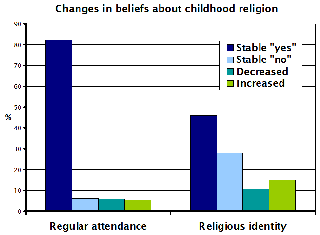 Trying to work out why and how religious beliefs change over their lifetime is challenging because hard data are rare. Instead, researchers often have to resort to asking adults what they believed when they were children.
Of course, everyone knows that such memories are not 100% reliable, but just how unreliable is hard to judge. David Hayward, at the University of Michigan, and colleagues, have been able to quantify it by using data from a survey that’s been running in Rhode Island since 1959.
The survey was conducted in waves, starting with mothers and their infant children, and then following up with three further surveys (the most recent was in 2001). In each survey, they asked about current religious behavior (“Do you regularly go to a church or other place of worship?”) and current religious identity (“Do you consider yourself a religious person?”). Crucially, they also asked about retrospective childhood religious behavior and retrospective childhood religious identity.
Comparing the earliest and last responses for each participant, they found that both current religious behaviour and current religious identity did change for around 20-30% of people. That’s as you might expect: some people became less religious, some people became more religious (this was more common), but most people stayed the same.
What was interesting is that recollections of childhood religion also changed.
In fact, most people were consistent in their reports of childhood religious behaviour. Only 10% changed their minds about whether or not they had regularly gone to church. However, 25% of people changed their minds about whether they considered their childhood selves to have been religious.
When Hayward and colleagues crunched the numbers, they found that current religious identity significantly influenced changes in childhood religious identity. In other words, people tend to change their ideas about their childhood religious identity to align it with their current identity. They comment that:
This pattern of results is consistent with predictions based on self-appraisal theory. Because we are motivated to see ourselves as basically stable on important dimensions across the life course, and to reduce perceived dissonance between past and present selves, it is likely that when people reevaluate their religiousness they tend to harmonize past identities with present ones.
That wasn’t the case with childhood religious behaviour. Perhaps that’s because behaviour is more objective, and can be independently verified. But maybe it’s also because your past behaviour is easier to explain away.
For example, if you don’t go to church now, you can explain away your childhood church going as simply the result of family pressure. SImilarly, current churchgoers can justify their lack of attendance in childhood as a result of family shortcomings.
You can explain away childhood behaviour without having to disturb your precious beliefs about your own values. But you can’t explain away childhood identity in this way so, in order to restore mental harmony, the temptation is to invent new memories!
 Hayward RD, Maselko J, & Meador KG (2012). Recollections of Childhood Religious Identity and Behavior as a Function of Adult Religiousness. The International journal for the psychology of religion, 22 (1), 79-88 PMID: 22844186
 This article by Tom Rees was first published on Epiphenom. It is licensed under Creative Commons.
Previous Post

August 9, 2012
Religion and ethnicity reinforce each other to create distrust
Next Post
August 26, 2012 Awe expands your sense of time - and makes you less materialistic
Browse Our Archives
Select a Category Causes of religion - evolution Causes of religion - psychological Causes of religion - social Demographics Digest Effects of religion - health Effects of religion - psychological Effects of religion - social Notifications Politics Uncategorized
Select a Month March 2016 February 2016 January 2016 December 2015 November 2015 October 2015 September 2015 August 2015 July 2015 June 2015 May 2015 April 2015 March 2015 February 2015 January 2015 December 2014 November 2014 October 2014 September 2014 August 2014 July 2014 June 2014 May 2014 April 2014 March 2014 February 2014 January 2014 December 2013 November 2013 October 2013 September 2013 August 2013 July 2013 June 2013 May 2013 April 2013 March 2013 February 2013 January 2013 December 2012 November 2012 October 2012 September 2012 August 2012 July 2012 June 2012 May 2012 April 2012 March 2012 February 2012 January 2012 December 2011 November 2011 October 2011 September 2011 August 2011 July 2011 June 2011 May 2011 April 2011 March 2011 February 2011 January 2011 December 2010 November 2010 October 2010 September 2010 August 2010 July 2010 June 2010 May 2010 April 2010 March 2010 February 2010 January 2010 December 2009 November 2009 October 2009 September 2009 August 2009 July 2009 June 2009 May 2009 April 2009 March 2009 February 2009 January 2009 December 2008 November 2008 October 2008 September 2008 August 2008 July 2008 June 2008 May 2008 April 2008 March 2008 February 2008 January 2008 December 2007 November 2007 October 2007
Follow Us!
TAKE THE
Religious Wisdom Quiz
Who had a colorful coat from his father?
Select your answer to see how you score.
Daniel David Joseph Isaac
Related posts from Epiphenom

Do social crises lead to religious revivals? Nah!

What kind of woman would pray for health...

Can you use religion to change attitudes towards...

Dogmatic atheism and fundamentalist Christianity: creating certainty in...
TRENDING AT PATHEOS Nonreligious

Dethroning Jesus and Enthroning Yourself
Jesus Never Asked to Be Worshipped. He Asked to Be Understood. Christianity...

Why Most Christians are Really Paulians and Jobians
I Don't Care, But It Matters Let's get this out of the...

Essential Tips to Successfully Navigate the Selling Process
Selling a house can feel overwhelming, but it doesn’t have to be....

To Make Remote Work Effective, Think About Others
The COVID-19 pandemic forced many companies to rapidly transition to remote work....

Flexibility Is Key to Solving Problems of Tomorrow
The world of work is undergoing a dramatic transformation. The COVID-19 pandemic...
view all Nonreligious blogs
Ad-Free & Subscriber Log-In Subscription Support
- About Us
- 2026 Calendar
- Videos
- Podcasts
- Library of World Religions
- Faith In Media Tracker
- Advertise With Us
- Write for Us
- Privacy Policy
- Terms of Service
- Do Not Sell My Data
- Contact Us
- Radiant Digital
- Manage Newsletter Subscriptions
- Unsubscribe From Notifications
- Sitemap
Copyright 2008-2026, Patheos. All rights reserved.
Subscription Support Ad-Free & Subscriber Log-In
Follow Patheos