
BuddhistCatholicContemplativeEvangelicalGeneral ChristianHinduJewishLatter-day SaintMuslimNew VisionsProgressive Christian
Beliefs
- Buddhist
- Catholic
- Contemplative
- Evangelical
- General Christian
- Hindu
- Jewish
- Latter-day Saint
- More Voices
- Muslim
- New Visions
- Pagan
- Progressive Christian
Topics
- Religion News
- Food and Religion
- Sports and Religion
- Religious Art
- Religious Music and Entertainment
- Religious Events
- History and Religion
- Style and Religion
- Politics and Religion
- Women in Religion
- Recreation Outdoors and Religion
- Business Finance and Religion
- Careers Workplace and Religion
- Education and Religion
- Family Parenting and Religion
- Health Fitness and Religion
- Home and Religion
- Relationships and Religion
- Technology and Religion
- Travel and Religion
Columnists
- Buddhist Columnists
- Business Finance and Religion Columnists
- Careers Workplace and Religion Columnists
- Catholic Columnists
- Contemplative Columnists
- Education and Religion Columnists
- Evangelists Columnists
- Family Parenting and Religion Columnists
- General Christian Columnists
- Health Fitness and Religion Columnists
- Hindu Columnists
- History and Religion Columnists
- Home and Religion Columnists
- Jewish Columnists
- More Voices Columnists
- Latter Day Columnists
- Muslim Columnists
- New Visions Columnists
- Nonreligious Columnists
- Pagan Columnists
- Politics and Religion Columnists
- Progressive Columnists
- Recreation Outdoors and Religion Columnists
- Relationships and Religion Columnists
- Religion News Columnists
- Religious Art Columnists
- Religious Events Columnists
- Religious Music and Entertainment Columnists
- Sports and Religion Columnists
- Style and Religion Columnists
- Technology and Religion Columnists
- Travel and Religion Columnists
- Women in Religion Columnists
Resource Library
- 2026 Calendar
- Library of World Religions
- The 100 Most Holy Places on Earth
- Patheos Answers
- Podcasts
- Videos
- Faith Leaders Database
- Anglican Episcopalian
- Bahai
- Baptist
- Buddhism
- Christianity
- Confucianism
- Eastern Orthodoxy
- Hinduism
- Holiness and Pentecostal
- ISKCON
- Islam
- Judaism
- Lutheran
- Methodist
- The Church of Jesus Christ of Latter-day Saints
- New Age
- Paganism
- Presbytarian and Reformed
- Protestantism
- Religion Behind the Scenes
- Roman Catholic
- Scientology
- Shia Islam
- Sikhism
- Sufism
- Sunni Islam
- Taoism
- Zen
- See all religions
Research Tools
 Ad-Free & Subscriber Log-In Subscription Support
Ad-Free & Subscriber Log-In Subscription Support
Follow Patheos 

- Trending:
- Forgiveness
- |
- Marriage
- |
- Consciousness
- |
- Death Penalty
- |
- Election
- |
- Halloween
 Epiphenom
- Home
- Nonreligious
- Catholics and Muslims want democracy – but for different reasons
Catholics and Muslims want democracy – but for different reasons
Last updated on: November 12, 2014 at 3:21 am by Epiphenom
Catholics and Muslims want democracy – but for different reasons 2014-11-12T03:21:19+01:00 Epiphenom
Patheos Explore the world's faith through different perspectives on religion and spirituality! Patheos has the views of the prevalent religions and spiritualities of the world.
So, what’s wrong with Muslim countries, eh? That’s something I hear with increasing frequency – usually by people who are implying some kind of cultural superiority over the faithful.
After all, Muslim countries are mostly autocratic, and even after the Arab spring real democracy seems like a distant hope for most.
Among academics, there are two popular theories for why democracy does not take root in Muslim countries. The first says that it’s down to a lack of modernization – stronger economies would “produce a more articulate, liberal, and tolerant public”.
The second theory asserts that Islamic societies don’t embrace the spirit of democracy – that is, they do not score well on essential civic values, such as interpersonal trust, social tolerance, support for political equality, and civic engagement.
To investigate these ideas, ManLi Gu and Eduard Bomhoff (Monash University, Sunway, Malaysia) analysed data from the World Values Survey, hoping to find out whether Muslims support democracy, and why. They looked at a selection of Catholic and Muslim Countries, chosen because there are a number of Catholic countries (in South America) with low levels of economic development.
They used a statistical technique to isolate clusters of opinions. In particular, they were looking at how attitudes to religion cluster with political attitudes.
The first thing they found is that Muslim and Catholic countries had similar levels of desire for democracy, and that all the countries they looked at had a sizable cluster of people who were both highly religious and very much in favour of democracy. What’s more, there didn’t seem to be any notable clusters of religious, anti-democratic individuals (except in Columbia and Mexico).
Incidentally, France, Spain and Uruguay were the only nations to have a sizable non-religious, pro-democracy group – presumably because the other countries had few non-religious people over all.
So, neither religions seem to form an intrinsic barrier to democracy. However, support for democracy was linked with very different attitudes among Catholics versus Muslims.
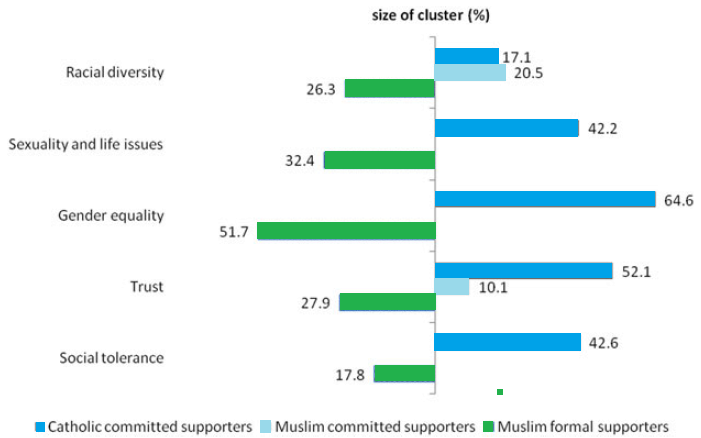
Gu and Bomhoff found that in Catholic countries there were sizeable groups of people whose support for democracy was linked to support for other liberal ideas – such as racial diversity, sexual liberation, gender equality, trust and social tolerance (see graphic).
In Muslims countries, these clusters mostly did not exist. But what did exist was the exact opposite – large groups of people who combined support for democracy with rejection of liberal values!
Further analysis showed that support for democracy in Muslim countries was linked not with liberal values but desire for prosperity and wealth redistribution. They conclude:
Support for democracy in the Catholic countries stems from a pro-democratic civic culture that embodies certain distinct attributes such as tolerance of diversity, mutual trust, and an emphasis on gender equality … Citizens in Islamic countries, on the other hand, endorse the term democracy without necessarily embracing those liberal values that arguably are crucial for a vigorous and open democracy.
So people living in Muslim countries see democracy just as a tool that brings economic benefits. And the problem with that, according to Gu and Bomhoff, is that support for democracy won’t endure in the face of economic downturns.
Now, it was not all that long ago that you could find similar attitudes in Catholic countries. After all, Spain and Latin America have had a pretty ambivalent relationship with democracy until relatively recently. However, attitudes in these countries have shifted quite dramatically in recent years. Democratization was accompanied by a surge in support for liberal values, especially among the young.
In Muslim countries, however, the young are just as conservative as their parents and grandparents (at least, according to the World Values Survey). There are no signs of shifting attitudes.
All of this leads Gu and Bomhoff to a gloomy prognosis for Muslim countries:
We concur with the Culturalist theorists that there is a cultural basis for the absence of democracy in the Muslim world — the democratic deficit has something to do with a shortfall in deeper democratic values and a lack of appreciation of freedom and openness at the mass level.
Quite why this is so is another matter. I suspect it is not due to religious differences – at least, not in any direct way. After all, both religions include traditions that could be called upon to support either liberal or conservative attitudes.
So I suspect that the difference has something to do with the cultural history, and in particular the conflict with the Christian West. Throughout most of the history of Islam, the West was culturally and materially inferior to Islam. Maybe this cultural memory has something to do with the resistance to what are seen today as ‘Western’ values.

Man-Li Gu, & Eduard J. Bomhoff (2012). Religion and Support for Democracy: A Comparative Study for Catholic and Muslim Countries Politics and Religion, 5 (2), 280-316 : 10.1017/S1755048312000041
 This article by Tom Rees was first published on Epiphenom. It is licensed under Creative Commons.
Previous Post

August 26, 2012
Awe expands your sense of time - and makes you less materialistic
Browse Our Archives
Select a Category Causes of religion - evolution Causes of religion - psychological Causes of religion - social Demographics Digest Effects of religion - health Effects of religion - psychological Effects of religion - social Notifications Politics Uncategorized
Select a Month March 2016 February 2016 January 2016 December 2015 November 2015 October 2015 September 2015 August 2015 July 2015 June 2015 May 2015 April 2015 March 2015 February 2015 January 2015 December 2014 November 2014 October 2014 September 2014 August 2014 July 2014 June 2014 May 2014 April 2014 March 2014 February 2014 January 2014 December 2013 November 2013 October 2013 September 2013 August 2013 July 2013 June 2013 May 2013 April 2013 March 2013 February 2013 January 2013 December 2012 November 2012 October 2012 September 2012 August 2012 July 2012 June 2012 May 2012 April 2012 March 2012 February 2012 January 2012 December 2011 November 2011 October 2011 September 2011 August 2011 July 2011 June 2011 May 2011 April 2011 March 2011 February 2011 January 2011 December 2010 November 2010 October 2010 September 2010 August 2010 July 2010 June 2010 May 2010 April 2010 March 2010 February 2010 January 2010 December 2009 November 2009 October 2009 September 2009 August 2009 July 2009 June 2009 May 2009 April 2009 March 2009 February 2009 January 2009 December 2008 November 2008 October 2008 September 2008 August 2008 July 2008 June 2008 May 2008 April 2008 March 2008 February 2008 January 2008 December 2007 November 2007 October 2007
Follow Us!
TAKE THE
Religious Wisdom Quiz
Who said, "The just shall live by faith"?
Select your answer to see how you score.
Peter Jesus Paul John
Related posts from Epiphenom

Do social crises lead to religious revivals? Nah!

What kind of woman would pray for health...

Can you use religion to change attitudes towards...

Dogmatic atheism and fundamentalist Christianity: creating certainty in...
TRENDING AT PATHEOS Nonreligious

Dethroning Jesus and Enthroning Yourself
Jesus Never Asked to Be Worshipped. He Asked to Be Understood. Christianity...

Why Most Christians are Really Paulians and Jobians
I Don't Care, But It Matters Let's get this out of the...

Essential Tips to Successfully Navigate the Selling Process
Selling a house can feel overwhelming, but it doesn’t have to be....

To Make Remote Work Effective, Think About Others
The COVID-19 pandemic forced many companies to rapidly transition to remote work....

Flexibility Is Key to Solving Problems of Tomorrow
The world of work is undergoing a dramatic transformation. The COVID-19 pandemic...
view all Nonreligious blogs
Ad-Free & Subscriber Log-In Subscription Support
- About Us
- 2026 Calendar
- Videos
- Podcasts
- Library of World Religions
- Faith In Media Tracker
- Advertise With Us
- Write for Us
- Privacy Policy
- Terms of Service
- Do Not Sell My Data
- Contact Us
- Radiant Digital
- Manage Newsletter Subscriptions
- Unsubscribe From Notifications
- Sitemap
Copyright 2008-2026, Patheos. All rights reserved.
Subscription Support Ad-Free & Subscriber Log-In
Follow Patheos