
BuddhistCatholicContemplativeEvangelicalGeneral ChristianHinduJewishLatter-day SaintMuslimNew VisionsProgressive Christian
Beliefs
- Buddhist
- Catholic
- Contemplative
- Evangelical
- General Christian
- Hindu
- Jewish
- Latter-day Saint
- More Voices
- Muslim
- New Visions
- Pagan
- Progressive Christian
Topics
- Religion News
- Food and Religion
- Sports and Religion
- Religious Art
- Religious Music and Entertainment
- Religious Events
- History and Religion
- Style and Religion
- Politics and Religion
- Women in Religion
- Recreation Outdoors and Religion
- Business Finance and Religion
- Careers Workplace and Religion
- Education and Religion
- Family Parenting and Religion
- Health Fitness and Religion
- Home and Religion
- Relationships and Religion
- Technology and Religion
- Travel and Religion
Columnists
- Buddhist Columnists
- Business Finance and Religion Columnists
- Careers Workplace and Religion Columnists
- Catholic Columnists
- Contemplative Columnists
- Education and Religion Columnists
- Evangelists Columnists
- Family Parenting and Religion Columnists
- General Christian Columnists
- Health Fitness and Religion Columnists
- Hindu Columnists
- History and Religion Columnists
- Home and Religion Columnists
- Jewish Columnists
- More Voices Columnists
- Latter Day Columnists
- Muslim Columnists
- New Visions Columnists
- Nonreligious Columnists
- Pagan Columnists
- Politics and Religion Columnists
- Progressive Columnists
- Recreation Outdoors and Religion Columnists
- Relationships and Religion Columnists
- Religion News Columnists
- Religious Art Columnists
- Religious Events Columnists
- Religious Music and Entertainment Columnists
- Sports and Religion Columnists
- Style and Religion Columnists
- Technology and Religion Columnists
- Travel and Religion Columnists
- Women in Religion Columnists
Resource Library
- 2026 Calendar
- Library of World Religions
- The 100 Most Holy Places on Earth
- Patheos Answers
- Podcasts
- Videos
- Faith Leaders Database
- Anglican Episcopalian
- Bahai
- Baptist
- Buddhism
- Christianity
- Confucianism
- Eastern Orthodoxy
- Hinduism
- Holiness and Pentecostal
- ISKCON
- Islam
- Judaism
- Lutheran
- Methodist
- The Church of Jesus Christ of Latter-day Saints
- New Age
- Paganism
- Presbytarian and Reformed
- Protestantism
- Religion Behind the Scenes
- Roman Catholic
- Scientology
- Shia Islam
- Sikhism
- Sufism
- Sunni Islam
- Taoism
- Zen
- See all religions
Research Tools
 Ad-Free & Subscriber Log-In Subscription Support
Ad-Free & Subscriber Log-In Subscription Support
Follow Patheos 

- Trending:
- Forgiveness
- |
- Marriage
- |
- Consciousness
- |
- Death Penalty
- |
- Election
- |
- Halloween
 Epiphenom
- Home
- Nonreligious
- Wars increasingly involve religion, but it’s not a clash of civilisations
Wars increasingly involve religion, but it’s not a clash of civilisations
Last updated on: November 12, 2014 at 3:27 am by Epiphenom
Wars increasingly involve religion, but it’s not a clash of civilisations 2014-11-12T03:27:49+01:00 Epiphenom
Patheos Explore the world's faith through different perspectives on religion and spirituality! Patheos has the views of the prevalent religions and spiritualities of the world.
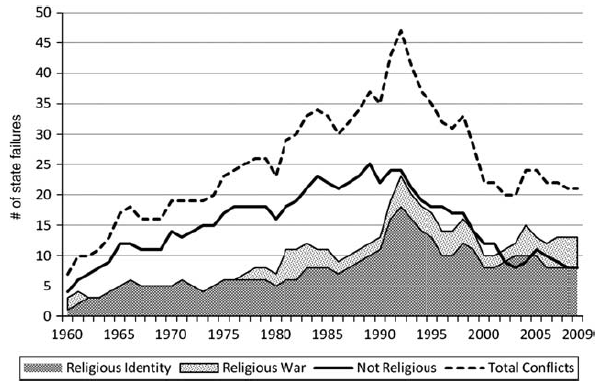
Jonathan Fox, a Political Scientist at Bar-Ilan University in Ramat Gan, Israel, has reviewed data on conflicts worldwide since 1960, and found not only that there are currently more religious conflicts that there were in the 60s, but that religion now plays a role in over half of all conflicts.
By ‘religious conflict’ he doesn’t mean one that is just about religion – such conflicts are few and far between. Rather, he means one in which religion is a significant factor, meeting at least one of these criteria:
- It is between groups who belong to different religions;
- It is between groups that belong to different denominations of the same religions (e.g. Protestants vs. Catholics or Sunni Muslims vs. Shi’i Muslims)
- The issues in the conflict include (but are by no means limited to) significant religious issues, such as state religion policy or the role of religion in the regime. These issues need not be the most important issue in the conflict but they must be among the central issues in the conflict.
He used a standard and widely-used database of conflicts (the PITF), extracting data on ethnic wars, genocides and politicides and revolutionary wars, and categorised them according to whether they involved a conflict of religious identity conflict (the two groups involved in the conflict belong to different religions or different denominations of the same religion) or a religious war (both sides are the same religion, but religion is an issue in the conflict – usually fundamentalists versus secular states).
Overall, wars of all kinds peaked in the early 1990s and have dropped away since. The same trend is shown by religious wars, although the drop-off has not been so sharp.
The result is that religious wars are making up an increasingly large portion of the total – a trend that can be identified as starting in the late 1970s (think: Iranian Revolution).
These wars increasingly involve Islamic fighters. In recent years, 70% of all conflict and 100% of all religious wars have had an Islamic component.
However, they are not inter-religious wars. Conflicts involving Christians have declined somewhat, and other religions even more. This conflicts with the ‘Clash of Civilisations‘ idea, in which Samuel Huntingdon proposed that conflicts between the West and Islam would increase following the end of the Cold War.
What Fox thinks is happening is a combination of two factors.
Firstly, he cites David Rapoport’s Wave Theory of terrorist causes. This basically says that terrorist causes rise and fall roughly every 45 years. Each generation, looking for a cause to make its own, rejects the causes of the generation before and seeks out a new cause.
Islam, then, is simply the current vehicle for revolutionary idealism – following on in the footsteps of anarchism, anti-colonialism, and ‘new-left’ terrorism. Revolutionaries latch onto Islamism as it offers a stark contrast to the established, secular states.
In this reading, the current wave of Islamic conflict will ebb in turn, probably over the next 10-20 years. Maybe the ‘Arab Spring’ is the first flickerings of the next wave!

Jonathan Fox (2012). The Religious Wave: Religion and Domestic Conflict from 1960 to 2009 Civil Wars DOI: 10.1080/13698249.2012.679492
 This article by Tom Rees was first published on Epiphenom. It is licensed under Creative Commons.
Previous Post

July 2, 2012
What sort of religious person believes in meddling spirits?
Browse Our Archives
Select a Category Causes of religion - evolution Causes of religion - psychological Causes of religion - social Demographics Digest Effects of religion - health Effects of religion - psychological Effects of religion - social Notifications Politics Uncategorized
Select a Month March 2016 February 2016 January 2016 December 2015 November 2015 October 2015 September 2015 August 2015 July 2015 June 2015 May 2015 April 2015 March 2015 February 2015 January 2015 December 2014 November 2014 October 2014 September 2014 August 2014 July 2014 June 2014 May 2014 April 2014 March 2014 February 2014 January 2014 December 2013 November 2013 October 2013 September 2013 August 2013 July 2013 June 2013 May 2013 April 2013 March 2013 February 2013 January 2013 December 2012 November 2012 October 2012 September 2012 August 2012 July 2012 June 2012 May 2012 April 2012 March 2012 February 2012 January 2012 December 2011 November 2011 October 2011 September 2011 August 2011 July 2011 June 2011 May 2011 April 2011 March 2011 February 2011 January 2011 December 2010 November 2010 October 2010 September 2010 August 2010 July 2010 June 2010 May 2010 April 2010 March 2010 February 2010 January 2010 December 2009 November 2009 October 2009 September 2009 August 2009 July 2009 June 2009 May 2009 April 2009 March 2009 February 2009 January 2009 December 2008 November 2008 October 2008 September 2008 August 2008 July 2008 June 2008 May 2008 April 2008 March 2008 February 2008 January 2008 December 2007 November 2007 October 2007
Follow Us!
TAKE THE
Religious Wisdom Quiz
In the New Testament what is the last book?
Select your answer to see how you score.
Revelation Matthew Luke Titus
Related posts from Epiphenom

Do social crises lead to religious revivals? Nah!

What kind of woman would pray for health...

Can you use religion to change attitudes towards...

Dogmatic atheism and fundamentalist Christianity: creating certainty in...
TRENDING AT PATHEOS Nonreligious

Dethroning Jesus and Enthroning Yourself
Jesus Never Asked to Be Worshipped. He Asked to Be Understood. Christianity...

Why Most Christians are Really Paulians and Jobians
I Don't Care, But It Matters Let's get this out of the...

Essential Tips to Successfully Navigate the Selling Process
Selling a house can feel overwhelming, but it doesn’t have to be....

To Make Remote Work Effective, Think About Others
The COVID-19 pandemic forced many companies to rapidly transition to remote work....

Flexibility Is Key to Solving Problems of Tomorrow
The world of work is undergoing a dramatic transformation. The COVID-19 pandemic...
view all Nonreligious blogs
Ad-Free & Subscriber Log-In Subscription Support
- About Us
- 2026 Calendar
- Videos
- Podcasts
- Library of World Religions
- Faith In Media Tracker
- Advertise With Us
- Write for Us
- Privacy Policy
- Terms of Service
- Do Not Sell My Data
- Contact Us
- Radiant Digital
- Manage Newsletter Subscriptions
- Unsubscribe From Notifications
- Sitemap
Copyright 2008-2026, Patheos. All rights reserved.
Subscription Support Ad-Free & Subscriber Log-In
Follow Patheos