
BuddhistCatholicContemplativeEvangelicalGeneral ChristianHinduJewishLatter-day SaintMuslimNew VisionsProgressive Christian
Beliefs
- Buddhist
- Catholic
- Contemplative
- Evangelical
- General Christian
- Hindu
- Jewish
- Latter-day Saint
- More Voices
- Muslim
- New Visions
- Pagan
- Progressive Christian
Topics
- Religion News
- Food and Religion
- Sports and Religion
- Religious Art
- Religious Music and Entertainment
- Religious Events
- History and Religion
- Style and Religion
- Politics and Religion
- Women in Religion
- Recreation Outdoors and Religion
- Business Finance and Religion
- Careers Workplace and Religion
- Education and Religion
- Family Parenting and Religion
- Health Fitness and Religion
- Home and Religion
- Relationships and Religion
- Technology and Religion
- Travel and Religion
Columnists
- Buddhist Columnists
- Business Finance and Religion Columnists
- Careers Workplace and Religion Columnists
- Catholic Columnists
- Contemplative Columnists
- Education and Religion Columnists
- Evangelists Columnists
- Family Parenting and Religion Columnists
- General Christian Columnists
- Health Fitness and Religion Columnists
- Hindu Columnists
- History and Religion Columnists
- Home and Religion Columnists
- Jewish Columnists
- More Voices Columnists
- Latter Day Columnists
- Muslim Columnists
- New Visions Columnists
- Nonreligious Columnists
- Pagan Columnists
- Politics and Religion Columnists
- Progressive Columnists
- Recreation Outdoors and Religion Columnists
- Relationships and Religion Columnists
- Religion News Columnists
- Religious Art Columnists
- Religious Events Columnists
- Religious Music and Entertainment Columnists
- Sports and Religion Columnists
- Style and Religion Columnists
- Technology and Religion Columnists
- Travel and Religion Columnists
- Women in Religion Columnists
Resource Library
- 2026 Calendar
- Library of World Religions
- The 100 Most Holy Places on Earth
- Patheos Answers
- Podcasts
- Videos
- Faith Leaders Database
- Anglican Episcopalian
- Bahai
- Baptist
- Buddhism
- Christianity
- Confucianism
- Eastern Orthodoxy
- Hinduism
- Holiness and Pentecostal
- ISKCON
- Islam
- Judaism
- Lutheran
- Methodist
- The Church of Jesus Christ of Latter-day Saints
- New Age
- Paganism
- Presbytarian and Reformed
- Protestantism
- Religion Behind the Scenes
- Roman Catholic
- Scientology
- Shia Islam
- Sikhism
- Sufism
- Sunni Islam
- Taoism
- Zen
- See all religions
Research Tools
 Ad-Free & Subscriber Log-In Subscription Support
Ad-Free & Subscriber Log-In Subscription Support
Follow Patheos 

- Trending:
- Forgiveness
- |
- Marriage
- |
- Consciousness
- |
- Death Penalty
- |
- Election
- |
- Halloween
 Epiphenom
- Home
- Nonreligious
- Letting God do the punishment for you
Letting God do the punishment for you
Last updated on: November 12, 2014 at 3:23 am by Epiphenom
Letting God do the punishment for you 2014-11-12T03:23:31+01:00 Epiphenom
Patheos Explore the world's faith through different perspectives on religion and spirituality! Patheos has the views of the prevalent religions and spiritualities of the world.
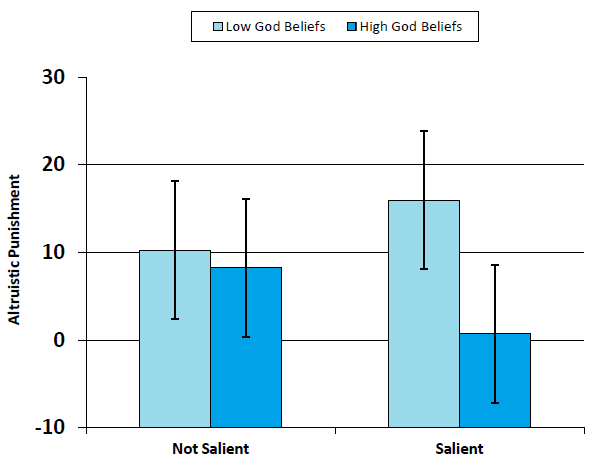
There are lots of stereotypes about the attitudes of religious people to punishment.
There is the one that says religious people are mild and meek, and turn the other cheek rather than seek revenge. Then there is the other one that says that religious people are full of fire and brimstone, demanding flogging and hanging for every misdemeanour.
But which stereotype is most accurate?
Kristin Laurin, at the University of Waterloo in Canada, sought to find out by looking at a behaviour known as costly punishment. This is when an individual punishes a wrongdoer, even though there is no overall benefit to the individual themselves. So the individual incurs a cost (the effort and sometimes risk involved in punishment), in order to do the community as a whole a service.
Costly punishment is interesting to behavioural psychologists as it’s hard to make sense of it from an evolutionary perspective. Looking at it in a straightforward way: if you don’t benefit, then you would be better off not punishing, and letting the wrongdoer go free.
One typical experiment involves three players. Player A gets $20, and is told to share as much or as little as they want with Player B. Player C is the costly punisher. Player C gets $10 and can spend as much of that as they want punishing Player A. For every $1 they spend, Player A loses $3.
So Player C can spend some of their money just for the satisfaction of punishing Player A, if they feel Player A is not being generous enough.
Now, all of this is done anonymously – nobody knows who was Player A, B or C (in fact, through an experimental sleight of hand, everyone who took part actually played the role of Player C!).
What they found was that players who said they were more religious tended to punish more.
However, belief in a powerful god (one that is as least partly in control and has some kind of plan for the universe) had the opposite effect!
In other words, these two different aspects of religion had opposing effects – religious attitudes increased the motivation to punish, while god beliefs decreased it.
They tested this finding pretty rigorously. First, they found that it only worked if you asked about religious attitudes and beliefs before taking the test. That means that these ideas had to be prominent in their minds to have any effect.
And this in turn means that we can be fairly confident that it is religion causing these attitudes, rather than the other way around.
They also did a similar study, but asking about a real-world case – a business executive who stole from the company to feed his gambling habit. How much of their tax money would they want devoted to catching and punishing him? The result was similar.
They also ruled out a couple of other explanations (although only using a small group of 25 students, it has to be admitted). Still, they found that in this group, there was no evidence that people who believe in a powerful god also think that punishment is wrong in principle (in fact, they found the opposite). And they ruled out the possibility that these people don’t believe in free will – and so don’t see the point in punishment.
Laurin and colleagues conclude that what is happening here is that people who believe in a powerful god are ‘outsourcing’ punishment to God. After all, why endure the cost of inflicting punishment, if you can be confident that God will do it for you?
Now, this has all sorts of interesting implications. They propose that the invention of moralistic, punishing gods (which, they argue, are a creation of large societies), may have helped these large societies develop. By reducing the costs of punishment, but maintaining co-operation through the threat of divine punishment, society could have become more efficient.
I’m a bit sceptical of that idea. It doesn’t square with what I know of classical and medieval Europe – which often had an obsession with punishment that bordered on the pathological.
Another thing: as they found in this study, religion is complex, and the net effect of religion is often unclear. It seems likely that religion can serve to both increase and decrease costly punishment, depending on precisely how it is formulated in any given society. And that means that means that religion is a cultural tool that can be used to amplify different behaviour. but it is not necessarily linked with any particular one.
And one last factor to consider is that it’s still not clear whether costly punishment is in fact beneficial to societies or individuals (e.g. Rankin, 2009). Even if it is, it is probably only helpful under certain limited conditions (like when societies are pitched against each other in conflict – dos Santos, 2011).
All of which makes me wonder whether belief in a powerful god is attractive to individuals because it allows you to ‘cheat’ on your societal obligations – perhaps ones that are honed by evolution to be hard-wired into our psyche.
And if endless rounds of punishment, retribution and cruelty, driven by our base instincts, are, in fact, damaging to society? Well then perhaps the invention of powerful gods did help to give birth to our modern societies – just not in the way that you might at first expect!

Laurin K, Shariff AF, Henrich J, & Kay AC (2012). Outsourcing punishment to God: beliefs in divine control reduce earthly punishment. Proceedings. Biological sciences / The Royal Society, 279 (1741), 3272-81 PMID: 22628465
 This article by Tom Rees was first published on Epiphenom. It is licensed under Creative Commons.
Previous Post

July 19, 2012
Why do thoughts of death make people more religious?
Next Post
July 29, 2012 Praying for pain relief
Browse Our Archives
Select a Category Causes of religion - evolution Causes of religion - psychological Causes of religion - social Demographics Digest Effects of religion - health Effects of religion - psychological Effects of religion - social Notifications Politics Uncategorized
Select a Month March 2016 February 2016 January 2016 December 2015 November 2015 October 2015 September 2015 August 2015 July 2015 June 2015 May 2015 April 2015 March 2015 February 2015 January 2015 December 2014 November 2014 October 2014 September 2014 August 2014 July 2014 June 2014 May 2014 April 2014 March 2014 February 2014 January 2014 December 2013 November 2013 October 2013 September 2013 August 2013 July 2013 June 2013 May 2013 April 2013 March 2013 February 2013 January 2013 December 2012 November 2012 October 2012 September 2012 August 2012 July 2012 June 2012 May 2012 April 2012 March 2012 February 2012 January 2012 December 2011 November 2011 October 2011 September 2011 August 2011 July 2011 June 2011 May 2011 April 2011 March 2011 February 2011 January 2011 December 2010 November 2010 October 2010 September 2010 August 2010 July 2010 June 2010 May 2010 April 2010 March 2010 February 2010 January 2010 December 2009 November 2009 October 2009 September 2009 August 2009 July 2009 June 2009 May 2009 April 2009 March 2009 February 2009 January 2009 December 2008 November 2008 October 2008 September 2008 August 2008 July 2008 June 2008 May 2008 April 2008 March 2008 February 2008 January 2008 December 2007 November 2007 October 2007
Follow Us!
TAKE THE
Religious Wisdom Quiz
Which Christian group practices foot washing as an ordinance?
Select your answer to see how you score.
Methodists Catholics Baptists Anabaptists
Related posts from Epiphenom

Do social crises lead to religious revivals? Nah!

What kind of woman would pray for health...

Can you use religion to change attitudes towards...

Dogmatic atheism and fundamentalist Christianity: creating certainty in...
TRENDING AT PATHEOS Nonreligious

Dethroning Jesus and Enthroning Yourself
Jesus Never Asked to Be Worshipped. He Asked to Be Understood. Christianity...

Why Most Christians are Really Paulians and Jobians
I Don't Care, But It Matters Let's get this out of the...

Essential Tips to Successfully Navigate the Selling Process
Selling a house can feel overwhelming, but it doesn’t have to be....

To Make Remote Work Effective, Think About Others
The COVID-19 pandemic forced many companies to rapidly transition to remote work....

Flexibility Is Key to Solving Problems of Tomorrow
The world of work is undergoing a dramatic transformation. The COVID-19 pandemic...
view all Nonreligious blogs
Ad-Free & Subscriber Log-In Subscription Support
- About Us
- 2026 Calendar
- Videos
- Podcasts
- Library of World Religions
- Faith In Media Tracker
- Advertise With Us
- Write for Us
- Privacy Policy
- Terms of Service
- Do Not Sell My Data
- Contact Us
- Radiant Digital
- Manage Newsletter Subscriptions
- Unsubscribe From Notifications
- Sitemap
Copyright 2008-2026, Patheos. All rights reserved.
Subscription Support Ad-Free & Subscriber Log-In
Follow Patheos