
BuddhistCatholicContemplativeEvangelicalGeneral ChristianHinduJewishLatter-day SaintMuslimNew VisionsProgressive Christian
Beliefs
- Buddhist
- Catholic
- Contemplative
- Evangelical
- General Christian
- Hindu
- Jewish
- Latter-day Saint
- More Voices
- Muslim
- New Visions
- Pagan
- Progressive Christian
Topics
- Religion News
- Food and Religion
- Sports and Religion
- Religious Art
- Religious Music and Entertainment
- Religious Events
- History and Religion
- Style and Religion
- Politics and Religion
- Women in Religion
- Recreation Outdoors and Religion
- Business Finance and Religion
- Careers Workplace and Religion
- Education and Religion
- Family Parenting and Religion
- Health Fitness and Religion
- Home and Religion
- Relationships and Religion
- Technology and Religion
- Travel and Religion
Columnists
- Buddhist Columnists
- Business Finance and Religion Columnists
- Careers Workplace and Religion Columnists
- Catholic Columnists
- Contemplative Columnists
- Education and Religion Columnists
- Evangelists Columnists
- Family Parenting and Religion Columnists
- General Christian Columnists
- Health Fitness and Religion Columnists
- Hindu Columnists
- History and Religion Columnists
- Home and Religion Columnists
- Jewish Columnists
- More Voices Columnists
- Latter Day Columnists
- Muslim Columnists
- New Visions Columnists
- Nonreligious Columnists
- Pagan Columnists
- Politics and Religion Columnists
- Progressive Columnists
- Recreation Outdoors and Religion Columnists
- Relationships and Religion Columnists
- Religion News Columnists
- Religious Art Columnists
- Religious Events Columnists
- Religious Music and Entertainment Columnists
- Sports and Religion Columnists
- Style and Religion Columnists
- Technology and Religion Columnists
- Travel and Religion Columnists
- Women in Religion Columnists
Resource Library
- 2026 Calendar
- Library of World Religions
- The 100 Most Holy Places on Earth
- Patheos Answers
- Podcasts
- Videos
- Faith Leaders Database
- Anglican Episcopalian
- Bahai
- Baptist
- Buddhism
- Christianity
- Confucianism
- Eastern Orthodoxy
- Hinduism
- Holiness and Pentecostal
- ISKCON
- Islam
- Judaism
- Lutheran
- Methodist
- The Church of Jesus Christ of Latter-day Saints
- New Age
- Paganism
- Presbytarian and Reformed
- Protestantism
- Religion Behind the Scenes
- Roman Catholic
- Scientology
- Shia Islam
- Sikhism
- Sufism
- Sunni Islam
- Taoism
- Zen
- See all religions
Research Tools
 Ad-Free & Subscriber Log-In Subscription Support
Ad-Free & Subscriber Log-In Subscription Support
Follow Patheos 

- Trending:
- Forgiveness
- |
- Marriage
- |
- Consciousness
- |
- Death Penalty
- |
- Election
- |
- Halloween
 Epiphenom
- Home
- Nonreligious
- Does belief in a compassionate god increase murder rates?
Does belief in a compassionate god increase murder rates?
Last updated on: March 29, 2015 at 10:05 pm by Epiphenom
Does belief in a compassionate god increase murder rates? 2015-03-29T22:05:53+01:00 Epiphenom
Patheos Explore the world's faith through different perspectives on religion and spirituality! Patheos has the views of the prevalent religions and spiritualities of the world.
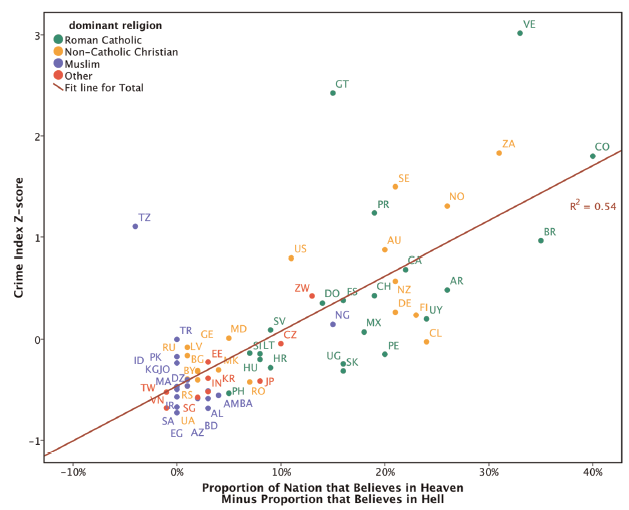 Azim Shariff, who’s now at the University of Oregon in the USA, has taken a look at how belief in heaven and hell relates to crime rates around the world.
The basic approach was dead simple. Using data from the World Values Survey, he subtracted the proportion of people who believe in hell from the proportion that believes in heaven.
Then he took a bunch of crime stats provided by the UN (homicide, rape , kidnapping, assault, theft, drug crime, auto theft, burglary, and human trafficking), computed an overall crime score for each nation, and correlated one against the other.
The result, shown in the figure, shows a clear relationship. Crime rates are lowest in nations where equal numbers of people believe in both heaven and hell.
As belief in hell drops away, so that more people believe in heaven but not in hell, crime rates go up.
Now, if you look at the figure closely, you will see that there are some trends here – poor Muslim countries have high belief in hell and low crime rates, while wealthy Christian nations have low belief in hell and high crime rates.
Shariff adjusted for a wide range of factors, including the nation’s majority religion, wealth, inequality, life expectancy, urbanisation and dominant psychologies. He also adjusted for belief in God and religious service attendance.
Doing all this had pretty much no effect – the result was just as strong and clear cut. What’s more, Shariff found that countries with a high belief in God in general also had lower crime rates.
Now that’s a pretty surprising result. Shariff argues that this is evidence that belief in hell reduces crime through a supernatural deterrent effect, which is possible (see Punitive Gods stop cheaters, compassionate gods encourage them).
But I would have expected any such deterrent to be relatively weak compared with the opposite effect – that high crime rates would encourage higher rates of belief in God.
That’s certainly what your would expect from other studies. Daniel Treisman found that high levels of belief in hell are accompanied by high levels of fear, and Gary Jensen has found that ‘passionate dualism’ (characterised by high levels of belief in hell along with religious fervour) is linked to high rates of homicide.
So what could be going on here? Well, there are some strange anomalies in the data. For a start, according to these data, Sweden and Norway are among the most crime-ridden countries in the world – on a par with South Africa!
Perhaps there is a problem here with how crime is recorded. Gregory Paul, in his comment on the article, points out that there are serious problems with trying to compare cross-national crime rates:
Interpol merely gathers and reports nonlethal crime statistics provided by member nations without standardizing or vetting it. For example, assaults are reported at a rate about 6 times higher in Australia and Sweden than in Canada and France, this level of disparity is suspect. Rates of theft are reported to be twice as high in Sweden as in France; are the former actually twice as larcenous as the French, or are the latter twice as unlikely to file a report, or is the reality somewhere in-between?
Similarly suspicious discrepancies exist in International Crime Victims Survey results. Reported rates of rape are two to twenty times higher in the U.S. than in other 1st world nations, but this only means that American females report being raped at far higher rates, not that American males are more prone to committing sexual assaults.
Nonlethal crimes are difficult to compare even between the relatively uniform 1st world countries, they only grow worse when comparing 2nd and 3rd world nations with greater disparities between the quality of crime reporting.
So part of it may simply be that crime reporting and recording is done less efficiently in nations with a high level of belief in hell. But this can’t be the whole story.
That’s because there is one crime statistic that is comparable between nations: homicide. Homicide is usually reported and recorded, and is relatively easy to define in a standardised way.
And yet Shariff finds that homicide, too, is linked to belief in Heaven without belief in Hell. The effect is weaker – only about half as strong as for crime in general – but it’s still there.
So how to explain the discrepancy between this result and that of the earlier studies? Well, one factor may be how Shariff has computed his measure of belief.
Shariff subtracted the percentage of people who believe in heaven from the number who believe in hell. So that means, for example, a country in which 95% of people believe in heaven and 50% in hell is scored exactly the same as a country in which 50% of people believe in heaven and only 5% believe in hell.
Yet you would expect these to be quite different countries. All they have in common is that around half the population believe in heaven and not in hell.
So perhaps that’s it. It’s not that belief in heaven affects crime rates, or that belief in hell does. It’s that believing in a compassionate God increases crime rates.
I’m not really convinced – I think there are too many problems with the data to make strong conclusions. But it’s an intriguing idea.

Shariff AF, & Rhemtulla M (2012). Divergent effects of beliefs in heaven and hell on national crime rates. PloS one, 7 (6) PMID: 22723927
 This article by Tom Rees was first published on Epiphenom. It is licensed under Creative Commons.
Previous Post

June 23, 2012
Religious people give to religious charities
Next Post
July 2, 2012 What sort of religious person believes in meddling spirits?
Browse Our Archives
Select a Category Causes of religion - evolution Causes of religion - psychological Causes of religion - social Demographics Digest Effects of religion - health Effects of religion - psychological Effects of religion - social Notifications Politics Uncategorized
Select a Month March 2016 February 2016 January 2016 December 2015 November 2015 October 2015 September 2015 August 2015 July 2015 June 2015 May 2015 April 2015 March 2015 February 2015 January 2015 December 2014 November 2014 October 2014 September 2014 August 2014 July 2014 June 2014 May 2014 April 2014 March 2014 February 2014 January 2014 December 2013 November 2013 October 2013 September 2013 August 2013 July 2013 June 2013 May 2013 April 2013 March 2013 February 2013 January 2013 December 2012 November 2012 October 2012 September 2012 August 2012 July 2012 June 2012 May 2012 April 2012 March 2012 February 2012 January 2012 December 2011 November 2011 October 2011 September 2011 August 2011 July 2011 June 2011 May 2011 April 2011 March 2011 February 2011 January 2011 December 2010 November 2010 October 2010 September 2010 August 2010 July 2010 June 2010 May 2010 April 2010 March 2010 February 2010 January 2010 December 2009 November 2009 October 2009 September 2009 August 2009 July 2009 June 2009 May 2009 April 2009 March 2009 February 2009 January 2009 December 2008 November 2008 October 2008 September 2008 August 2008 July 2008 June 2008 May 2008 April 2008 March 2008 February 2008 January 2008 December 2007 November 2007 October 2007
Follow Us!
TAKE THE
Religious Wisdom Quiz
In Philippians, Paul says to work out your salvation with what?
Select your answer to see how you score.
Prayer and fasting Fear and trembling Joy and thanksgiving Faith and obedience
Related posts from Epiphenom

Can you use religion to change attitudes towards...

Do you wanna be in my clan? Moralising...
The decline of religion in Europe did not...

How religious schools led to the decline of...
TRENDING AT PATHEOS Nonreligious

Dethroning Jesus and Enthroning Yourself
Jesus Never Asked to Be Worshipped. He Asked to Be Understood. Christianity...

Why Most Christians are Really Paulians and Jobians
I Don't Care, But It Matters Let's get this out of the...

Essential Tips to Successfully Navigate the Selling Process
Selling a house can feel overwhelming, but it doesn’t have to be....

To Make Remote Work Effective, Think About Others
The COVID-19 pandemic forced many companies to rapidly transition to remote work....

Flexibility Is Key to Solving Problems of Tomorrow
The world of work is undergoing a dramatic transformation. The COVID-19 pandemic...
view all Nonreligious blogs
Ad-Free & Subscriber Log-In Subscription Support
- About Us
- 2026 Calendar
- Videos
- Podcasts
- Library of World Religions
- Faith In Media Tracker
- Advertise With Us
- Write for Us
- Privacy Policy
- Terms of Service
- Do Not Sell My Data
- Contact Us
- Radiant Digital
- Manage Newsletter Subscriptions
- Unsubscribe From Notifications
- Sitemap
Copyright 2008-2026, Patheos. All rights reserved.
Subscription Support Ad-Free & Subscriber Log-In
Follow Patheos