
BuddhistCatholicContemplativeEvangelicalGeneral ChristianHinduJewishLatter-day SaintMuslimNew VisionsProgressive Christian
Beliefs
- Buddhist
- Catholic
- Contemplative
- Evangelical
- General Christian
- Hindu
- Jewish
- Latter-day Saint
- More Voices
- Muslim
- New Visions
- Pagan
- Progressive Christian
Topics
- Religion News
- Food and Religion
- Sports and Religion
- Religious Art
- Religious Music and Entertainment
- Religious Events
- History and Religion
- Style and Religion
- Politics and Religion
- Women in Religion
- Recreation Outdoors and Religion
- Business Finance and Religion
- Careers Workplace and Religion
- Education and Religion
- Family Parenting and Religion
- Health Fitness and Religion
- Home and Religion
- Relationships and Religion
- Technology and Religion
- Travel and Religion
Columnists
- Buddhist Columnists
- Business Finance and Religion Columnists
- Careers Workplace and Religion Columnists
- Catholic Columnists
- Contemplative Columnists
- Education and Religion Columnists
- Evangelists Columnists
- Family Parenting and Religion Columnists
- General Christian Columnists
- Health Fitness and Religion Columnists
- Hindu Columnists
- History and Religion Columnists
- Home and Religion Columnists
- Jewish Columnists
- More Voices Columnists
- Latter Day Columnists
- Muslim Columnists
- New Visions Columnists
- Nonreligious Columnists
- Pagan Columnists
- Politics and Religion Columnists
- Progressive Columnists
- Recreation Outdoors and Religion Columnists
- Relationships and Religion Columnists
- Religion News Columnists
- Religious Art Columnists
- Religious Events Columnists
- Religious Music and Entertainment Columnists
- Sports and Religion Columnists
- Style and Religion Columnists
- Technology and Religion Columnists
- Travel and Religion Columnists
- Women in Religion Columnists
Resource Library
- 2026 Calendar
- Library of World Religions
- The 100 Most Holy Places on Earth
- Patheos Answers
- Podcasts
- Videos
- Faith Leaders Database
- Anglican Episcopalian
- Bahai
- Baptist
- Buddhism
- Christianity
- Confucianism
- Eastern Orthodoxy
- Hinduism
- Holiness and Pentecostal
- ISKCON
- Islam
- Judaism
- Lutheran
- Methodist
- The Church of Jesus Christ of Latter-day Saints
- New Age
- Paganism
- Presbytarian and Reformed
- Protestantism
- Religion Behind the Scenes
- Roman Catholic
- Scientology
- Shia Islam
- Sikhism
- Sufism
- Sunni Islam
- Taoism
- Zen
- See all religions
Research Tools
 Ad-Free & Subscriber Log-In Subscription Support
Ad-Free & Subscriber Log-In Subscription Support
Follow Patheos 

- Trending:
- Forgiveness
- |
- Marriage
- |
- Consciousness
- |
- Death Penalty
- |
- Election
- |
- Halloween
 Epiphenom
- Home
- Nonreligious
- Do ‘world religions’ make cuckoldry easier?
Do ‘world religions’ make cuckoldry easier?
Last updated on: November 12, 2014 at 3:29 am by Epiphenom
Do ‘world religions’ make cuckoldry easier? 2014-11-12T03:29:15+01:00 Epiphenom
Patheos Explore the world's faith through different perspectives on religion and spirituality! Patheos has the views of the prevalent religions and spiritualities of the world.
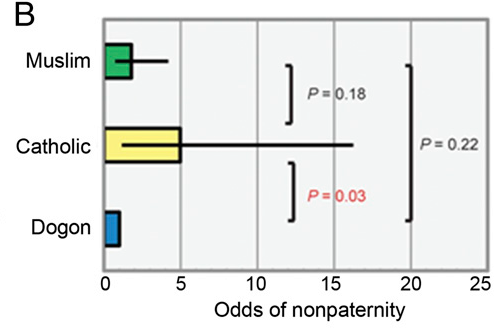
You may have seen this one recently – perhaps under a headline such as How Religion Promotes Confidence About Paternity. It’s an eye-catching headline, but that’s not actually what the study showed – for a start, they didn’t compare religious with non-religious people.
Actually, what the data reveal is a more complex and rather more interesting picture.
First, to summarize what was done. Beverly Strassman (University of Michigan) and colleagues have been studying the Dogon of Mali in West Africa, who practice a range of different religions. Most of them hold on to their traditional beliefs, some are Muslim, and increasing numbers have been converted to Christianity.
They’ve built up a large genetic database, allowing them to test 1,706 father–son pairs in 29 patrilineages to see if they match.
What they found was that the Dogon had the lowest odds of non-paternity, followed by the Muslims (although this difference was not statistically significant), while the Catholics had the highest rates of cuckoldry.
Strassman looked into several possible explanations (polygamy, poverty etc) but the one that stood out was a particular cultural practice that marks out traditional Dogon culture: menstrual huts.
Dogon women have high fertility. Typically they are either pregnant or lactating, so menstruation is a rare event that is usually rapidly followed by pregnancy. Traditional Dogon culture demands that menstruating women relocate to special huts, close to where the men of a single patrilineage live. It’s an effective way to control the reproductive options for these women.
Dogon Muslims have abandoned these huts, but Muslim women must notify their husbands and are not allowed to pray. So they clearly signal their fertility.
Christians don’t have any such safeguards, which likely explains their higher rates of cuckoldry.
That’s not to say that Christians tolerate cuckoldry. Far from it. In fact these religions strictly forbid it and warn of supernatural punishment (certainly that’s the case for Christianity and Islam).
All of this got me thinking. After all, one popular argument is that world religions helped to bring about complex societies. They did this by facilitate interactions between strangers by increasing trust – by threatening cheaters with supernatural punishment.
Maybe what we’re seeing here is the flipside of that. Christianity, a religion designed for the complex urban societies of the late Roman period, has fewer rules and regulations designed at forcing honest behaviour. It relies, instead, on assumptions of trust backed up by threats of supernatural punishment.
As a result, world religions – and the relative personal freedom they allow – actually make cheating easier, compared with the controlling traditionalist religions. Just a thought.

Strassmann, B., Kurapati, N., Hug, B., Burke, E., Gillespie, B., Karafet, T., & Hammer, M. (2012). Religion as a means to assure paternity Proceedings of the National Academy of Sciences DOI: 10.1073/pnas.1110442109
 This article by Tom Rees was first published on Epiphenom. It is licensed under Creative Commons.
Previous Post

June 9, 2012
Christians find it harder than atheists to recognize their own faces
Next Post
June 23, 2012 Religious people give to religious charities
Browse Our Archives
Select a Category Causes of religion - evolution Causes of religion - psychological Causes of religion - social Demographics Digest Effects of religion - health Effects of religion - psychological Effects of religion - social Notifications Politics Uncategorized
Select a Month March 2016 February 2016 January 2016 December 2015 November 2015 October 2015 September 2015 August 2015 July 2015 June 2015 May 2015 April 2015 March 2015 February 2015 January 2015 December 2014 November 2014 October 2014 September 2014 August 2014 July 2014 June 2014 May 2014 April 2014 March 2014 February 2014 January 2014 December 2013 November 2013 October 2013 September 2013 August 2013 July 2013 June 2013 May 2013 April 2013 March 2013 February 2013 January 2013 December 2012 November 2012 October 2012 September 2012 August 2012 July 2012 June 2012 May 2012 April 2012 March 2012 February 2012 January 2012 December 2011 November 2011 October 2011 September 2011 August 2011 July 2011 June 2011 May 2011 April 2011 March 2011 February 2011 January 2011 December 2010 November 2010 October 2010 September 2010 August 2010 July 2010 June 2010 May 2010 April 2010 March 2010 February 2010 January 2010 December 2009 November 2009 October 2009 September 2009 August 2009 July 2009 June 2009 May 2009 April 2009 March 2009 February 2009 January 2009 December 2008 November 2008 October 2008 September 2008 August 2008 July 2008 June 2008 May 2008 April 2008 March 2008 February 2008 January 2008 December 2007 November 2007 October 2007
Follow Us!
TAKE THE
Religious Wisdom Quiz
What does "Naphtali" mean in Hebrew?
Select your answer to see how you score.
My struggle Chosen One The Lord is my strength God is my rock
Related posts from Epiphenom

Do social crises lead to religious revivals? Nah!

What kind of woman would pray for health...

Can you use religion to change attitudes towards...

Dogmatic atheism and fundamentalist Christianity: creating certainty in...
TRENDING AT PATHEOS Nonreligious

Dethroning Jesus and Enthroning Yourself
Jesus Never Asked to Be Worshipped. He Asked to Be Understood. Christianity...

Why Most Christians are Really Paulians and Jobians
I Don't Care, But It Matters Let's get this out of the...

Essential Tips to Successfully Navigate the Selling Process
Selling a house can feel overwhelming, but it doesn’t have to be....

To Make Remote Work Effective, Think About Others
The COVID-19 pandemic forced many companies to rapidly transition to remote work....

Flexibility Is Key to Solving Problems of Tomorrow
The world of work is undergoing a dramatic transformation. The COVID-19 pandemic...
view all Nonreligious blogs
Ad-Free & Subscriber Log-In Subscription Support
- About Us
- 2026 Calendar
- Videos
- Podcasts
- Library of World Religions
- Faith In Media Tracker
- Advertise With Us
- Write for Us
- Privacy Policy
- Terms of Service
- Do Not Sell My Data
- Contact Us
- Radiant Digital
- Manage Newsletter Subscriptions
- Unsubscribe From Notifications
- Sitemap
Copyright 2008-2026, Patheos. All rights reserved.
Subscription Support Ad-Free & Subscriber Log-In
Follow Patheos