
BuddhistCatholicContemplativeEvangelicalGeneral ChristianHinduJewishLatter-day SaintMuslimNew VisionsProgressive Christian
Beliefs
- Buddhist
- Catholic
- Contemplative
- Evangelical
- General Christian
- Hindu
- Jewish
- Latter-day Saint
- More Voices
- Muslim
- New Visions
- Pagan
- Progressive Christian
Topics
- Religion News
- Food and Religion
- Sports and Religion
- Religious Art
- Religious Music and Entertainment
- Religious Events
- History and Religion
- Style and Religion
- Politics and Religion
- Women in Religion
- Recreation Outdoors and Religion
- Business Finance and Religion
- Careers Workplace and Religion
- Education and Religion
- Family Parenting and Religion
- Health Fitness and Religion
- Home and Religion
- Relationships and Religion
- Technology and Religion
- Travel and Religion
Columnists
- Buddhist Columnists
- Business Finance and Religion Columnists
- Careers Workplace and Religion Columnists
- Catholic Columnists
- Contemplative Columnists
- Education and Religion Columnists
- Evangelists Columnists
- Family Parenting and Religion Columnists
- General Christian Columnists
- Health Fitness and Religion Columnists
- Hindu Columnists
- History and Religion Columnists
- Home and Religion Columnists
- Jewish Columnists
- More Voices Columnists
- Latter Day Columnists
- Muslim Columnists
- New Visions Columnists
- Nonreligious Columnists
- Pagan Columnists
- Politics and Religion Columnists
- Progressive Columnists
- Recreation Outdoors and Religion Columnists
- Relationships and Religion Columnists
- Religion News Columnists
- Religious Art Columnists
- Religious Events Columnists
- Religious Music and Entertainment Columnists
- Sports and Religion Columnists
- Style and Religion Columnists
- Technology and Religion Columnists
- Travel and Religion Columnists
- Women in Religion Columnists
Resource Library
- 2026 Calendar
- Library of World Religions
- The 100 Most Holy Places on Earth
- Patheos Answers
- Podcasts
- Videos
- Faith Leaders Database
- Anglican Episcopalian
- Bahai
- Baptist
- Buddhism
- Christianity
- Confucianism
- Eastern Orthodoxy
- Hinduism
- Holiness and Pentecostal
- ISKCON
- Islam
- Judaism
- Lutheran
- Methodist
- The Church of Jesus Christ of Latter-day Saints
- New Age
- Paganism
- Presbytarian and Reformed
- Protestantism
- Religion Behind the Scenes
- Roman Catholic
- Scientology
- Shia Islam
- Sikhism
- Sufism
- Sunni Islam
- Taoism
- Zen
- See all religions
Research Tools
 Ad-Free & Subscriber Log-In Subscription Support
Ad-Free & Subscriber Log-In Subscription Support
Follow Patheos 

- Trending:
- Forgiveness
- |
- Marriage
- |
- Consciousness
- |
- Death Penalty
- |
- Election
- |
- Halloween
 Epiphenom
- Home
- Nonreligious
- For less-religious Americans, compassion is a significant factor in prosocial behaviour
For less-religious Americans, compassion is a significant factor in prosocial behaviour
Last updated on: November 12, 2014 at 3:31 am by Epiphenom
For less-religious Americans, compassion is a significant factor in prosocial behaviour 2014-11-12T03:31:55+01:00 Epiphenom
Patheos Explore the world's faith through different perspectives on religion and spirituality! Patheos has the views of the prevalent religions and spiritualities of the world.
Apologies if you saw this one when it came out last month, but it’s an interesting study that really deserves a closer look!
Laura Saslow (University of California at San Francisco) and colleagues wanted to know whether compassion influenced the prosocial tendencies (altruism, generosity, trust etc) of the religious and non religious. So they ran three different studies – different groups of people, and different tests.
In the first, they found that across the USA (looking at data from the 2004 General Survey), religious people were slightly more likely to say that they did prosocial things like giving food or money to a homeless person, returning money after getting too much change, allowing a stranger to go ahead in line, volunteering time for a charity, etc. They were also more likely to say that they were compassionate (for example, that they often have tender, concerned feelings for less fortunate people, or that when they see someone being taken advantage of, they feel kind of protective towards them).
Now, that’s not too surprising – it’s been known for a long time that religious people report being more prosocial (although whether they are is another matter!). However the interesting finding is that the difference between compassionate and non-compassionate people was much bigger for the less religious than for the more religious.
In a second study, they asked American adults to watch one of two videos. The first was about child poverty, the second was just a clip of two guys talking. Then they were asked various apparently non-related things – like how much salary should be spent on charity, or how much they would donate in the Dictator Game.
Once again, the more religious participants said that they were somewhat more prosocial, but they were not not affected by the video. The result was that less religious who had watched the video reported being more prosocial than the more religious (regardless of whether they had watched the video).
In the final study, they brought a group of students to the lab and asked them how compassionate they were feeling right now. Then they got them to go through a battery of games designed to test prosocial behaviour – basically these are all variants of the “Prisoners Dilemma”, in which the subjects have to give money, or bet money in the hope that their anonymous co-players will reciprocate.
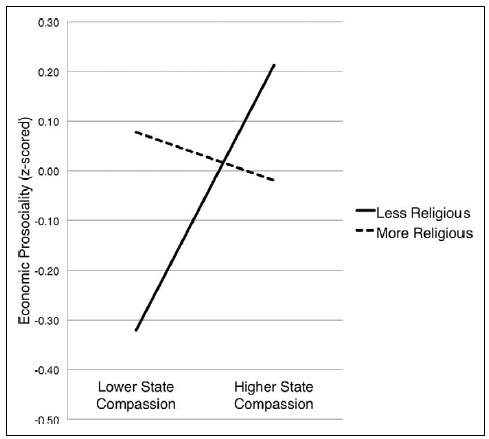
As you can see in the graphic, for the less religious Americans prosociality was much higher in those who said they were feeling compassionate. For the more religious Americans, prosociality was pretty much the same – or maybe even a little less.
The authors think these results suggest that the less religious are bound to others by emotional connection. They go on to say that:
The more religious, on the other hand, may ground their generosity less in emotion and more in other factors such as doctrine, a communal identity, or reputational concerns.
That seems likely. In fact, I think there’s probably an additional factor here – because these studies took place in the USA, where religion is the social norm.
It could be that religious people assume that the recipients of their generosity are co-religionists – in most US communities, that’s a pretty strong likelihood. Therefore pro-social behaviour is less about pure altruism and more about group norms of back scratching and favours being returned – reciprocal altruism.
Atheists, on the other hand, may feel like outsiders, and so be less inclined to be pro-social – unless they are in a compassionate frame of mind for some reason.

Saslow, L., Willer, R., Feinberg, M., Piff, P., Clark, K., Keltner, D., & Saturn, S. (2012). My Brother’s Keeper? Compassion Predicts Generosity More Among Less Religious Individuals Social Psychological and Personality Science DOI: 10.1177/1948550612444137
 This article by Tom Rees was first published on Epiphenom. It is licensed under Creative Commons.
Next Post

May 26, 2012 Repetitious magic rituals are thought to be more effective
Browse Our Archives
Select a Category Causes of religion - evolution Causes of religion - psychological Causes of religion - social Demographics Digest Effects of religion - health Effects of religion - psychological Effects of religion - social Notifications Politics Uncategorized
Select a Month March 2016 February 2016 January 2016 December 2015 November 2015 October 2015 September 2015 August 2015 July 2015 June 2015 May 2015 April 2015 March 2015 February 2015 January 2015 December 2014 November 2014 October 2014 September 2014 August 2014 July 2014 June 2014 May 2014 April 2014 March 2014 February 2014 January 2014 December 2013 November 2013 October 2013 September 2013 August 2013 July 2013 June 2013 May 2013 April 2013 March 2013 February 2013 January 2013 December 2012 November 2012 October 2012 September 2012 August 2012 July 2012 June 2012 May 2012 April 2012 March 2012 February 2012 January 2012 December 2011 November 2011 October 2011 September 2011 August 2011 July 2011 June 2011 May 2011 April 2011 March 2011 February 2011 January 2011 December 2010 November 2010 October 2010 September 2010 August 2010 July 2010 June 2010 May 2010 April 2010 March 2010 February 2010 January 2010 December 2009 November 2009 October 2009 September 2009 August 2009 July 2009 June 2009 May 2009 April 2009 March 2009 February 2009 January 2009 December 2008 November 2008 October 2008 September 2008 August 2008 July 2008 June 2008 May 2008 April 2008 March 2008 February 2008 January 2008 December 2007 November 2007 October 2007
Follow Us!
TAKE THE
Religious Wisdom Quiz
How many daughters did Job have after his restoration?
Select your answer to see how you score.
Two Seven Five Three
Related posts from Epiphenom

Do social crises lead to religious revivals? Nah!

What kind of woman would pray for health...

Can you use religion to change attitudes towards...

Dogmatic atheism and fundamentalist Christianity: creating certainty in...
TRENDING AT PATHEOS Nonreligious

Dethroning Jesus and Enthroning Yourself
Jesus Never Asked to Be Worshipped. He Asked to Be Understood. Christianity...

Why Most Christians are Really Paulians and Jobians
I Don't Care, But It Matters Let's get this out of the...

Essential Tips to Successfully Navigate the Selling Process
Selling a house can feel overwhelming, but it doesn’t have to be....

To Make Remote Work Effective, Think About Others
The COVID-19 pandemic forced many companies to rapidly transition to remote work....

Flexibility Is Key to Solving Problems of Tomorrow
The world of work is undergoing a dramatic transformation. The COVID-19 pandemic...
view all Nonreligious blogs
Ad-Free & Subscriber Log-In Subscription Support
- About Us
- 2026 Calendar
- Videos
- Podcasts
- Library of World Religions
- Faith In Media Tracker
- Advertise With Us
- Write for Us
- Privacy Policy
- Terms of Service
- Do Not Sell My Data
- Contact Us
- Radiant Digital
- Manage Newsletter Subscriptions
- Unsubscribe From Notifications
- Sitemap
Copyright 2008-2026, Patheos. All rights reserved.
Subscription Support Ad-Free & Subscriber Log-In
Follow Patheos