
BuddhistCatholicContemplativeEvangelicalGeneral ChristianHinduJewishLatter-day SaintMuslimNew VisionsProgressive Christian
Beliefs
- Buddhist
- Catholic
- Contemplative
- Evangelical
- General Christian
- Hindu
- Jewish
- Latter-day Saint
- More Voices
- Muslim
- New Visions
- Pagan
- Progressive Christian
Topics
- Religion News
- Food and Religion
- Sports and Religion
- Religious Art
- Religious Music and Entertainment
- Religious Events
- History and Religion
- Style and Religion
- Politics and Religion
- Women in Religion
- Recreation Outdoors and Religion
- Business Finance and Religion
- Careers Workplace and Religion
- Education and Religion
- Family Parenting and Religion
- Health Fitness and Religion
- Home and Religion
- Relationships and Religion
- Technology and Religion
- Travel and Religion
Columnists
- Buddhist Columnists
- Business Finance and Religion Columnists
- Careers Workplace and Religion Columnists
- Catholic Columnists
- Contemplative Columnists
- Education and Religion Columnists
- Evangelists Columnists
- Family Parenting and Religion Columnists
- General Christian Columnists
- Health Fitness and Religion Columnists
- Hindu Columnists
- History and Religion Columnists
- Home and Religion Columnists
- Jewish Columnists
- More Voices Columnists
- Latter Day Columnists
- Muslim Columnists
- New Visions Columnists
- Nonreligious Columnists
- Pagan Columnists
- Politics and Religion Columnists
- Progressive Columnists
- Recreation Outdoors and Religion Columnists
- Relationships and Religion Columnists
- Religion News Columnists
- Religious Art Columnists
- Religious Events Columnists
- Religious Music and Entertainment Columnists
- Sports and Religion Columnists
- Style and Religion Columnists
- Technology and Religion Columnists
- Travel and Religion Columnists
- Women in Religion Columnists
Resource Library
- 2026 Calendar
- Library of World Religions
- The 100 Most Holy Places on Earth
- Patheos Answers
- Podcasts
- Videos
- Faith Leaders Database
- Anglican Episcopalian
- Bahai
- Baptist
- Buddhism
- Christianity
- Confucianism
- Eastern Orthodoxy
- Hinduism
- Holiness and Pentecostal
- ISKCON
- Islam
- Judaism
- Lutheran
- Methodist
- The Church of Jesus Christ of Latter-day Saints
- New Age
- Paganism
- Presbytarian and Reformed
- Protestantism
- Religion Behind the Scenes
- Roman Catholic
- Scientology
- Shia Islam
- Sikhism
- Sufism
- Sunni Islam
- Taoism
- Zen
- See all religions
Research Tools
 Ad-Free & Subscriber Log-In Subscription Support
Ad-Free & Subscriber Log-In Subscription Support
Follow Patheos 

- Trending:
- Forgiveness
- |
- Marriage
- |
- Consciousness
- |
- Death Penalty
- |
- Election
- |
- Halloween
 Epiphenom
- Home
- Nonreligious
- Religion facilitates learning about omniscience – but it still has to be learned
Religion facilitates learning about omniscience – but it still has to be learned
Last updated on: November 12, 2014 at 3:37 am by Epiphenom
Religion facilitates learning about omniscience – but it still has to be learned 2014-11-12T03:37:24+01:00 Epiphenom
Patheos Explore the world's faith through different perspectives on religion and spirituality! Patheos has the views of the prevalent religions and spiritualities of the world.
Recently, the New Scientist published a special ‘God’ issue(behind pay wall) arguing that religion is natural and beneficial to society. All very interesting, but several of the articles gave quite a one-sided view of several issues (properly speaking, they were opinion pieces written by leading scientists advocating their particular view point).
Take, for example, the article by Justin Barrett, arguing that children have an innate understanding of omniscience. That’s an important question, because if we have a built-in appreciation of the thorny concept of omniscience, then this suggests that religious, and in particular Judaeo-Christian, beliefs are intuitive.
Barrett cites research by himself and others that supports this view. Broadly speaking, the idea is that young children start off by thinking that everyone has god-like powers of omniscience, and that they have to learn that mortals (like their mum) have in fact only limited knowledge.
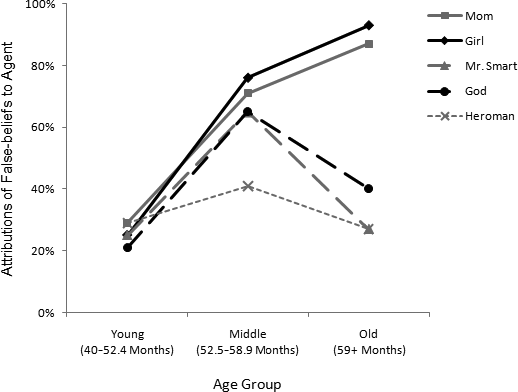
However, there are actually just as many studies that conflict with this idea. In particular, one I covered on this blog before suggests a more complex picture. What this research, by Jonathan Lane at the University of Michigan, suggests is that in fact very young children simply assume that you know everything they know.
When they get older, they learn that others don’t know everything they know. However, crucially, they make the same assumption about God. It’s only later, when they’ve learnt about omniscience, that they can correctly ascribed these powers to God.
Lane’s most recent work basically replicates the original, with the interesting twist that the second study was done in children who had attended religious Protestant Christian preschools.
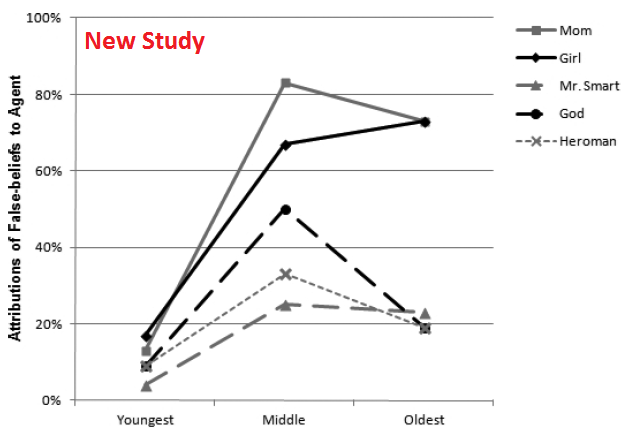
The results they got were basically the same as the first study, with one key difference (the previous study is at the top, the new one underneath). The kids who had been to a religious preschool were able to correctly say that Mr Smart can know things that you (and in fact no ordinary human) can not.
In short, they understood omniscience at an earlier age.
Intriguingly, they didn’t spontaneously attribute omniscience to God, only to ‘Mr Smart’. That’s probably because they were specifically told that Mr Smart “knows everything”, whereas they weren’t told anything about god.
What that means is that they understood the concept of omniscience, even though they hadn’t yet learned to automatically associate that idea with god.
When quizzing the children further, Lane also found that those who had more sophisticated knowledge of God’s abilities actually were more likely to understand the extraordinary powers of the other agents (Heroman, Mr Smart). It seems that the training about god they received from an early age does help them to understand the idea of extraordinary powers – but these ideas still have to be developed (they’re not innate).
Lane concludes: “…data from the current study provide compelling evidence that when children begin to understand the cognitive limitations of humans, they typically attribute those same limitations to God, and this applies even to religiously exposed children.
Only later, at around age 5 years did religiously exposed children reliably differentiate between humans’ fallible mental abilities and inaccurate mental states versus God’s less fallible abilities and states.
These results suggest that in their everyday reasoning, even children who are raised in religious settings often initially understand God’s mind as constrained and fallible, very similar to their understanding of ordinary human minds.”
So children have to develop an understanding of omniscience, even if they are raised in a religious environment. However, when raised in a religious environment, they seem to understand omniscience earlier – evidence of the importance of learning, as well as brain maturation.

Lane, J., Wellman, H., & Evans, E. (2012). Sociocultural Input Facilitates Children’s Developing Understanding of Extraordinary Minds Child Development DOI: 10.1111/j.1467-8624.2012.01741.x
 This article by Tom Rees was first published on Epiphenom. It is licensed under Creative Commons.
Previous Post

April 17, 2012
How fear and anxiety leads to more religion - a presentation
Browse Our Archives
Select a Category Causes of religion - evolution Causes of religion - psychological Causes of religion - social Demographics Digest Effects of religion - health Effects of religion - psychological Effects of religion - social Notifications Politics Uncategorized
Select a Month March 2016 February 2016 January 2016 December 2015 November 2015 October 2015 September 2015 August 2015 July 2015 June 2015 May 2015 April 2015 March 2015 February 2015 January 2015 December 2014 November 2014 October 2014 September 2014 August 2014 July 2014 June 2014 May 2014 April 2014 March 2014 February 2014 January 2014 December 2013 November 2013 October 2013 September 2013 August 2013 July 2013 June 2013 May 2013 April 2013 March 2013 February 2013 January 2013 December 2012 November 2012 October 2012 September 2012 August 2012 July 2012 June 2012 May 2012 April 2012 March 2012 February 2012 January 2012 December 2011 November 2011 October 2011 September 2011 August 2011 July 2011 June 2011 May 2011 April 2011 March 2011 February 2011 January 2011 December 2010 November 2010 October 2010 September 2010 August 2010 July 2010 June 2010 May 2010 April 2010 March 2010 February 2010 January 2010 December 2009 November 2009 October 2009 September 2009 August 2009 July 2009 June 2009 May 2009 April 2009 March 2009 February 2009 January 2009 December 2008 November 2008 October 2008 September 2008 August 2008 July 2008 June 2008 May 2008 April 2008 March 2008 February 2008 January 2008 December 2007 November 2007 October 2007
Follow Us!
TAKE THE
Religious Wisdom Quiz
In the New Testament what is the last book?
Select your answer to see how you score.
Revelation Matthew Luke Titus
Related posts from Epiphenom

Do social crises lead to religious revivals? Nah!

What kind of woman would pray for health...

Can you use religion to change attitudes towards...

Dogmatic atheism and fundamentalist Christianity: creating certainty in...
TRENDING AT PATHEOS Nonreligious

Dethroning Jesus and Enthroning Yourself
Jesus Never Asked to Be Worshipped. He Asked to Be Understood. Christianity...

Why Most Christians are Really Paulians and Jobians
I Don't Care, But It Matters Let's get this out of the...

Essential Tips to Successfully Navigate the Selling Process
Selling a house can feel overwhelming, but it doesn’t have to be....

To Make Remote Work Effective, Think About Others
The COVID-19 pandemic forced many companies to rapidly transition to remote work....

Flexibility Is Key to Solving Problems of Tomorrow
The world of work is undergoing a dramatic transformation. The COVID-19 pandemic...
view all Nonreligious blogs
Ad-Free & Subscriber Log-In Subscription Support
- About Us
- 2026 Calendar
- Videos
- Podcasts
- Library of World Religions
- Faith In Media Tracker
- Advertise With Us
- Write for Us
- Privacy Policy
- Terms of Service
- Do Not Sell My Data
- Contact Us
- Radiant Digital
- Manage Newsletter Subscriptions
- Unsubscribe From Notifications
- Sitemap
Copyright 2008-2026, Patheos. All rights reserved.
Subscription Support Ad-Free & Subscriber Log-In
Follow Patheos