
BuddhistCatholicContemplativeEvangelicalGeneral ChristianHinduJewishLatter-day SaintMuslimNew VisionsProgressive Christian
Beliefs
- Buddhist
- Catholic
- Contemplative
- Evangelical
- General Christian
- Hindu
- Jewish
- Latter-day Saint
- More Voices
- Muslim
- New Visions
- Pagan
- Progressive Christian
Topics
- Religion News
- Food and Religion
- Sports and Religion
- Religious Art
- Religious Music and Entertainment
- Religious Events
- History and Religion
- Style and Religion
- Politics and Religion
- Women in Religion
- Recreation Outdoors and Religion
- Business Finance and Religion
- Careers Workplace and Religion
- Education and Religion
- Family Parenting and Religion
- Health Fitness and Religion
- Home and Religion
- Relationships and Religion
- Technology and Religion
- Travel and Religion
Columnists
- Buddhist Columnists
- Business Finance and Religion Columnists
- Careers Workplace and Religion Columnists
- Catholic Columnists
- Contemplative Columnists
- Education and Religion Columnists
- Evangelists Columnists
- Family Parenting and Religion Columnists
- General Christian Columnists
- Health Fitness and Religion Columnists
- Hindu Columnists
- History and Religion Columnists
- Home and Religion Columnists
- Jewish Columnists
- More Voices Columnists
- Latter Day Columnists
- Muslim Columnists
- New Visions Columnists
- Nonreligious Columnists
- Pagan Columnists
- Politics and Religion Columnists
- Progressive Columnists
- Recreation Outdoors and Religion Columnists
- Relationships and Religion Columnists
- Religion News Columnists
- Religious Art Columnists
- Religious Events Columnists
- Religious Music and Entertainment Columnists
- Sports and Religion Columnists
- Style and Religion Columnists
- Technology and Religion Columnists
- Travel and Religion Columnists
- Women in Religion Columnists
Resource Library
- 2026 Calendar
- Library of World Religions
- The 100 Most Holy Places on Earth
- Patheos Answers
- Podcasts
- Videos
- Faith Leaders Database
- Anglican Episcopalian
- Bahai
- Baptist
- Buddhism
- Christianity
- Confucianism
- Eastern Orthodoxy
- Hinduism
- Holiness and Pentecostal
- ISKCON
- Islam
- Judaism
- Lutheran
- Methodist
- The Church of Jesus Christ of Latter-day Saints
- New Age
- Paganism
- Presbytarian and Reformed
- Protestantism
- Religion Behind the Scenes
- Roman Catholic
- Scientology
- Shia Islam
- Sikhism
- Sufism
- Sunni Islam
- Taoism
- Zen
- See all religions
Research Tools
 Ad-Free & Subscriber Log-In Subscription Support
Ad-Free & Subscriber Log-In Subscription Support
Follow Patheos 

- Trending:
- Forgiveness
- |
- Marriage
- |
- Consciousness
- |
- Death Penalty
- |
- Election
- |
- Halloween
 Epiphenom
- Home
- Nonreligious
- Religion, but not spirituality, helps protect against post-earthquake trauma
Religion, but not spirituality, helps protect against post-earthquake trauma
Last updated on: November 12, 2014 at 3:38 am by Epiphenom
Religion, but not spirituality, helps protect against post-earthquake trauma 2014-11-12T03:38:18+01:00 Epiphenom
Patheos Explore the world's faith through different perspectives on religion and spirituality! Patheos has the views of the prevalent religions and spiritualities of the world.
On the 6th of April 2009, a 6.3-magnitude earthquake struck the town of L’Aquila, in central Italy. The result was at least 309 deaths, with more than 1,000 people injured and 66,000 displaced. (After the earthquake, 6 scientists were put on trial for failing to predict it).
Some time after the earthquake, Paolo Stratta and colleagues from the Department of Mental Health in L’Aquila, along with colleagues from the University of Pisa and the University of L’Aquila, interviewed 410 people who had experienced the quake and another 491 from nearby districts that were not directly affected by the
event
Overall, those who had experienced the event reported that they had fewer spiritual experiences and beliefs. You can compare that with two other recent studies. Religious beliefs of Norwegian tsunami survivors did not changes in any systematic way (although they were more likely to change), while people bereaved in 9-11 terrorist attacks tended to become less religious. Overall, I would say that people change their beliefs in response to a traumatic event, and in religious countries (USA, Italy), that probably means becoming less religious.
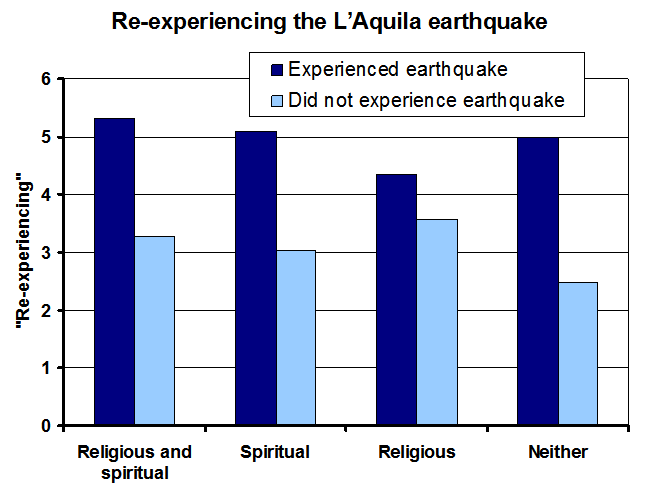
This study also found that people who had directly experienced the earthquake also reported suffering more post-traumatic stress. That’s not surprising, but they found something interesting when they divided the respondents according to whether they they said they were religious, spiritual, both or neither.
In general, the difference in stress levels between those who were exposed to the event and those who were not was smaller for religious people than for spiritual people or those who were neither.
This only reached statistical significance on two of the many subscales they looked at – assessing whether people had anxious flashbacks (shown in the graphic), and whether they were affected emotionally (things like dulled emotions, feeling cut off, or changed personality). But overall the effect seems to be robust.
The “Re-experiencing” subscale of the questionnaire they used asked whether, since the event, their subjects had ever:
- …had recurrent bad dreams or nightmares about the loss or event, or awakened terrified?
- …suddenly gotten bad feelings when you were around certain places, odors, sounds or people?
- …felt or acted as if the events were happening again?
- …had distressing thoughts, feelings, or images related to the loss or event?
- …become more distressed at the time of year when the loss or event occurred?
- Did you notice that other people avoided talking about the loss or event because you got so upset?
While the “Arousal” scale asked whether they had:
- …have trouble concentrating or paying attention, for example, following the story line of a TV program or book or remembering what you had read?
- …feel like you just couldn’t relax or let your guard down?
- …startle easily at the sound of sudden noises, or when someone touched you, spoke to you, or approached you unexpectedly?
- …feel more irritable, have outbursts of anger or rage, or lose your temper over minor things?
- …have more difficulty falling asleep or staying asleep than before or need a light on to go to sleep?
But if you look at the graph, you can see that something more complex is happening. The reason that there is no difference among religious people is not just because between those who experienced the event have fewer ill effects. It’s also because those who did not directly experience it have more flashbacks.
It seems that religious people who did not directly experience the event were still affected by it, while those who did experience it were less affected. Perhaps this is because they are plugged into a wider social network, which allows the burden of distressing events to be shared.

Stratta, P., Capanna, C., Riccardi, I., Perugi, G., Toni, C., Dell’Osso, L., & Rossi, A. (2012). Spirituality and Religiosity in the Aftermath of a Natural Catastrophe in Italy Journal of Religion and Health DOI: 10.1007/s10943-012-9591-z
Dell’Osso, L., Shear, M., Carmassi, C., Rucci, P., Maser, J., Frank, E., Endicott, J., Lorettu, L., Altamura, C., Carpiniello, B., Perris, F., Conversano, C., Ciapparelli, A., Carlini, M., Sarno, N., & Cassano, G. (2008). Validity and reliability of the Structured Clinical Interview for the Trauma and Loss Spectrum (SCI-TALS) Clinical Practice and Epidemiology in Mental Health, 4 (1) DOI: 10.1186/1745-0179-4-2
 This article by Tom Rees was first published on Epiphenom. It is licensed under Creative Commons.
Previous Post

March 28, 2012
Religious students have fewer interracial friends
Next Post
April 12, 2012 Religious people believe in a just world
Browse Our Archives
Select a Category Causes of religion - evolution Causes of religion - psychological Causes of religion - social Demographics Digest Effects of religion - health Effects of religion - psychological Effects of religion - social Notifications Politics Uncategorized
Select a Month March 2016 February 2016 January 2016 December 2015 November 2015 October 2015 September 2015 August 2015 July 2015 June 2015 May 2015 April 2015 March 2015 February 2015 January 2015 December 2014 November 2014 October 2014 September 2014 August 2014 July 2014 June 2014 May 2014 April 2014 March 2014 February 2014 January 2014 December 2013 November 2013 October 2013 September 2013 August 2013 July 2013 June 2013 May 2013 April 2013 March 2013 February 2013 January 2013 December 2012 November 2012 October 2012 September 2012 August 2012 July 2012 June 2012 May 2012 April 2012 March 2012 February 2012 January 2012 December 2011 November 2011 October 2011 September 2011 August 2011 July 2011 June 2011 May 2011 April 2011 March 2011 February 2011 January 2011 December 2010 November 2010 October 2010 September 2010 August 2010 July 2010 June 2010 May 2010 April 2010 March 2010 February 2010 January 2010 December 2009 November 2009 October 2009 September 2009 August 2009 July 2009 June 2009 May 2009 April 2009 March 2009 February 2009 January 2009 December 2008 November 2008 October 2008 September 2008 August 2008 July 2008 June 2008 May 2008 April 2008 March 2008 February 2008 January 2008 December 2007 November 2007 October 2007
Follow Us!
TAKE THE
Religious Wisdom Quiz
According to James, where does wisdom that is pure, peace-loving, and considerate come from?
Select your answer to see how you score.
From heaven From study From experience From Prayer
Related posts from Epiphenom

Do social crises lead to religious revivals? Nah!

What kind of woman would pray for health...

Can you use religion to change attitudes towards...

Dogmatic atheism and fundamentalist Christianity: creating certainty in...
TRENDING AT PATHEOS Nonreligious

Dethroning Jesus and Enthroning Yourself
Jesus Never Asked to Be Worshipped. He Asked to Be Understood. Christianity...

Why Most Christians are Really Paulians and Jobians
I Don't Care, But It Matters Let's get this out of the...

Essential Tips to Successfully Navigate the Selling Process
Selling a house can feel overwhelming, but it doesn’t have to be....

To Make Remote Work Effective, Think About Others
The COVID-19 pandemic forced many companies to rapidly transition to remote work....

Flexibility Is Key to Solving Problems of Tomorrow
The world of work is undergoing a dramatic transformation. The COVID-19 pandemic...
view all Nonreligious blogs
Ad-Free & Subscriber Log-In Subscription Support
- About Us
- 2026 Calendar
- Videos
- Podcasts
- Library of World Religions
- Faith In Media Tracker
- Advertise With Us
- Write for Us
- Privacy Policy
- Terms of Service
- Do Not Sell My Data
- Contact Us
- Radiant Digital
- Manage Newsletter Subscriptions
- Unsubscribe From Notifications
- Sitemap
Copyright 2008-2026, Patheos. All rights reserved.
Subscription Support Ad-Free & Subscriber Log-In
Follow Patheos