
BuddhistCatholicContemplativeEvangelicalGeneral ChristianHinduJewishLatter-day SaintMuslimNew VisionsProgressive Christian
Beliefs
- Buddhist
- Catholic
- Contemplative
- Evangelical
- General Christian
- Hindu
- Jewish
- Latter-day Saint
- More Voices
- Muslim
- New Visions
- Pagan
- Progressive Christian
Topics
- Religion News
- Food and Religion
- Sports and Religion
- Religious Art
- Religious Music and Entertainment
- Religious Events
- History and Religion
- Style and Religion
- Politics and Religion
- Women in Religion
- Recreation Outdoors and Religion
- Business Finance and Religion
- Careers Workplace and Religion
- Education and Religion
- Family Parenting and Religion
- Health Fitness and Religion
- Home and Religion
- Relationships and Religion
- Technology and Religion
- Travel and Religion
Columnists
- Buddhist Columnists
- Business Finance and Religion Columnists
- Careers Workplace and Religion Columnists
- Catholic Columnists
- Contemplative Columnists
- Education and Religion Columnists
- Evangelists Columnists
- Family Parenting and Religion Columnists
- General Christian Columnists
- Health Fitness and Religion Columnists
- Hindu Columnists
- History and Religion Columnists
- Home and Religion Columnists
- Jewish Columnists
- More Voices Columnists
- Latter Day Columnists
- Muslim Columnists
- New Visions Columnists
- Nonreligious Columnists
- Pagan Columnists
- Politics and Religion Columnists
- Progressive Columnists
- Recreation Outdoors and Religion Columnists
- Relationships and Religion Columnists
- Religion News Columnists
- Religious Art Columnists
- Religious Events Columnists
- Religious Music and Entertainment Columnists
- Sports and Religion Columnists
- Style and Religion Columnists
- Technology and Religion Columnists
- Travel and Religion Columnists
- Women in Religion Columnists
Resource Library
- 2026 Calendar
- Library of World Religions
- The 100 Most Holy Places on Earth
- Patheos Answers
- Podcasts
- Videos
- Faith Leaders Database
- Anglican Episcopalian
- Bahai
- Baptist
- Buddhism
- Christianity
- Confucianism
- Eastern Orthodoxy
- Hinduism
- Holiness and Pentecostal
- ISKCON
- Islam
- Judaism
- Lutheran
- Methodist
- The Church of Jesus Christ of Latter-day Saints
- New Age
- Paganism
- Presbytarian and Reformed
- Protestantism
- Religion Behind the Scenes
- Roman Catholic
- Scientology
- Shia Islam
- Sikhism
- Sufism
- Sunni Islam
- Taoism
- Zen
- See all religions
Research Tools
 Ad-Free & Subscriber Log-In Subscription Support
Ad-Free & Subscriber Log-In Subscription Support
Follow Patheos 

- Trending:
- Forgiveness
- |
- Marriage
- |
- Consciousness
- |
- Death Penalty
- |
- Election
- |
- Halloween
 Epiphenom
- Home
- Nonreligious
- Three puzzles of non-religion in Britain
Three puzzles of non-religion in Britain
Last updated on: November 12, 2014 at 3:41 am by Epiphenom
Three puzzles of non-religion in Britain 2014-11-12T03:41:47+01:00 Epiphenom
Patheos Explore the world's faith through different perspectives on religion and spirituality! Patheos has the views of the prevalent religions and spiritualities of the world.
Britain, like many countries in the West, has been undergoing a decline in the numbers of religious believers. The patterns of change, however, throw up some curious anomalies. Three of these puzzles have recently been investigated by David Voas, a demographer at the Institute for Social and Economic Research at the University of Essex – all quite different, each of them quirky, and all of them shedding a little fascinating insight into the trends and patterns of non-belief in the UK.
First off, why are baby girls more likely to be religious than baby boys? If that question at first sounds nonsensical, it’s because the UK census asks parents to state the religious affiliation of their children. The result is a small sex difference – one or two extra girls out of every hundred are labelled as being ‘Christian’ compared with boys.
The reason, Voas found, is probably because dads are less likely to be religious than mums. The child is given the religious affiliation that matches their same-sex parent. And so the gender gap is the biggest for families with a non-religious dad and a religious mum.
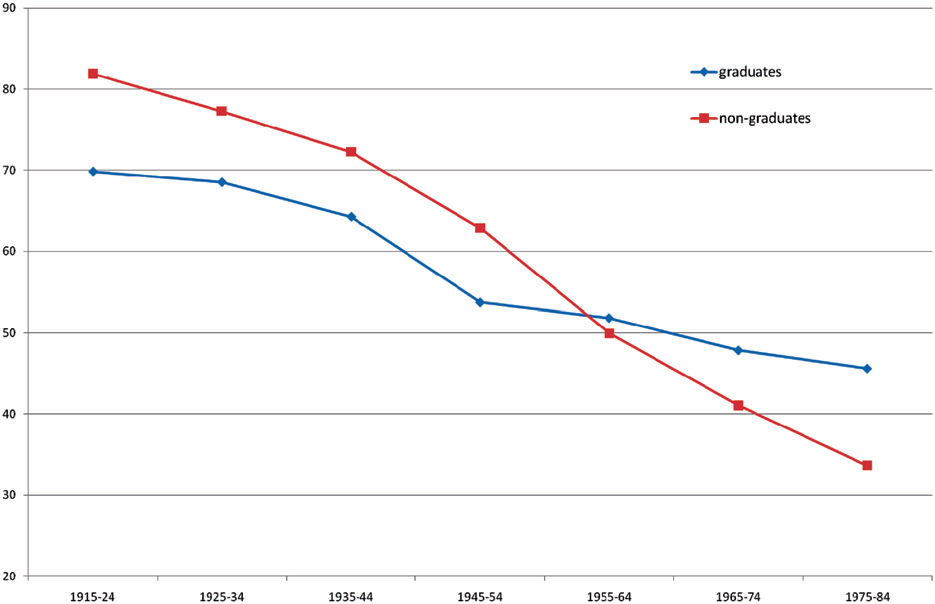
For the second puzzle, just take a look at this graph. It shows the change in religious affiliation since 1915 among graduates and non-graduates.
Affiliation has declined in both groups, but it’s been much faster among the non-graduates. As a result, although non-graduates were more religious than graduates at the start of the last century, now they are actually less religious!
It seems that this is probably because graduates are much more passionate about their beliefs – either religious or non-religious. Non-graduates are more likely to be in the fuzzy middle – nominally religious but not really devout.
Now, both nominal and devout religious will put themselves down on the census as ‘Christian’. However, as society as a whole becomes less religious, those who were formally nominally religious will now be completely non-religious. Those who once would have been strongly religious (many of whom are graduates) will now more likely be nominally religious – but still list themselves as Christian.
In other words, this is another artefact of the crude measure of religion used in the UK census. Because it only records broad affiliation, it misses the subtleties.
The last puzzle surrounds the patchiness of religious affiliation in Britain. If you look at a very fine level (at the level of individual local council wards), the percentage of people saying that they don’t identify with a religion ranges from 1.9% all the way up to a most godless 42.4% (this godless epicentre is actually a place in Brighton, just down the road from where I live).
Voas found that this variation can only partly be explained by factors such as average age and professional status. An additional major factor was the number of religious people in neighbouring wards.
So it seems that religion and non-religion tends to aggregate into clusters, although what causes this aggregation is hard to say, but Voas suspects that factors like social history and local economic factors probably play a large role.
On top of this, some areas have a strong local culture. Brighton, for example, has a long tradition as venue for a bit of escapism from the moral straitjacket of London soceity – as a result, the place is now full of counter-cultural Bohemians of all types! (And me…)

Voas, D., & McAndrew, S. (2012). Three Puzzles of Non-religion in Britain Journal of Contemporary Religion, 27 (1), 29-48 DOI: 10.1080/13537903.2012.642725
 This article by Tom Rees was first published on Epiphenom. It is licensed under Creative Commons.
Previous Post

February 15, 2012
The handedness of belief
Next Post
February 23, 2012 Religion, self esteem and psychological adjustment
Browse Our Archives
Select a Category Causes of religion - evolution Causes of religion - psychological Causes of religion - social Demographics Digest Effects of religion - health Effects of religion - psychological Effects of religion - social Notifications Politics Uncategorized
Select a Month March 2016 February 2016 January 2016 December 2015 November 2015 October 2015 September 2015 August 2015 July 2015 June 2015 May 2015 April 2015 March 2015 February 2015 January 2015 December 2014 November 2014 October 2014 September 2014 August 2014 July 2014 June 2014 May 2014 April 2014 March 2014 February 2014 January 2014 December 2013 November 2013 October 2013 September 2013 August 2013 July 2013 June 2013 May 2013 April 2013 March 2013 February 2013 January 2013 December 2012 November 2012 October 2012 September 2012 August 2012 July 2012 June 2012 May 2012 April 2012 March 2012 February 2012 January 2012 December 2011 November 2011 October 2011 September 2011 August 2011 July 2011 June 2011 May 2011 April 2011 March 2011 February 2011 January 2011 December 2010 November 2010 October 2010 September 2010 August 2010 July 2010 June 2010 May 2010 April 2010 March 2010 February 2010 January 2010 December 2009 November 2009 October 2009 September 2009 August 2009 July 2009 June 2009 May 2009 April 2009 March 2009 February 2009 January 2009 December 2008 November 2008 October 2008 September 2008 August 2008 July 2008 June 2008 May 2008 April 2008 March 2008 February 2008 January 2008 December 2007 November 2007 October 2007
Follow Us!
TAKE THE
Religious Wisdom Quiz
What is the Christian practice of eating bread and drinking wine in remembrance of Jesus?
Select your answer to see how you score.
Communion Ordination Confirmation Baptism
Related posts from Epiphenom

Do social crises lead to religious revivals? Nah!

What kind of woman would pray for health...

Can you use religion to change attitudes towards...

Dogmatic atheism and fundamentalist Christianity: creating certainty in...
TRENDING AT PATHEOS Nonreligious

Dethroning Jesus and Enthroning Yourself
Jesus Never Asked to Be Worshipped. He Asked to Be Understood. Christianity...

Why Most Christians are Really Paulians and Jobians
I Don't Care, But It Matters Let's get this out of the...

Essential Tips to Successfully Navigate the Selling Process
Selling a house can feel overwhelming, but it doesn’t have to be....

To Make Remote Work Effective, Think About Others
The COVID-19 pandemic forced many companies to rapidly transition to remote work....

Flexibility Is Key to Solving Problems of Tomorrow
The world of work is undergoing a dramatic transformation. The COVID-19 pandemic...
view all Nonreligious blogs
Ad-Free & Subscriber Log-In Subscription Support
- About Us
- 2026 Calendar
- Videos
- Podcasts
- Library of World Religions
- Faith In Media Tracker
- Advertise With Us
- Write for Us
- Privacy Policy
- Terms of Service
- Do Not Sell My Data
- Contact Us
- Radiant Digital
- Manage Newsletter Subscriptions
- Unsubscribe From Notifications
- Sitemap
Copyright 2008-2026, Patheos. All rights reserved.
Subscription Support Ad-Free & Subscriber Log-In
Follow Patheos