
BuddhistCatholicContemplativeEvangelicalGeneral ChristianHinduJewishLatter-day SaintMuslimNew VisionsProgressive Christian
Beliefs
- Buddhist
- Catholic
- Contemplative
- Evangelical
- General Christian
- Hindu
- Jewish
- Latter-day Saint
- More Voices
- Muslim
- New Visions
- Pagan
- Progressive Christian
Topics
- Religion News
- Food and Religion
- Sports and Religion
- Religious Art
- Religious Music and Entertainment
- Religious Events
- History and Religion
- Style and Religion
- Politics and Religion
- Women in Religion
- Recreation Outdoors and Religion
- Business Finance and Religion
- Careers Workplace and Religion
- Education and Religion
- Family Parenting and Religion
- Health Fitness and Religion
- Home and Religion
- Relationships and Religion
- Technology and Religion
- Travel and Religion
Columnists
- Buddhist Columnists
- Business Finance and Religion Columnists
- Careers Workplace and Religion Columnists
- Catholic Columnists
- Contemplative Columnists
- Education and Religion Columnists
- Evangelists Columnists
- Family Parenting and Religion Columnists
- General Christian Columnists
- Health Fitness and Religion Columnists
- Hindu Columnists
- History and Religion Columnists
- Home and Religion Columnists
- Jewish Columnists
- More Voices Columnists
- Latter Day Columnists
- Muslim Columnists
- New Visions Columnists
- Nonreligious Columnists
- Pagan Columnists
- Politics and Religion Columnists
- Progressive Columnists
- Recreation Outdoors and Religion Columnists
- Relationships and Religion Columnists
- Religion News Columnists
- Religious Art Columnists
- Religious Events Columnists
- Religious Music and Entertainment Columnists
- Sports and Religion Columnists
- Style and Religion Columnists
- Technology and Religion Columnists
- Travel and Religion Columnists
- Women in Religion Columnists
Resource Library
- 2026 Calendar
- Library of World Religions
- The 100 Most Holy Places on Earth
- Patheos Answers
- Podcasts
- Videos
- Faith Leaders Database
- Anglican Episcopalian
- Bahai
- Baptist
- Buddhism
- Christianity
- Confucianism
- Eastern Orthodoxy
- Hinduism
- Holiness and Pentecostal
- ISKCON
- Islam
- Judaism
- Lutheran
- Methodist
- The Church of Jesus Christ of Latter-day Saints
- New Age
- Paganism
- Presbytarian and Reformed
- Protestantism
- Religion Behind the Scenes
- Roman Catholic
- Scientology
- Shia Islam
- Sikhism
- Sufism
- Sunni Islam
- Taoism
- Zen
- See all religions
Research Tools
 Ad-Free & Subscriber Log-In Subscription Support
Ad-Free & Subscriber Log-In Subscription Support
Follow Patheos 

- Trending:
- Forgiveness
- |
- Marriage
- |
- Consciousness
- |
- Death Penalty
- |
- Election
- |
- Halloween
 Epiphenom
- Home
- Nonreligious
- Religion and health – a double edged sword
Religion and health – a double edged sword
Last updated on: November 12, 2014 at 3:44 am by Epiphenom
Religion and health – a double edged sword 2014-11-12T03:44:59+01:00 Epiphenom
Patheos Explore the world's faith through different perspectives on religion and spirituality! Patheos has the views of the prevalent religions and spiritualities of the world.
Long-time readers of this blog may remember a post from 2009 on religion and health. It summarized the findings of nearly 60 studies, and concluded that while going to church seemed to be linked to better health, religious beliefs per se were unimportant.
Studies that have been published since seem to support this notion, but what nobody’s been quite sure of is why church going should be linked to better health at all. Two recent studies have shed some light on the issue.
The first used data from a survey of 35,000 Norwegians, and found that regular churchgoers had lower blood pressure – after taking into account other factors that can affect blood pressure, such as age. Blood pressure is a good general indicator of your overall cardiovascular health, and so picks out those people most at risk of having a heart attack or stroke.
Now, there have been a lot of previous studies that have found similar things, but this is the first large study in a mostly non-religious country. Given that only 4% of Norwegians attend church regularly, it’s fascinating that the link between church and blood pressure still holds.
The second study is even more interesting.
Darren Sherkat, a sociologist at Southern Illinois University, and Ben Moulton (a data analyst), wanted to find out how religion, health, and education interact. They used data from 22,000 Americans who participated in the National Health Interview Survey in 1987, and whose deaths were recorded over the next 20 years.
What they found (after crunching the numbers through a model to account for a host of other factors) is best understood by taking a quick squint at the graphic below. Higher bars indicate greater likelihood of dying.
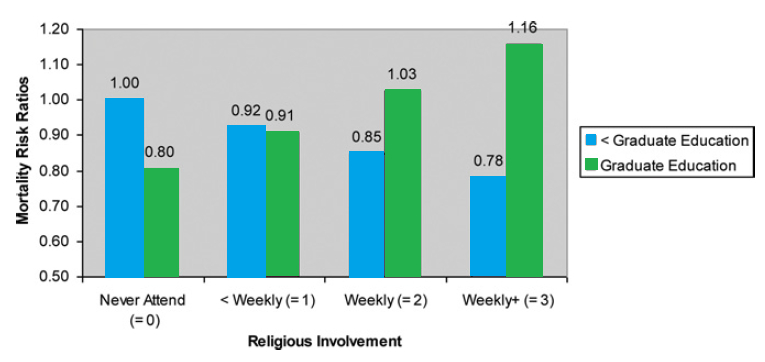
You can see that, for the less well educated, the risk of dying goes down as church attendance goes up. As you would expect.
Surprisingly, however, for the educated the effect is exactly opposite! Educated people who go to church often are actually more likely to die young!
Sherkat puts this down to the double-edged effects of religious teaching on healthy behaviour.
On the one hand, it encourages abstinence from harmful drugs like tobacco and alcohol. That’s great for the ill-educated who may not know any better (or be motivated to abstain). But not so much use for the educated, who have had the risks drummed into them and who are unlikely to overdo the booze and fags in the first place.
On the other hand, it tends to undermine science and evidence-based medicine. That might be particularly a problem for the educated, who might otherwise be expect to know better.
Overall, because there are more ill-educated people than educated ones, religious attendance has a beneficial effect. But the benefit really accrues to the ill-educated. For the educated, religion (at least, the kind of religion widely practised in the USA) might actually be harmful.

Sørensen, T., Danbolt, L., Lien, L., Koenig, H., & Holmen, J. (2011). The Relationship between Religious Attendance and Blood Pressure: The Hunt Study, Norway The International Journal of Psychiatry in Medicine, 42 (1), 13-28 DOI: 10.2190/PM.42.1.b
Moulton, B., & Sherkat, D. (2012). Specifying the Effects of Religious Participation and Educational Attainment on Mortality Risk for U.S. Adults Sociological Spectrum, 32 (1), 1-19 DOI: 10.1080/02732173.2012.628552
 This article by Tom Rees was first published on Epiphenom. It is licensed under Creative Commons.
Previous Post

January 9, 2012
How your genes can affect your response to religion
Next Post
January 18, 2012 People say they're good if they think God is watching
Browse Our Archives
Select a Category Causes of religion - evolution Causes of religion - psychological Causes of religion - social Demographics Digest Effects of religion - health Effects of religion - psychological Effects of religion - social Notifications Politics Uncategorized
Select a Month March 2016 February 2016 January 2016 December 2015 November 2015 October 2015 September 2015 August 2015 July 2015 June 2015 May 2015 April 2015 March 2015 February 2015 January 2015 December 2014 November 2014 October 2014 September 2014 August 2014 July 2014 June 2014 May 2014 April 2014 March 2014 February 2014 January 2014 December 2013 November 2013 October 2013 September 2013 August 2013 July 2013 June 2013 May 2013 April 2013 March 2013 February 2013 January 2013 December 2012 November 2012 October 2012 September 2012 August 2012 July 2012 June 2012 May 2012 April 2012 March 2012 February 2012 January 2012 December 2011 November 2011 October 2011 September 2011 August 2011 July 2011 June 2011 May 2011 April 2011 March 2011 February 2011 January 2011 December 2010 November 2010 October 2010 September 2010 August 2010 July 2010 June 2010 May 2010 April 2010 March 2010 February 2010 January 2010 December 2009 November 2009 October 2009 September 2009 August 2009 July 2009 June 2009 May 2009 April 2009 March 2009 February 2009 January 2009 December 2008 November 2008 October 2008 September 2008 August 2008 July 2008 June 2008 May 2008 April 2008 March 2008 February 2008 January 2008 December 2007 November 2007 October 2007
Follow Us!
TAKE THE
Religious Wisdom Quiz
What did Lamentations describe happening to Jerusalem?
Select your answer to see how you score.
Its rebuilding Its blessing and expansion Its destruction and mourning Its prosperity
Related posts from Epiphenom

Do social crises lead to religious revivals? Nah!

What kind of woman would pray for health...

Can you use religion to change attitudes towards...

Dogmatic atheism and fundamentalist Christianity: creating certainty in...
TRENDING AT PATHEOS Nonreligious

Dethroning Jesus and Enthroning Yourself
Jesus Never Asked to Be Worshipped. He Asked to Be Understood. Christianity...

Why Most Christians are Really Paulians and Jobians
I Don't Care, But It Matters Let's get this out of the...

Essential Tips to Successfully Navigate the Selling Process
Selling a house can feel overwhelming, but it doesn’t have to be....

To Make Remote Work Effective, Think About Others
The COVID-19 pandemic forced many companies to rapidly transition to remote work....

Flexibility Is Key to Solving Problems of Tomorrow
The world of work is undergoing a dramatic transformation. The COVID-19 pandemic...
view all Nonreligious blogs
Ad-Free & Subscriber Log-In Subscription Support
- About Us
- 2026 Calendar
- Videos
- Podcasts
- Library of World Religions
- Faith In Media Tracker
- Advertise With Us
- Write for Us
- Privacy Policy
- Terms of Service
- Do Not Sell My Data
- Contact Us
- Radiant Digital
- Manage Newsletter Subscriptions
- Unsubscribe From Notifications
- Sitemap
Copyright 2008-2026, Patheos. All rights reserved.
Subscription Support Ad-Free & Subscriber Log-In
Follow Patheos