
BuddhistCatholicContemplativeEvangelicalGeneral ChristianHinduJewishLatter-day SaintMuslimNew VisionsProgressive Christian
Beliefs
- Buddhist
- Catholic
- Contemplative
- Evangelical
- General Christian
- Hindu
- Jewish
- Latter-day Saint
- More Voices
- Muslim
- New Visions
- Pagan
- Progressive Christian
Topics
- Religion News
- Food and Religion
- Sports and Religion
- Religious Art
- Religious Music and Entertainment
- Religious Events
- History and Religion
- Style and Religion
- Politics and Religion
- Women in Religion
- Recreation Outdoors and Religion
- Business Finance and Religion
- Careers Workplace and Religion
- Education and Religion
- Family Parenting and Religion
- Health Fitness and Religion
- Home and Religion
- Relationships and Religion
- Technology and Religion
- Travel and Religion
Columnists
- Buddhist Columnists
- Business Finance and Religion Columnists
- Careers Workplace and Religion Columnists
- Catholic Columnists
- Contemplative Columnists
- Education and Religion Columnists
- Evangelists Columnists
- Family Parenting and Religion Columnists
- General Christian Columnists
- Health Fitness and Religion Columnists
- Hindu Columnists
- History and Religion Columnists
- Home and Religion Columnists
- Jewish Columnists
- More Voices Columnists
- Latter Day Columnists
- Muslim Columnists
- New Visions Columnists
- Nonreligious Columnists
- Pagan Columnists
- Politics and Religion Columnists
- Progressive Columnists
- Recreation Outdoors and Religion Columnists
- Relationships and Religion Columnists
- Religion News Columnists
- Religious Art Columnists
- Religious Events Columnists
- Religious Music and Entertainment Columnists
- Sports and Religion Columnists
- Style and Religion Columnists
- Technology and Religion Columnists
- Travel and Religion Columnists
- Women in Religion Columnists
Resource Library
- 2026 Calendar
- Library of World Religions
- The 100 Most Holy Places on Earth
- Patheos Answers
- Podcasts
- Videos
- Faith Leaders Database
- Anglican Episcopalian
- Bahai
- Baptist
- Buddhism
- Christianity
- Confucianism
- Eastern Orthodoxy
- Hinduism
- Holiness and Pentecostal
- ISKCON
- Islam
- Judaism
- Lutheran
- Methodist
- The Church of Jesus Christ of Latter-day Saints
- New Age
- Paganism
- Presbytarian and Reformed
- Protestantism
- Religion Behind the Scenes
- Roman Catholic
- Scientology
- Shia Islam
- Sikhism
- Sufism
- Sunni Islam
- Taoism
- Zen
- See all religions
Research Tools
 Ad-Free & Subscriber Log-In Subscription Support
Ad-Free & Subscriber Log-In Subscription Support
Follow Patheos 

- Trending:
- Forgiveness
- |
- Marriage
- |
- Consciousness
- |
- Death Penalty
- |
- Election
- |
- Halloween
 Epiphenom
- Home
- Nonreligious
- Does Christianity make mere thoughts into crime?
Does Christianity make mere thoughts into crime?
Last updated on: November 12, 2014 at 3:50 am by Epiphenom
Does Christianity make mere thoughts into crime? 2014-11-12T03:50:35+01:00 Epiphenom
Patheos Explore the world's faith through different perspectives on religion and spirituality! Patheos has the views of the prevalent religions and spiritualities of the world.
Does religion actually make any difference? By that I mean, does the brand of religion that takes hold in a particular region (Islam, Buddhism, Animism etc) actually change the culture in any meaningful way.
Of course, we know that there are real, measurable differences between adherents of different religions. But is that caused by the religion, or is it simply that cultures differ and that the local religion moulds itself to the local culture?
Adam Cohen, at Arizona State University, thinks that religion can change culture, and he’s written an excellent, plain English introduction to his research in the open-access journal “Readings in Psychology and Culture”.
A key point that Cohen makes is that Jews and Christians differ on whether simply thinking something wicked is as bad as actually doing something wicked.
So, for example, he found that Christians were more likely than Jews to believe that a man who thinks adulterous thoughts has done something wrong. And not just adultery either – there were similar differences of opinion over a student who fantasises about poisoning his Professor’s dog after getting a bad grade.
In another test, he asked Jews and Christians to:
Imagine a son, Mr. K., who does not like his parents very much, because they have very different personalities from him. That son can either pretend to like his parents, or he can ignore and neglect them. If he doesn’t like his parents inside, does it mean anything for him to behave nicely toward them?
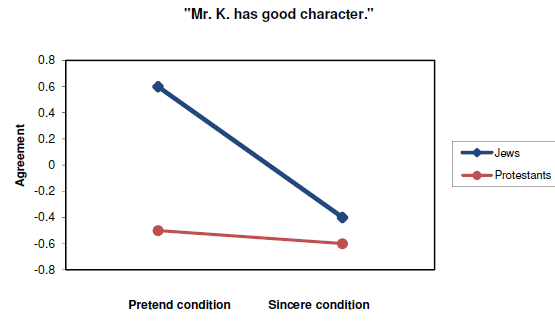
As the figure shows, Jews and Christians see Mr. K the same if he both inwardly dislikes his parents and also neglects them in reality (the ‘Sincere condition’ in the graph). But Jews, in contrast to Christians, were much more likely to think favourably of Mr K if he pretends to like his parents.
Cohen attributes these differences to differences in their respective holy books. For example, Jesus explicitly condemns thought crime (“You have heard that it was said, ‘You shall not commit adultery.’ But I say to you that everyone who looks at a woman with lustful intent has already committed adultery with her in his heart.”). In contrast, Cohen says,
…the Jewish attitude is that it is better to override your temptations out of obedience to God. True virtue is doing what God says even if you don’t internally want to.
All of this puts me in mind of George Orwell’s novel, 1984, in which he wrote about thoughtcrime:
The thought police would get him just the same. He had committed – would have committed, even if he had never set pen to paper – the essential crime that contained all others in itself. Thoughtcrime, they called it.
Now, Orwell was an atheist, and his book had a pretty big impact on me when I was a kid. All of which set me to thinking: is thinking bad thoughts a crime for atheists, or are they more like Jews? Even more interesting, are Atheist Jews different from Atheist Christians in this regard?
There is one study out there, which I wrote about last year, which found that Protestants were more likely than Atheists to conflate thinking and doing (Protestants tempt fate, but atheists don’t!)
I’d love to hear your perspective, though. Should you feel guilty about thinking nasty things someone and then lying to them? Is that kind of dishonesty bad? If not, why not?
 This article by Tom Rees was first published on Epiphenom. It is licensed under Creative Commons.
Previous Post

November 11, 2011
In the West, religious nations are more sexist
Next Post
November 21, 2011 Religious diversity linked to unhappiness
Browse Our Archives
Select a Category Causes of religion - evolution Causes of religion - psychological Causes of religion - social Demographics Digest Effects of religion - health Effects of religion - psychological Effects of religion - social Notifications Politics Uncategorized
Select a Month March 2016 February 2016 January 2016 December 2015 November 2015 October 2015 September 2015 August 2015 July 2015 June 2015 May 2015 April 2015 March 2015 February 2015 January 2015 December 2014 November 2014 October 2014 September 2014 August 2014 July 2014 June 2014 May 2014 April 2014 March 2014 February 2014 January 2014 December 2013 November 2013 October 2013 September 2013 August 2013 July 2013 June 2013 May 2013 April 2013 March 2013 February 2013 January 2013 December 2012 November 2012 October 2012 September 2012 August 2012 July 2012 June 2012 May 2012 April 2012 March 2012 February 2012 January 2012 December 2011 November 2011 October 2011 September 2011 August 2011 July 2011 June 2011 May 2011 April 2011 March 2011 February 2011 January 2011 December 2010 November 2010 October 2010 September 2010 August 2010 July 2010 June 2010 May 2010 April 2010 March 2010 February 2010 January 2010 December 2009 November 2009 October 2009 September 2009 August 2009 July 2009 June 2009 May 2009 April 2009 March 2009 February 2009 January 2009 December 2008 November 2008 October 2008 September 2008 August 2008 July 2008 June 2008 May 2008 April 2008 March 2008 February 2008 January 2008 December 2007 November 2007 October 2007
Follow Us!
TAKE THE
Religious Wisdom Quiz
Who killed his brother: Cain or Abel?
Select your answer to see how you score.
Seth Adam Cain Abel
Related posts from Epiphenom

Do social crises lead to religious revivals? Nah!

What kind of woman would pray for health...

Can you use religion to change attitudes towards...

Dogmatic atheism and fundamentalist Christianity: creating certainty in...
TRENDING AT PATHEOS Nonreligious

Dethroning Jesus and Enthroning Yourself
Jesus Never Asked to Be Worshipped. He Asked to Be Understood. Christianity...

Why Most Christians are Really Paulians and Jobians
I Don't Care, But It Matters Let's get this out of the...

Essential Tips to Successfully Navigate the Selling Process
Selling a house can feel overwhelming, but it doesn’t have to be....

To Make Remote Work Effective, Think About Others
The COVID-19 pandemic forced many companies to rapidly transition to remote work....

Flexibility Is Key to Solving Problems of Tomorrow
The world of work is undergoing a dramatic transformation. The COVID-19 pandemic...
view all Nonreligious blogs
Ad-Free & Subscriber Log-In Subscription Support
- About Us
- 2026 Calendar
- Videos
- Podcasts
- Library of World Religions
- Faith In Media Tracker
- Advertise With Us
- Write for Us
- Privacy Policy
- Terms of Service
- Do Not Sell My Data
- Contact Us
- Radiant Digital
- Manage Newsletter Subscriptions
- Unsubscribe From Notifications
- Sitemap
Copyright 2008-2026, Patheos. All rights reserved.
Subscription Support Ad-Free & Subscriber Log-In
Follow Patheos