
BuddhistCatholicContemplativeEvangelicalGeneral ChristianHinduJewishLatter-day SaintMuslimNew VisionsProgressive Christian
Beliefs
- Buddhist
- Catholic
- Contemplative
- Evangelical
- General Christian
- Hindu
- Jewish
- Latter-day Saint
- More Voices
- Muslim
- New Visions
- Pagan
- Progressive Christian
Topics
- Religion News
- Food and Religion
- Sports and Religion
- Religious Art
- Religious Music and Entertainment
- Religious Events
- History and Religion
- Style and Religion
- Politics and Religion
- Women in Religion
- Recreation Outdoors and Religion
- Business Finance and Religion
- Careers Workplace and Religion
- Education and Religion
- Family Parenting and Religion
- Health Fitness and Religion
- Home and Religion
- Relationships and Religion
- Technology and Religion
- Travel and Religion
Columnists
- Buddhist Columnists
- Business Finance and Religion Columnists
- Careers Workplace and Religion Columnists
- Catholic Columnists
- Contemplative Columnists
- Education and Religion Columnists
- Evangelists Columnists
- Family Parenting and Religion Columnists
- General Christian Columnists
- Health Fitness and Religion Columnists
- Hindu Columnists
- History and Religion Columnists
- Home and Religion Columnists
- Jewish Columnists
- More Voices Columnists
- Latter Day Columnists
- Muslim Columnists
- New Visions Columnists
- Nonreligious Columnists
- Pagan Columnists
- Politics and Religion Columnists
- Progressive Columnists
- Recreation Outdoors and Religion Columnists
- Relationships and Religion Columnists
- Religion News Columnists
- Religious Art Columnists
- Religious Events Columnists
- Religious Music and Entertainment Columnists
- Sports and Religion Columnists
- Style and Religion Columnists
- Technology and Religion Columnists
- Travel and Religion Columnists
- Women in Religion Columnists
Resource Library
- 2026 Calendar
- Library of World Religions
- The 100 Most Holy Places on Earth
- Patheos Answers
- Podcasts
- Videos
- Faith Leaders Database
- Anglican Episcopalian
- Bahai
- Baptist
- Buddhism
- Christianity
- Confucianism
- Eastern Orthodoxy
- Hinduism
- Holiness and Pentecostal
- ISKCON
- Islam
- Judaism
- Lutheran
- Methodist
- The Church of Jesus Christ of Latter-day Saints
- New Age
- Paganism
- Presbytarian and Reformed
- Protestantism
- Religion Behind the Scenes
- Roman Catholic
- Scientology
- Shia Islam
- Sikhism
- Sufism
- Sunni Islam
- Taoism
- Zen
- See all religions
Research Tools
 Ad-Free & Subscriber Log-In Subscription Support
Ad-Free & Subscriber Log-In Subscription Support
Follow Patheos 

- Trending:
- Forgiveness
- |
- Marriage
- |
- Consciousness
- |
- Death Penalty
- |
- Election
- |
- Halloween
 Epiphenom
- Home
- Nonreligious
- Atheists and rapists: you just can’t trust ’em
Atheists and rapists: you just can’t trust ’em
Last updated on: November 12, 2014 at 3:50 am by Epiphenom
Atheists and rapists: you just can’t trust ’em 2014-11-12T03:50:03+01:00 Epiphenom
Patheos Explore the world's faith through different perspectives on religion and spirituality! Patheos has the views of the prevalent religions and spiritualities of the world.
Atheists are a pretty disliked bunch of people in North America. Most atheists will be aware of polling data that puts them at the bottom of the loathing pile.
Question is, what’s driving that loathing? Will Gervais (University of British Columbia, Canada), who’s previously published some fascinating research into this topic, is back with some more research (co-authored by another couple of names familiar to this blog: Azim Shariff and Ara Norenzayan).
Gervais’ basic hypothesis is that prejudice against people who are not part of your group can be driven by different fears. For example, White Americans fear Black Americans, but view homosexual Americans with disgust. Gervais puts that together with another idea that many people have – that fear of supernatural punishment makes people more honest – to hypothesise that people dislike atheists specifically because they distrust them.
To test this, they took advantage of a clever psychological trick. Here is its original form (invented by Nobel prize-winning psychologist Daniel Kahneman), as described recently in The Guardian:
Linda is a single 31-year-old, who is very bright and deeply concerned with issues of social justice. Which of the following statements is more probable: a) that Linda works in a bank, or b) that Linda works in a bank and is active in the feminist movement? The overwhelming majority of respondents go for b), even though that’s logically impossible. (It can’t be more likely that both things are true than that just one of them is.) This is the “conjunctive fallacy”, whereby our judgment is warped by the persuasive combination of plausible details. We are much better storytellers than we are logicians.
In Gervais’ twist on this classic study, students at the University of British Columbia were told about Richard. Here’s Richard’s story:
Richard is 31 years old. On his way to work one day, he accidentally backed his car into a parked van. Because pedestrians were watching, he got out of his car. He pretended to write down his insurance information. He then tucked the blank note into the van’s window before getting back into his car and driving away.
Later the same day, Richard found a wallet on the sidewalk. Nobody was looking, so he took all of the money out of the wallet. He then threw the wallet in a trash can.
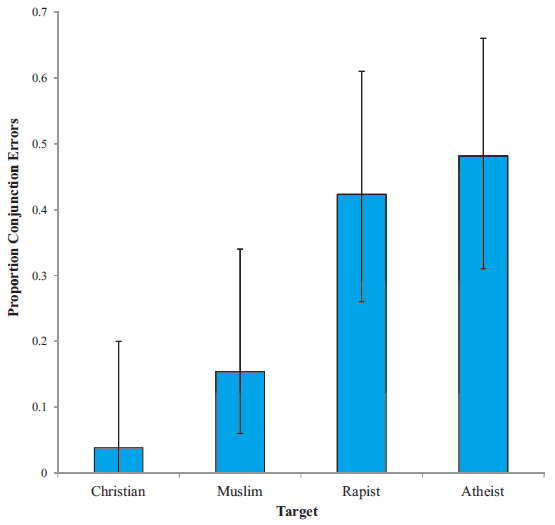
So, is Richard most likely to be a teacher, or a teacher and a Christian? What about a teacher and Muslim. Or a rapist? Or an atheist?
Well, the chilling results are shown in the graphic. Atheism was up there with rapist as an intuitive fit to Richard’s character. Atheists? Don’t trust ’em!
Gervais and co ran another study, in which half the students were given a different version of Richard. This Richard is not untrustworthy, but he is disgusting (with horrible, flaky skin and snot all over him).
They found that that the disgusting Richard was not associated with atheism (or, indeed, with homosexuality – even though they found in a different study that homosexuals evoke disgust).
What this and some other studies they did showed is that the reason atheists are disliked is specifically because they are distrusted.
They also found that the degree of this distrust is governed by the strength of belief that supernatural monitoring helps to enforce good behaviour. Those who believe this are most likely to distrust atheists.
So although lack of familiarity with atheists increases distrust, it seems that the root of this distrust is not simple fear of the unknown, or even fear about moral corruption, but rather a genuine and seemingly deep-rooted fear that people will not behave well unless they have an invisible policeman watching over them.
Which probably says rather more about these Christians than it does about atheists!

Gervais, W., Shariff, A., & Norenzayan, A. (2011). Do you believe in atheists? Distrust is central to anti-atheist prejudice. Journal of Personality and Social Psychology, 101 (6), 1189-1206 DOI: 10.1037/a0025882
 This article by Tom Rees was first published on Epiphenom. It is licensed under Creative Commons.
Previous Post

November 21, 2011
Religious diversity linked to unhappiness
Next Post
December 1, 2011 Why do the religious give to charity: learning from Taiwan
Browse Our Archives
Select a Category Causes of religion - evolution Causes of religion - psychological Causes of religion - social Demographics Digest Effects of religion - health Effects of religion - psychological Effects of religion - social Notifications Politics Uncategorized
Select a Month March 2016 February 2016 January 2016 December 2015 November 2015 October 2015 September 2015 August 2015 July 2015 June 2015 May 2015 April 2015 March 2015 February 2015 January 2015 December 2014 November 2014 October 2014 September 2014 August 2014 July 2014 June 2014 May 2014 April 2014 March 2014 February 2014 January 2014 December 2013 November 2013 October 2013 September 2013 August 2013 July 2013 June 2013 May 2013 April 2013 March 2013 February 2013 January 2013 December 2012 November 2012 October 2012 September 2012 August 2012 July 2012 June 2012 May 2012 April 2012 March 2012 February 2012 January 2012 December 2011 November 2011 October 2011 September 2011 August 2011 July 2011 June 2011 May 2011 April 2011 March 2011 February 2011 January 2011 December 2010 November 2010 October 2010 September 2010 August 2010 July 2010 June 2010 May 2010 April 2010 March 2010 February 2010 January 2010 December 2009 November 2009 October 2009 September 2009 August 2009 July 2009 June 2009 May 2009 April 2009 March 2009 February 2009 January 2009 December 2008 November 2008 October 2008 September 2008 August 2008 July 2008 June 2008 May 2008 April 2008 March 2008 February 2008 January 2008 December 2007 November 2007 October 2007
Follow Us!
TAKE THE
Religious Wisdom Quiz
What does "Gideon" mean in Hebrew?
Select your answer to see how you score.
Warrior God is my Strength Hewer Redeemer
Related posts from Epiphenom

Do social crises lead to religious revivals? Nah!

What kind of woman would pray for health...

Can you use religion to change attitudes towards...

Dogmatic atheism and fundamentalist Christianity: creating certainty in...
TRENDING AT PATHEOS Nonreligious

Dethroning Jesus and Enthroning Yourself
Jesus Never Asked to Be Worshipped. He Asked to Be Understood. Christianity...

Why Most Christians are Really Paulians and Jobians
I Don't Care, But It Matters Let's get this out of the...

Essential Tips to Successfully Navigate the Selling Process
Selling a house can feel overwhelming, but it doesn’t have to be....

To Make Remote Work Effective, Think About Others
The COVID-19 pandemic forced many companies to rapidly transition to remote work....

Flexibility Is Key to Solving Problems of Tomorrow
The world of work is undergoing a dramatic transformation. The COVID-19 pandemic...
view all Nonreligious blogs
Ad-Free & Subscriber Log-In Subscription Support
- About Us
- 2026 Calendar
- Videos
- Podcasts
- Library of World Religions
- Faith In Media Tracker
- Advertise With Us
- Write for Us
- Privacy Policy
- Terms of Service
- Do Not Sell My Data
- Contact Us
- Radiant Digital
- Manage Newsletter Subscriptions
- Unsubscribe From Notifications
- Sitemap
Copyright 2008-2026, Patheos. All rights reserved.
Subscription Support Ad-Free & Subscriber Log-In
Follow Patheos