
BuddhistCatholicContemplativeEvangelicalGeneral ChristianHinduJewishLatter-day SaintMuslimNew VisionsProgressive Christian
Beliefs
- Buddhist
- Catholic
- Contemplative
- Evangelical
- General Christian
- Hindu
- Jewish
- Latter-day Saint
- More Voices
- Muslim
- New Visions
- Pagan
- Progressive Christian
Topics
- Religion News
- Food and Religion
- Sports and Religion
- Religious Art
- Religious Music and Entertainment
- Religious Events
- History and Religion
- Style and Religion
- Politics and Religion
- Women in Religion
- Recreation Outdoors and Religion
- Business Finance and Religion
- Careers Workplace and Religion
- Education and Religion
- Family Parenting and Religion
- Health Fitness and Religion
- Home and Religion
- Relationships and Religion
- Technology and Religion
- Travel and Religion
Columnists
- Buddhist Columnists
- Business Finance and Religion Columnists
- Careers Workplace and Religion Columnists
- Catholic Columnists
- Contemplative Columnists
- Education and Religion Columnists
- Evangelists Columnists
- Family Parenting and Religion Columnists
- General Christian Columnists
- Health Fitness and Religion Columnists
- Hindu Columnists
- History and Religion Columnists
- Home and Religion Columnists
- Jewish Columnists
- More Voices Columnists
- Latter Day Columnists
- Muslim Columnists
- New Visions Columnists
- Nonreligious Columnists
- Pagan Columnists
- Politics and Religion Columnists
- Progressive Columnists
- Recreation Outdoors and Religion Columnists
- Relationships and Religion Columnists
- Religion News Columnists
- Religious Art Columnists
- Religious Events Columnists
- Religious Music and Entertainment Columnists
- Sports and Religion Columnists
- Style and Religion Columnists
- Technology and Religion Columnists
- Travel and Religion Columnists
- Women in Religion Columnists
Resource Library
- 2026 Calendar
- Library of World Religions
- The 100 Most Holy Places on Earth
- Patheos Answers
- Podcasts
- Videos
- Faith Leaders Database
- Anglican Episcopalian
- Bahai
- Baptist
- Buddhism
- Christianity
- Confucianism
- Eastern Orthodoxy
- Hinduism
- Holiness and Pentecostal
- ISKCON
- Islam
- Judaism
- Lutheran
- Methodist
- The Church of Jesus Christ of Latter-day Saints
- New Age
- Paganism
- Presbytarian and Reformed
- Protestantism
- Religion Behind the Scenes
- Roman Catholic
- Scientology
- Shia Islam
- Sikhism
- Sufism
- Sunni Islam
- Taoism
- Zen
- See all religions
Research Tools
 Ad-Free & Subscriber Log-In Subscription Support
Ad-Free & Subscriber Log-In Subscription Support
Follow Patheos 

- Trending:
- Forgiveness
- |
- Marriage
- |
- Consciousness
- |
- Death Penalty
- |
- Election
- |
- Halloween
 Epiphenom
- Home
- Nonreligious
- Supernatural explanations just don’t occur to kids – they need to be taught them
Supernatural explanations just don’t occur to kids – they need to be taught them
Last updated on: November 12, 2014 at 3:54 am by Epiphenom
Supernatural explanations just don’t occur to kids – they need to be taught them 2014-11-12T03:54:22+01:00 Epiphenom
Patheos Explore the world's faith through different perspectives on religion and spirituality! Patheos has the views of the prevalent religions and spiritualities of the world.
It’s pretty much taken as an assumption these days that human beings are ‘natural-born believers’. Ask a cognitive scientist who specializes in religion, and they will tell you that our brains are predisposed to all sorts of supernatural concepts.
One consequence of this consensus is a vast outpouring of articles and books pondering over what the evolutionary advantages of religion are. A lot of these explanations are pretty tendentious, and to me it has never seemed likely that this was the whole story.
One popular way to investigate the ‘naturalness’ of religion problem is to see if supernatural concepts are hardwired into children – as you would expect if religious ideas are intuitive and naturalistic ideas have to be learned. Perhaps surprisingly there are very few studies to support this idea – the same ‘classic’ studies keep getting recycled in each new article or book.
And when independent researchers outside the core groups test the hypothesis, they often get results that don’t fit the story. That’s the case with a new study by Jacqui Woolley, a psychologist at the University of Texas.
She and her colleagues read some short tales to a bunch of kids (67 in total) aged 8, 10 or 12, and also 22 adults. All the stories illustrated a ‘difficult to explain’ event.
For example, one featured a guy who steals a little money regularly, until he has enough money to buy a really fast car – which he promptly crashes. Another featured a terminal cancer patient whose cancer went away ‘miraculously’. And another featured a woman who jogged regularly, and yet on her wedding day she tripped and hurt her leg badly – thus making her miss her wedding and also stopped her running. The stories were designed to illustrate events that could be ascribed to moral justice, divine intervention, or luck/fate.
So they read these stories and then asked the listener how the event could be explained. The surprising thing was that the kids hardly ever offered up supernatural explanations. Instead, they would say that maybe the cancer patient slept a lot, which helped her get better. Or, for the athletic woman who tripped on her wedding day, “because she tripped over a rock while she was walking. People usually trip over stuff and fall.”
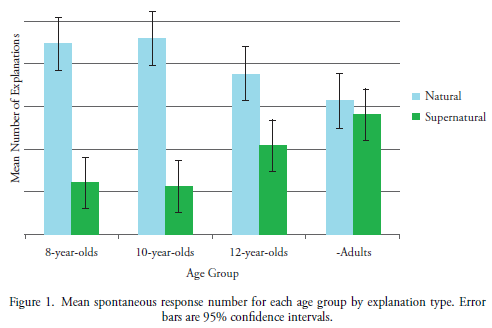
Adults, on the other hand, readily offered up supernatural explanations. There was a clear trend, too, as you can see in the graph – the older the child, the more likely they were to explain these strange happenings by recourse to the supernatural
Then Woolley and Co. put some suggested explanations to them. The kids tended to agree that god or other supernatural explanations were plausible (although they felt that god explanations were more likely for stories with happy outcomes). So it’s not that they aren’t aware of the concepts – it just that they don’t occur to them spontaneously.
Crucially, even the religious kids were more likely to provide naturalistic explanations than supernatural ones. They were, it’s true, more likely to give supernatural explanations than the non-religious, and they were also more likely to give god-based explanations – but according to Woolley even this relationship only becomes significant at around age 12.
This doesn’t of course, mean that humans are not predisposed to think supernaturally. Clearly, in some circumstances we are – and it seems likely that some people are more predisposed to think supernaturally than others.
But what this, along with other evidence, does show is that it is far too simplistic to argue that we are ‘born believers’. In fact, we are born with a wide range of tools with which to understand the world around us, and culture is critical for shaping how those predispositions are shaped into beliefs.
 Woolley, J., Cornelius, C., & Lacy, W. (2011). Developmental Changes in the Use of Supernatural Explanations for Unusual Events Journal of Cognition and Culture, 11 (3), 311-337 DOI: 10.1163/156853711X591279
 This article by Tom Rees was first published on Epiphenom. It is licensed under Creative Commons.
Previous Post

September 30, 2011
Deep thinkers are more likely to lose their faith
Next Post
October 8, 2011 Religion stops authoritarians from telling white lies
Browse Our Archives
Select a Category Causes of religion - evolution Causes of religion - psychological Causes of religion - social Demographics Digest Effects of religion - health Effects of religion - psychological Effects of religion - social Notifications Politics Uncategorized
Select a Month March 2016 February 2016 January 2016 December 2015 November 2015 October 2015 September 2015 August 2015 July 2015 June 2015 May 2015 April 2015 March 2015 February 2015 January 2015 December 2014 November 2014 October 2014 September 2014 August 2014 July 2014 June 2014 May 2014 April 2014 March 2014 February 2014 January 2014 December 2013 November 2013 October 2013 September 2013 August 2013 July 2013 June 2013 May 2013 April 2013 March 2013 February 2013 January 2013 December 2012 November 2012 October 2012 September 2012 August 2012 July 2012 June 2012 May 2012 April 2012 March 2012 February 2012 January 2012 December 2011 November 2011 October 2011 September 2011 August 2011 July 2011 June 2011 May 2011 April 2011 March 2011 February 2011 January 2011 December 2010 November 2010 October 2010 September 2010 August 2010 July 2010 June 2010 May 2010 April 2010 March 2010 February 2010 January 2010 December 2009 November 2009 October 2009 September 2009 August 2009 July 2009 June 2009 May 2009 April 2009 March 2009 February 2009 January 2009 December 2008 November 2008 October 2008 September 2008 August 2008 July 2008 June 2008 May 2008 April 2008 March 2008 February 2008 January 2008 December 2007 November 2007 October 2007
Follow Us!
TAKE THE
Religious Wisdom Quiz
What did Elisha heal by throwing salt into it?
Select your answer to see how you score.
A pot of stew River Jordan A spring of water A fig tree
Related posts from Epiphenom

Do social crises lead to religious revivals? Nah!

What kind of woman would pray for health...

Can you use religion to change attitudes towards...

Dogmatic atheism and fundamentalist Christianity: creating certainty in...
TRENDING AT PATHEOS Nonreligious

Dethroning Jesus and Enthroning Yourself
Jesus Never Asked to Be Worshipped. He Asked to Be Understood. Christianity...

Why Most Christians are Really Paulians and Jobians
I Don't Care, But It Matters Let's get this out of the...

Essential Tips to Successfully Navigate the Selling Process
Selling a house can feel overwhelming, but it doesn’t have to be....

To Make Remote Work Effective, Think About Others
The COVID-19 pandemic forced many companies to rapidly transition to remote work....

Flexibility Is Key to Solving Problems of Tomorrow
The world of work is undergoing a dramatic transformation. The COVID-19 pandemic...
view all Nonreligious blogs
Ad-Free & Subscriber Log-In Subscription Support
- About Us
- 2026 Calendar
- Videos
- Podcasts
- Library of World Religions
- Faith In Media Tracker
- Advertise With Us
- Write for Us
- Privacy Policy
- Terms of Service
- Do Not Sell My Data
- Contact Us
- Radiant Digital
- Manage Newsletter Subscriptions
- Unsubscribe From Notifications
- Sitemap
Copyright 2008-2026, Patheos. All rights reserved.
Subscription Support Ad-Free & Subscriber Log-In
Follow Patheos