
BuddhistCatholicContemplativeEvangelicalGeneral ChristianHinduJewishLatter-day SaintMuslimNew VisionsProgressive Christian
Beliefs
- Buddhist
- Catholic
- Contemplative
- Evangelical
- General Christian
- Hindu
- Jewish
- Latter-day Saint
- More Voices
- Muslim
- New Visions
- Pagan
- Progressive Christian
Topics
- Religion News
- Food and Religion
- Sports and Religion
- Religious Art
- Religious Music and Entertainment
- Religious Events
- History and Religion
- Style and Religion
- Politics and Religion
- Women in Religion
- Recreation Outdoors and Religion
- Business Finance and Religion
- Careers Workplace and Religion
- Education and Religion
- Family Parenting and Religion
- Health Fitness and Religion
- Home and Religion
- Relationships and Religion
- Technology and Religion
- Travel and Religion
Columnists
- Buddhist Columnists
- Business Finance and Religion Columnists
- Careers Workplace and Religion Columnists
- Catholic Columnists
- Contemplative Columnists
- Education and Religion Columnists
- Evangelists Columnists
- Family Parenting and Religion Columnists
- General Christian Columnists
- Health Fitness and Religion Columnists
- Hindu Columnists
- History and Religion Columnists
- Home and Religion Columnists
- Jewish Columnists
- More Voices Columnists
- Latter Day Columnists
- Muslim Columnists
- New Visions Columnists
- Nonreligious Columnists
- Pagan Columnists
- Politics and Religion Columnists
- Progressive Columnists
- Recreation Outdoors and Religion Columnists
- Relationships and Religion Columnists
- Religion News Columnists
- Religious Art Columnists
- Religious Events Columnists
- Religious Music and Entertainment Columnists
- Sports and Religion Columnists
- Style and Religion Columnists
- Technology and Religion Columnists
- Travel and Religion Columnists
- Women in Religion Columnists
Resource Library
- 2026 Calendar
- Library of World Religions
- The 100 Most Holy Places on Earth
- Patheos Answers
- Podcasts
- Videos
- Faith Leaders Database
- Anglican Episcopalian
- Bahai
- Baptist
- Buddhism
- Christianity
- Confucianism
- Eastern Orthodoxy
- Hinduism
- Holiness and Pentecostal
- ISKCON
- Islam
- Judaism
- Lutheran
- Methodist
- The Church of Jesus Christ of Latter-day Saints
- New Age
- Paganism
- Presbytarian and Reformed
- Protestantism
- Religion Behind the Scenes
- Roman Catholic
- Scientology
- Shia Islam
- Sikhism
- Sufism
- Sunni Islam
- Taoism
- Zen
- See all religions
Research Tools
 Ad-Free & Subscriber Log-In Subscription Support
Ad-Free & Subscriber Log-In Subscription Support
Follow Patheos 

- Trending:
- Forgiveness
- |
- Marriage
- |
- Consciousness
- |
- Death Penalty
- |
- Election
- |
- Halloween
 Epiphenom
- Home
- Nonreligious
- Religion stops authoritarians from telling white lies
Religion stops authoritarians from telling white lies
Last updated on: November 12, 2014 at 3:54 am by Epiphenom
Religion stops authoritarians from telling white lies 2014-11-12T03:54:11+01:00 Epiphenom
Patheos Explore the world's faith through different perspectives on religion and spirituality! Patheos has the views of the prevalent religions and spiritualities of the world.
Is it ever OK to lie? If they are honest, most people would say “yes”. After all small lies, done for the greater good, are what lubricates many social interactions. In fact, lying is probably one of the key things that sets us apart from other animals.
Of course, lying is also socially destructive, which is why there are strong cultural pressures against lying. That creates a quandary, since you have to use your judgement about when to contravene social norms.
Vassilis Saroglou and Matthieu Van Pachterbeke, psychologists at Université catholique de Louvain, have previously shown that authoritarians (people characterised by conservative ideology and submission to established authorities) tend to disapprove of lying even when it might result in benefit to an associate and no overall harm to wider society.
So, they wanted to know whether religious people are the same and, even more importantly, whether there was an interaction between religion and authoritarianism. You see, religiosity and authoritarianism quite often go hand-in-hand, so it’s not clear which is having the effect on lying.
The experimental set-up was straightforward. First the subjects (who were recruited by a student asking around friends and neighbours!) were given a word search puzzle to do.
This word search either had religious words to find, or non-religious words. That way, half the subjects were primed with religion, and half were not.
Then they were given a series of nine moral dilemmas to answer. Here’s one, for example:
You visit a friend who has been hospitalized for one year due to late-stage cancer. He spent his life running a small industry. He is very proud of it, having started it from nothing and expanding it to having, one year ago, 60 workers in a familial atmosphere. The person handed the management of this firm on to his son just after his cancer diagnosis, hoping that his son would carry on his work. The patient asks you for news about the firm. You know that, aiming gains, his son sold the firm to a multinational that restructured it. Do you tell the patient or do you lie?
They weren’t all explicitly about lying, although they did involve breaking the rules and not telling the whole truth in some minor way (like not reporting an acquaintance who is a foreign student to the police who are looking for him to deport him following a car accident).
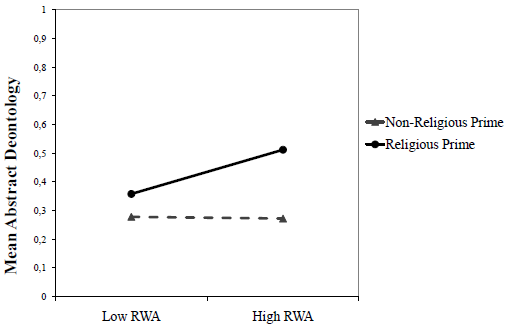
Anyway, what they found was interesting, and the graphic basically tells the story.
For people who didn’t get the religious prime, authoritarianism didn’t matter. Authoritarians and non-authoritarians were equally comfortable in being a little bit disopbedient.
For non-authoritarians, the religious prime didn’t matter. Religious priming didn’t make non-authoritarians obey the rules any better.
But for authoritarians, there was an effect. Priming them with religion made them significantly more likely to obey abstract social norms, even to the detriment of their associates.
Now, it wasn’t a huge effect, but then you wouldn’t really expect to see a large effect from such a trivial set-up.
But it is a critically important effect. What it says is that religious activates authoritarianism – at least for these Belgians. Unprompted, the moral decisions of authoritarians and liberals were similar.
Subtly remind the authoritarians of religion, however, and they ramp up their moral righteousness!

Van Pachterbeke, M., Freyer, C., & Saroglou, V. (2011). When authoritarianism meets religion: Sacrificing others in the name of abstract deontology European Journal of Social Psychology DOI: 10.1002/ejsp.834
 This article by Tom Rees was first published on Epiphenom. It is licensed under Creative Commons.
Next Post

October 12, 2011 For atheists, the dead can live - but only if there's no corpse
Browse Our Archives
Select a Category Causes of religion - evolution Causes of religion - psychological Causes of religion - social Demographics Digest Effects of religion - health Effects of religion - psychological Effects of religion - social Notifications Politics Uncategorized
Select a Month March 2016 February 2016 January 2016 December 2015 November 2015 October 2015 September 2015 August 2015 July 2015 June 2015 May 2015 April 2015 March 2015 February 2015 January 2015 December 2014 November 2014 October 2014 September 2014 August 2014 July 2014 June 2014 May 2014 April 2014 March 2014 February 2014 January 2014 December 2013 November 2013 October 2013 September 2013 August 2013 July 2013 June 2013 May 2013 April 2013 March 2013 February 2013 January 2013 December 2012 November 2012 October 2012 September 2012 August 2012 July 2012 June 2012 May 2012 April 2012 March 2012 February 2012 January 2012 December 2011 November 2011 October 2011 September 2011 August 2011 July 2011 June 2011 May 2011 April 2011 March 2011 February 2011 January 2011 December 2010 November 2010 October 2010 September 2010 August 2010 July 2010 June 2010 May 2010 April 2010 March 2010 February 2010 January 2010 December 2009 November 2009 October 2009 September 2009 August 2009 July 2009 June 2009 May 2009 April 2009 March 2009 February 2009 January 2009 December 2008 November 2008 October 2008 September 2008 August 2008 July 2008 June 2008 May 2008 April 2008 March 2008 February 2008 January 2008 December 2007 November 2007 October 2007
Follow Us!
TAKE THE
Religious Wisdom Quiz
What river did the Israelites cross to enter the Promised Land?
Select your answer to see how you score.
Tigris River Jordan River Euphrates River Nile River
Related posts from Epiphenom

Do social crises lead to religious revivals? Nah!

What kind of woman would pray for health...

Can you use religion to change attitudes towards...

Dogmatic atheism and fundamentalist Christianity: creating certainty in...
TRENDING AT PATHEOS Nonreligious

Dethroning Jesus and Enthroning Yourself
Jesus Never Asked to Be Worshipped. He Asked to Be Understood. Christianity...

Why Most Christians are Really Paulians and Jobians
I Don't Care, But It Matters Let's get this out of the...

Essential Tips to Successfully Navigate the Selling Process
Selling a house can feel overwhelming, but it doesn’t have to be....

To Make Remote Work Effective, Think About Others
The COVID-19 pandemic forced many companies to rapidly transition to remote work....

Flexibility Is Key to Solving Problems of Tomorrow
The world of work is undergoing a dramatic transformation. The COVID-19 pandemic...
view all Nonreligious blogs
Ad-Free & Subscriber Log-In Subscription Support
- About Us
- 2026 Calendar
- Videos
- Podcasts
- Library of World Religions
- Faith In Media Tracker
- Advertise With Us
- Write for Us
- Privacy Policy
- Terms of Service
- Do Not Sell My Data
- Contact Us
- Radiant Digital
- Manage Newsletter Subscriptions
- Unsubscribe From Notifications
- Sitemap
Copyright 2008-2026, Patheos. All rights reserved.
Subscription Support Ad-Free & Subscriber Log-In
Follow Patheos