
BuddhistCatholicContemplativeEvangelicalGeneral ChristianHinduJewishLatter-day SaintMuslimNew VisionsProgressive Christian
Beliefs
- Buddhist
- Catholic
- Contemplative
- Evangelical
- General Christian
- Hindu
- Jewish
- Latter-day Saint
- More Voices
- Muslim
- New Visions
- Pagan
- Progressive Christian
Topics
- Religion News
- Food and Religion
- Sports and Religion
- Religious Art
- Religious Music and Entertainment
- Religious Events
- History and Religion
- Style and Religion
- Politics and Religion
- Women in Religion
- Recreation Outdoors and Religion
- Business Finance and Religion
- Careers Workplace and Religion
- Education and Religion
- Family Parenting and Religion
- Health Fitness and Religion
- Home and Religion
- Relationships and Religion
- Technology and Religion
- Travel and Religion
Columnists
- Buddhist Columnists
- Business Finance and Religion Columnists
- Careers Workplace and Religion Columnists
- Catholic Columnists
- Contemplative Columnists
- Education and Religion Columnists
- Evangelists Columnists
- Family Parenting and Religion Columnists
- General Christian Columnists
- Health Fitness and Religion Columnists
- Hindu Columnists
- History and Religion Columnists
- Home and Religion Columnists
- Jewish Columnists
- More Voices Columnists
- Latter Day Columnists
- Muslim Columnists
- New Visions Columnists
- Nonreligious Columnists
- Pagan Columnists
- Politics and Religion Columnists
- Progressive Columnists
- Recreation Outdoors and Religion Columnists
- Relationships and Religion Columnists
- Religion News Columnists
- Religious Art Columnists
- Religious Events Columnists
- Religious Music and Entertainment Columnists
- Sports and Religion Columnists
- Style and Religion Columnists
- Technology and Religion Columnists
- Travel and Religion Columnists
- Women in Religion Columnists
Resource Library
- 2026 Calendar
- Library of World Religions
- The 100 Most Holy Places on Earth
- Patheos Answers
- Podcasts
- Videos
- Faith Leaders Database
- Anglican Episcopalian
- Bahai
- Baptist
- Buddhism
- Christianity
- Confucianism
- Eastern Orthodoxy
- Hinduism
- Holiness and Pentecostal
- ISKCON
- Islam
- Judaism
- Lutheran
- Methodist
- The Church of Jesus Christ of Latter-day Saints
- New Age
- Paganism
- Presbytarian and Reformed
- Protestantism
- Religion Behind the Scenes
- Roman Catholic
- Scientology
- Shia Islam
- Sikhism
- Sufism
- Sunni Islam
- Taoism
- Zen
- See all religions
Research Tools
 Ad-Free & Subscriber Log-In Subscription Support
Ad-Free & Subscriber Log-In Subscription Support
Follow Patheos 

- Trending:
- Forgiveness
- |
- Marriage
- |
- Consciousness
- |
- Death Penalty
- |
- Election
- |
- Halloween
 Epiphenom
- Home
- Nonreligious
- Europe’s religious future
Europe’s religious future
Last updated on: October 31, 2014 at 10:21 pm by Epiphenom
Europe’s religious future 2014-10-31T22:21:49+01:00 Epiphenom
Patheos Explore the world's faith through different perspectives on religion and spirituality! Patheos has the views of the prevalent religions and spiritualities of the world.
Eric Kaufmann is a demographer and author of the book “Shall the religious inherit the earth?” Back in 2009 he made some demographic projections for the US and concluded that, by 2050, immigration of religious people and their higher fertility will turn back the tide of secularisation (see Secularisation in the US will be swamped by religious fertility and immigration)
Now Kaufmann has taken a look at Europe. That’s a bit more of a challenge because Europe is such a patchwork, and so good, comprehensive data are not so available.
He finds, as expected, that religion has declined in Europe. It began after WWII in Northern Europe, but only really got underway in Catholic countries in recent decades.
However, in the Protestant countries of Northern Europe, secularisation seems to have bottomed out at around 5% regular Church attenders and 40-50% who consider themselves to be religious (somewhat higher numbers believe in God).
But how to project the future? Well, one aspect is fertility. The religious have higher lifetime birth rates, but on the other hand the young are much more likely to be non-religious – and so have greater potential for begetting.
Then too you have to take into account switching into and out of religion. And here’s where things get interesting. It turns out that Muslims have the highest fertility rates, and also are the most resistant to switching out.
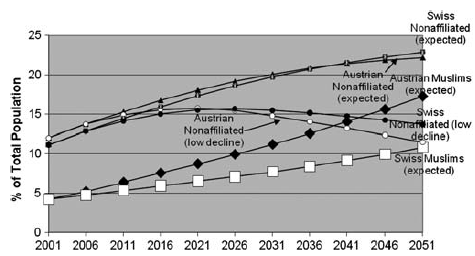 Kaufmann focussed on Austria and Switzerland, two countries with the best data. Here, the non-religious have fertility rates of around 1, Protestants around 1.3, Catholics around 1.4, and Muslims around 2.4.
Plug this into the model and you get what’s shown in the graph, which shows Muslims and non-affiliated in Switzerland and Austria under two scenarios.
Under the ‘expected’ model (which assumes current rates of switching out of religion are maintained), growth of the non-affililiated slows to zero by 2050.
Under the ‘low decline’ model (which assumes, based on the experiences of Northern European Countries, that the rate of switching out will slow to zero), the non-affiliated will actually be in decline as a percent of the population by 2050.
Now, the future is notoriously difficult to predict, and Kaufman lays out some of the many factors that could change these projections:
Major geopolitical changes could ease tension between Muslims and other Europeans; liberalizing theological shifts could pave the way for an increase in the rate of Muslim apostasy. Immigration could become ethnically controlled, as in Japan or Singapore, due to a surge of ethnic nationalism, thereby slowing the demographic growth of religion. A new vogue for family life might narrow the fertility gap between the secular and the religious. These changes would set European religious decline back on its formerly robust course.
One factor that interests me is the idea that a “new vogue for family life might narrow the fertility gap between the secular and the religious”. Because one of the problems with these kinds of analyses is that the religious groups examined are far from homogenous.
So it is clear that some Protestant sects have more children than others. In the same way, some atheists have more children than others. Presumably those atheists who are family oriented will pass on that mindset to their children – which could influence future birth rates.
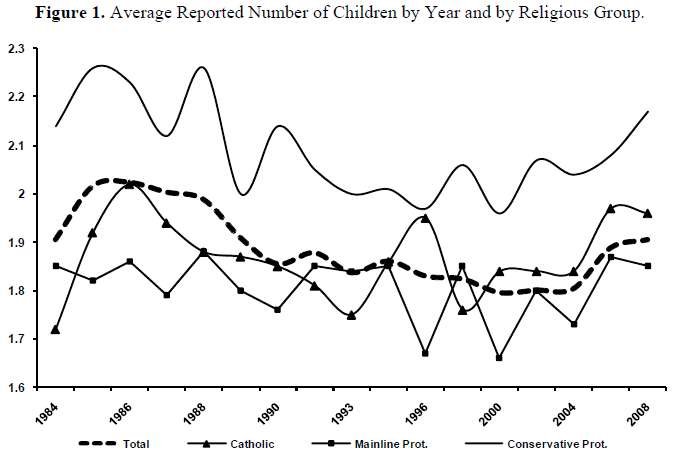 Another recent study, by Casey Borch and colleagues at the University of Alabama, helps to flesh out the picture a little. They split out mainline Protestants and conservative Protestants (aka Fundamentalists).
That’s important, because the fertility rates of the mainline Protestants are only a little higher than those of the non-religious. Conservative Protestants have a much higher fertility rate – the graph shows the trends of fertility over time for the three main religious groups in the USA.
What’s interesting is that, relative to Catholics, the fertility rates of both mainline and conservative Protestants seem to be dropping very slightly. However, somewhat bigger drops are seen among the non-religious and those of ‘other religions’. So the fertility gap seems to be growing.
Will we see something similar in Europe? It’s hard to say. What is known is that the very low rates of fertility seen in the 1990s seem to have been reversed in recent years, particularly in Northern Europe. That’s because many couples chose to delay parenthood, rather than abandon it all together. Yet another complicating factor when trying to figure out fertility trends!
 Kaufmann, E., Goujon, A., & Skirbekk, V. (2011). The End of Secularization in Europe?: A Socio-Demographic Perspective Sociology of Religion DOI: 10.1093/socrel/srr033
Borch, C., West, M., & Gauchat, G. (2011). Go Forth and Multiply: Revisiting Religion and Fertility in the United States, 1984-2008 Religions, 2 (4), 469-484 DOI: 10.3390/rel2040469
 This article by Tom Rees was first published on Epiphenom. It is licensed under Creative Commons.
Previous Post

October 23, 2011
Does Chinese culture reflect a lack of monotheism?
Next Post
November 1, 2011 Deliver us from temptation (and take care of everything else, too)
Browse Our Archives
Select a Category Causes of religion - evolution Causes of religion - psychological Causes of religion - social Demographics Digest Effects of religion - health Effects of religion - psychological Effects of religion - social Notifications Politics Uncategorized
Select a Month March 2016 February 2016 January 2016 December 2015 November 2015 October 2015 September 2015 August 2015 July 2015 June 2015 May 2015 April 2015 March 2015 February 2015 January 2015 December 2014 November 2014 October 2014 September 2014 August 2014 July 2014 June 2014 May 2014 April 2014 March 2014 February 2014 January 2014 December 2013 November 2013 October 2013 September 2013 August 2013 July 2013 June 2013 May 2013 April 2013 March 2013 February 2013 January 2013 December 2012 November 2012 October 2012 September 2012 August 2012 July 2012 June 2012 May 2012 April 2012 March 2012 February 2012 January 2012 December 2011 November 2011 October 2011 September 2011 August 2011 July 2011 June 2011 May 2011 April 2011 March 2011 February 2011 January 2011 December 2010 November 2010 October 2010 September 2010 August 2010 July 2010 June 2010 May 2010 April 2010 March 2010 February 2010 January 2010 December 2009 November 2009 October 2009 September 2009 August 2009 July 2009 June 2009 May 2009 April 2009 March 2009 February 2009 January 2009 December 2008 November 2008 October 2008 September 2008 August 2008 July 2008 June 2008 May 2008 April 2008 March 2008 February 2008 January 2008 December 2007 November 2007 October 2007
Follow Us!
TAKE THE
Religious Wisdom Quiz
What does "Jehovah Nissi" mean?
Select your answer to see how you score.
The Lord is My Banner The Lord is My Provider The Lord Saves The Lord is Holy
Related posts from Epiphenom

Do social crises lead to religious revivals? Nah!

What kind of woman would pray for health...

Can you use religion to change attitudes towards...

Dogmatic atheism and fundamentalist Christianity: creating certainty in...
TRENDING AT PATHEOS Nonreligious

Dethroning Jesus and Enthroning Yourself
Jesus Never Asked to Be Worshipped. He Asked to Be Understood. Christianity...

Why Most Christians are Really Paulians and Jobians
I Don't Care, But It Matters Let's get this out of the...

Essential Tips to Successfully Navigate the Selling Process
Selling a house can feel overwhelming, but it doesn’t have to be....

To Make Remote Work Effective, Think About Others
The COVID-19 pandemic forced many companies to rapidly transition to remote work....

Flexibility Is Key to Solving Problems of Tomorrow
The world of work is undergoing a dramatic transformation. The COVID-19 pandemic...
view all Nonreligious blogs
Ad-Free & Subscriber Log-In Subscription Support
- About Us
- 2026 Calendar
- Videos
- Podcasts
- Library of World Religions
- Faith In Media Tracker
- Advertise With Us
- Write for Us
- Privacy Policy
- Terms of Service
- Do Not Sell My Data
- Contact Us
- Radiant Digital
- Manage Newsletter Subscriptions
- Unsubscribe From Notifications
- Sitemap
Copyright 2008-2026, Patheos. All rights reserved.
Subscription Support Ad-Free & Subscriber Log-In
Follow Patheos